Pages

Showing posts with label volunteers. Show all posts

Friday, 27 January 2023

Parkside Asylum Case Books - Not just names on a page…

The history of Parkside Asylum can be found on-line today (Parkside - County Asylums) but what do we know about the patients who were admitted there? Who were they? Where did they live? Why were they admitted? How long did they stay? Where can we find their stories?

At Cheshire Archives, we are just beginning to explore the wealth of incredible material found within Parkside’s case books. Technology is supporting the information shift from these original leather-bound books into a searchable, accessible on-line research goldmine. With that transformation, our insight into the lives of those living within its walls magnifies and we start to gather information beyond the medical…These patients were real people, with real lives, in a time when we were just learning about mental health.

Where did they come from? 

Parkside Asylum was in Macclesfield; however, its patients came from all over the United Kingdom. The case books are an incredible source of address and place information, which helps us delve even further and join the dots with sources already available to us – censuses, births, marriages and deaths indexes, electoral registers.

What did they do before they came to Parkside? 

The occupations of the Parkside patients are incredibly diverse – from actresses to accountants, cloggers to cooks, shepherds to schoolmasters, paupers, and private patients alike. Parkside treated patients from every walk of life.


Could these be the only images of your ancestors? 

The casebooks contain small passport-sized images of many of the patients. Putting a face to a name and their story. An interesting observation is although there are a few from the 1870’s, these photographs are generally much more common during the 1880’s onwards.

Happenstance or hereditary…

The detailed case notes, medical terms and diagnoses of Parkside’s patients will help us to better understand mental illness and its treatment in the 19th century. Why were patients admitted? How were they treated? What was their diagnosis? Some patients were admitted many, many times. Can we find out why? Although some died at the Asylum, others were discharged, some were transferred to other asylums or hospitals. With the right connections, perhaps one day we can build a timeline of what happened to them. After all, wouldn’t you want to know what happened to your great Aunt or great-great Grandmother?

The use of different sources, like the census, comes in handy as interpreting the copperplate writing from the original books is sometimes a challenge! Were they a Boden, Bowden, or Bodan? Is that a T, a J, or an S – occupation Tailor, Jailor, or a Sailor?



Prepare to be shocked…there was no holding back with how medics described their patients in the 1870’s. Some of the terminology used then, we certainly wouldn’t use now. Medical terms and names of diseases are vast and varied. Do you know what Mania a potu is, for example?

We have 40 years of detailed case books and - with the help of our amazing volunteers – we will continue to build and develop this incredibly valuable information source for us all.
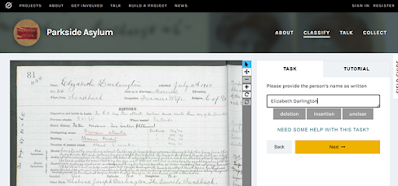

So, you see, the patients of Parkside Lunatic Asylum are not just names on a page, and we’re starting to tell their stories…


Our team of remote volunteers are helping Cheshire Archives index the Parkside case notes. This means the data can easily be searched and analysed by the public and researchers alike.

Want to be a part of it? You can! Email us for more information or join up straight away on the Zooniverse website


Wednesday, 14 December 2022

The Journey of a Local Studies Donation

Earlier this year we received a fantastic collection of photographs of Crewe in the 1890s, kindly donated to us by one of our volunteers, Susan. We thought this blog would be a great opportunity to showcase the collection, as well as thank Susan for her donation, and to highlight all the staff and volunteers involved with the donation and cataloguing process.

First a bit more about the photographs, and why Susan decided to donate it to us. Richard Baxter Booth was a Crewe dental surgeon, and this photograph collection was compiled by him in the 1890s.

Susan says “I found the album for sale on eBay, and Baxter Booth’s granddaughter has been shown the images; her father, Walter (Baxter Booth’s son) was also a dentist and keen photographer. This is album number two; number one is lost unfortunately. Baxter Booth’s dental surgery was in the row of buildings on Crewe Market Square that was replaced by Marks & Spencer, it was the last one on the left on the corner of what is now Queensway. After his marriage he lived at Oaklands in Haslington; he was an active member of the Crewe Cycling Club, the Crewe Alexandra Cricket Club, and Crewe Golf Club. All the images are 'Kodak no. 2' prints”. Baxter Booth had previously lived at Fields Farm, Haslington, rented from the Crewe Estate.

Once we had received the collection and Susan had completed our donation form, the photographs were passed to one of our conservators, Angela.

Angela says, “The original binding had completely failed, so the loose album pages were cleaned with a plastic eraser and placed into custom made polyester sleeves and then put into an acid free folder. These preservation measures will protect the album pages and photographs when they are being handled and also protect them from dust and any fluctuating environmental conditions they may encounter.”


Next, the collection was looked at in more detail by our Local Studies Librarian, Heather. She tells us, “The collection was added to CALM, our collections management system, so that it could be found by staff, researchers, and members of the public online. CALM generated a unique 6-digit reference code for the item, 231804. It was also given a class number of VPH96, which helps to locate the item in our visual collection. Here I am storing the collection away in one of our strongrooms, in an archive box, and where temperature and humidity levels are monitored.”


Another of our volunteers, Helen, was tasked with looking at each individual photograph and indexing it onto a spreadsheet.

Helen says “I am currently a volunteer working on the photographic archives at Duke Street, finding out any extra information about the subjects of the photographs and then entering all the information onto a spreadsheet. These spreadsheets, such as the one I worked on for the Richard Baxter Booth collection, will allow the public to access the information online, widening public access to the contents of the archives.”

This should help any researcher interested in the collection to find the exact photograph most useful to them. Helped by Susan’s knowledge of the area at the time, and of the photographer Richard Baxter Booth, this task is now complete. Please speak to a member of staff if viewing this spreadsheet would be helpful to your research.


We have not yet digitised the whole collection, but a selection of our favourites are featured below. The album contains scenes and events in Crewe, such as the Crewe Flower Show and a football match, as well as buildings (the Mechanics Institute, Town Hall, pubs, churches), and also features the residences of other doctors/medical men in Crewe such as Dr Atkinson’s residence “Mirion House” on Earle Street. The photographer also used his friends, family, and pets as his subjects.


The next step will be to have more of this fantastic album digitised and available on the Cheshire Image Bank website. 

If this blog has inspired you to consider donating an item or collection to us, then we would love to hear from you. Please do contact us first, as we can then check that the item fits with our collection policy and is not something we already have. You can get in touch with us via our website, telephone 01244 972574 or email recordoffice@cheshiresharedservices.gov.uk.  

All of these photographs and more are available to view at Cheshire Record Office in Chester.

Friday, 15 May 2020

The Enduring Morris Dance


This blog post was written by our volunteer Megan, who recently catalogued and repackaged our Lesley Edwards collection.

The collection is made up of research papers, photographs and articles relating to Morris dancing in Cheshire, and covers several Cheshire towns and parishes in great detail. You can see the full catalogue for these records here.

Read on to find out more about this intriguing folk dance that has been an English tradition for more than six hundred years!

Cheshire Image Bank (c01114): Godley Hill Royal Morris Men,
prior to the start of the Knutsford May Day procession in 1906.

  
The Morris dance is distinguished by a specific set of characteristics, including rhythmic stepping, folk music, regionally specific costumes, bell pads and the use of sticks and swords. These elements have cemented the Morris dance as a unique, vibrant spectacle and an entertaining recreation.

Cheshire Image Bank (c08403): Fidlers Fancy Morris Group,
Wilmslow Carnival 1970s.

What is truly significant about the tradition of Morris dance, especially with regard to local history, is the settings in which it was found and what it can reveal about the communities that shaped it. 

For example, Morris dancing is often considered to have four distinct geographical variations, identified as Cotswold, Border, Sword Dancing (Yorkshire) and North West; each form shaped by culturally significant regional differences. 

As the centuries moved on and Morris dancing moved from the court out into the parishes to become a staple aspect of community celebration, the Morris adopted a regional identity, and in the North West this was influenced by the mill population.

The North West Morris dance, found in Cheshire and Lancashire, was popular at May and rose festivals, wakes week fairs and notably the rush bearing ceremonies of the 17th century. During this time rushes were brought to local churches and strewn on the floor in an effort to make kneeling more comfortable.  These ceremonies became processional, with the rush bearing carts flanked by Morris dancers. 

Cheshire Image Bank (c11524): Postcard showing
the Morris dancers at the Helsby Rose Queen fete in 1911.

The locality not only determined the ceremonies in which the Morris dancing was performed but also the music, form of the dance and the dress (which was often dependent on what was available). The North West Morris, for example, is described as being performed in a military drill like style. 

Societal shifts are evident in the rise and fall of the Morris dance. Its decline took place throughout the years of the industrial revolution, with the migration of communities away from the rural villages and agricultural lifestyles that had been the lifeblood of the dance.

Cheshire Image Bank (p4772): Chester Morris Women,
Bridge Street 1989.

Throughout the 20th century the Morris dance has undergone various resurgences, demonstrating the durability of the traditional folk dance and underpinning the enduring collective memory that allows it to thrive. 

Much of the research that has supported these revivals has come from the first hand accounts and memories of past Morris Dancers. The Lesley Edwards collection at Cheshire Archives and Local Studies provides a wealth of information on the Cheshire Morris dance, from steps, to costume and music. It is through the collation of research like this that the finer details of the regional forms of Morris dance are remembered and sustained.                                                                                                                                                    
Finally a quote from Alderley and Wilmslow Advertiser gives a glimpse into the simple purpose of the enduring Morris dance by emphasising the joy it bought to Mayday summer celebrations:

‘‘Their peculiar mode of dancing is certainly very pretty. Their dresses are handsome in the extreme.’


Friday, 14 February 2020

Absent Voters' Project—Katherine's rare and unusual ranks

After running for the past six years, with 1000's of hours of work put into it, we have finally completed an amazing project and are ready to share the results with you. The Cheshire First World War Servicemen's Index Spring 1919 Absent Voter's Lists online (or Absent Voter's Project for short) is now complete! The 1918 and 1919 Absent Voters' lists are an invaluable resource for anyone seeking ancestors serving in the First World War. Absent Voters' lists give names and addresses, details of individuals' service, service number, unit or ship. With the help of volunteers, these lists have been transcribed and are fully searchable.
You can find the site here and a walk through of how to use the site is on our YouTube channel here. These coming blogs are written by our volunteers who made this possible and give an insight into what they enjoyed about the project.

Working on the Absent Voters Lists for 1919 has immersed the volunteers in the world of the men and a few women, who were registered to vote during the First World War but who were not at home to do so. The database records names, addresses, ranks, regimental numbers and units for members of all the forces. This means that it should also be possible to search not just for the family member you are researching but other force members in their household at the time. Some families I transcribed sent three or four sons to war.


A section of the absent voters list showing three males from the same family in the military.
Three of the same family sent to war

Between the Cheshire Archive volunteers thousands of entries have been transcribed. Some of the most common ranks in Cheshire feature Private, Corporal, Lieutenant, Able Seaman, Air Mechanic and Gunner whilst the rarer ones are Artist, Writer and Bandsman. Some of the common units feature the Cheshire Regiment, Royal Engineers, Royal Field Artillery, Royal Garrison Artillery, Royal Army Medical Corps, the Royal Navy and the Royal Air Force. The less common ones that I transcribed were the Royal Canadian Horse Artillery, a camel corps and the Royal Inniskilling Fusiliers. The women, numbering less than five, that I transcribed, were nurses or matrons in the Royal Army Medical Corps. An overview of the Cheshire lists shows the enormous range of ranks and units from every corner, offering insight into the enormous contribution made by our county.  


A screenshot of the absent voters' website showing the details of a nurse serving in the war.
A nurse's details are listed


Being part of the Absent Voters project has been fascinating. Hopefully the newly transcribed records will provide vital information for anyone interested in researching a family member who served a hundred years ago, in the Great War.   


This project was funded by Cheshire East Reflects.

Absent Voters' Project— Mike and Military History

After running for the past six years, with 1000's of hours of work put into it, we have finally completed an amazing project and are ready to share the results with you. The Cheshire First World War Servicemen's Index Spring 1919 Absent Voter's Lists online (or Absent Voter's Project for short) is now complete! The 1918 and 1919 Absent Voters' lists are an invaluable resource for anyone seeking ancestors serving in the First World War. Absent Voters' lists give names and addresses, details of individuals' service, service number, unit or ship. With the help of volunteers, these lists have been transcribed and are fully searchable.
You can find the site here and a walk through of how to use the site is on our YouTube channel here. These coming blogs are written by our volunteers who made this possible and give an insight into what they enjoyed about the project.

LOOKING FOR A FIRST WORLD WAR SERVICEMAN'S RECORD?

When you first start to researching your ancestors military history during WWI, why is it so difficult to obtain their official service records? The conflict took place just over one hundred years ago; so surely these documents would be the most detailed set of records of an individual that you will find anywhere! Unfortunately even the resources of the modern internet do not provide this facility. The truth is that most soldiers’ service records dating from the First World War were sadly destroyed by Luftwaffe raids on the old Public Record Office during the London blitz. Only a few records survived the bombing and fire damage caused to the record office. Consequently information on ordinary servicemen’s files is very limited.

A section of an absent voters page, showing printed info and extra annotations
A sample of the extra information you can find in the lists

 
My Grandfather served as a soldier during the Great War of 1914 - 1918, but I had no information to start with; apart from his known address. I began my search with the Absent Voters List (AVL) at the Cheshire Record Office, and this document provided me with his rank, service number, unit and division in which he served. Eureka! This was the start of an unimaginable story of a hero. That is why I volunteered to help with transcribing the Absent Voters List.

Teaming up with other distance transcribers working on this project unlocks priceless data for both amateur and professionals alike. In the pursuit of military, family, and local history studies it has become a valuable asset as an online research tool.

A photo of Mike
Mike


Mike
Distance Transcriber.


This project was funded by Cheshire East Reflects.

Absent Voters' Project— Tina's Experience

After running for the past six years, with 1000's of hours of work put into it, we have finally completed an amazing project and are ready to share the results with you. The Cheshire First World War Servicemen's Index Spring 1919 Absent Voter's Lists online (or Absent Voter's Project for short) is now complete! The 1918 and 1919 Absent Voters' lists are an invaluable resource for anyone seeking ancestors serving in the First World War. Absent Voters' lists give names and addresses, details of individuals' service, service number, unit or ship. With the help of volunteers, these lists have been transcribed and are fully searchable.
You can find the site here and a walk through of how to use the site is on our YouTube channel here. These coming blogs are written by our volunteers who made this possible and give an insight into what they enjoyed about the project.

My name is Tina and I have been volunteering on the Absent Voters project for 2 years. As a qualified archivist I always get involved in as many projects as I can but I also have a keen interest in history of the World Wars and have volunteered on projects such as the Merchant Navy Crew List transcription project and Operation War Diaries, so this project really appealed to me.

A photo of Tina
Tina

I have submitted entries for mostly the Wirral parishes, starting with Irby, where I live. I was struck by the socio-economic information the pages offer for their parish. For example, Thurstaston had very few entries and there were several Officers, compared with larger towns where there many more entries with a wide variety of ranks, but a lot of Privates and Labourers

It was interesting spotting a few women included in the list serving in nursing roles such as Laura Ellen Tuson of Silverdale Road, Lower Bebington who was serving in an auxiliary hospital in Myrtle Street Liverpool, and Violet Baxter of Thornburn Road, New Ferry, who was serving at 1st Southern General Hospital, Birmingham.

I've enjoyed learning all of the units and regiments and ranks/roles in the British Armed Forces and seeing the wide variety of units Wirral and Cheshire men entered.

Cecil Arbuthnot St George Moore's absent voter entry
Cecil Arbuthnot St. George Moore


There were also some fantastic names. Cecil Arbuthnot St. George Moore, a Lieutenant in the Royal Engineers, was just one that I couldn't help researching further.


This project was funded by Cheshire East Reflects.

Friday, 24 May 2019

The Month of May 1919 in the Sailors and Soldiers Rest


Crewe: Soldiers' Sailors' Rest, Nantwich Road (ref. c00801)


The signing of the Armistice in November 1918 ended the major part of the hostilities of the First World War. However, it took many more months to organise the return of the vast numbers of men scattered across the globe. 

One of our previous blog posts, “Crewe Station - the Heart of Britain’s Railways in World War I”, focuses on the Sailors and Soldiers Rest at Crewe Station and the two Rest visitors’ books held at Cheshire Archives.

These books give a fascinating glimpse into the experiences of the men that stayed at the Rest. Many called in at the Rest for a cup of tea, a meal, or a bed for the night, while others killed time between trains. 

Their comments often included grateful remarks about the hospitality, their relief at being demobilized, or regret at having more time to serve after a spell of leave.


A copy of a local news magazine published in March 1916 by Eardleys, the major printing company in Crewe, is pasted into one of the visitor books and states:

“The crude verses the men have written, the sometimes misapplied quotations, and the slang methods of expression, form an interesting study and throw a curious light upon the varied personality of the visitors.”

Battles were said to be fought over again, trench incidents recounted, and, according to Eardley, “…one has an excellent opportunity of studying the tranquil humanity which makes Tommy and Jack conspicuous among the fighting units of the world”.

In the month of May 1919 over 2,000 men passing through Crewe signed the book, well illustrating the world-wide nature of the Great War. Destinations included Cape Town, New York, Miami, Victoria BC, Adelaide, Nicaragua, Johannesburg, Moose Jaw Saskatchewan, and Arkinsaw, and of course many places in Britain including Chester. 

Journeys had started in Germany, Italy, Palestine, France, Bulgaria, Malta, naval bases from Scapa Flow to Plymouth, and  RAF airfields including Shotwick, (a few miles from Chester), and RAF Shawbury in Shropshire.  Many were travelling to and from Prees Heath, a massive army camp near Whitchurch.

A number of the troops, including many from the Royal Field Artillery, were heading for North Russia, via Crewe, as part of the Russian Relief Force. This was partly to keep the Bolsheviks back whilst the allies were evacuated and also for other plans that Winston Churchill was said to have devised.


Some other messages from the troops included:

“Fed up waiting at Crewe 5 ½ hours”

"Is the bacon still rationed? Once more unto the breach”

"Treated extremely well at Crewe”

“Always open when others are closed”

"Waiting for an airship”

“Cymry am byth”

“Tray Bon”

“Puggled to the wide” (said more than once!)

“I wish the pubs were open, I am dry”

“Here all night without a pint” (the Rest was established by the Church of England Mens Society in a Temperance Union mission room...)


And from a member of the Field Survey Battalion, Royal Engineers:

“If on earth there is some bliss, It is this – It is this – It is this!”

It is interesting to attempt to trace the details of some of the men who stayed at the Rest using online resources. For instance, Acting Lance Corporal Walter Shard, formerly a joiner of Towers Cottages, Poynton, joined up in September 1914. 

He was a hospital orderly in the Royal Army Medical Corps for 3 ½ years and in August 1918 he contracted Trench Fever, resulting in pains around his heart and shortness of breath.

He left the following heartfelt phrase in the Visitors' Book: 

“Happiest day of my life viz:- FINAL DEMOB”


This blog was written and researched by one of our volunteers, Susan Chambers. Susan will be blogging more about the Sailors and Soldiers Rest in the coming months - check back soon to hear more stories from Crewe!


Monday, 1 April 2019

Crewe Station - the Heart of Britain’s Railways in World War I


Crewe Railway Station
(Cheshire Image Bank c10557)
Throughout the years of the Great War a vital role was played by Crewe Station in Britain’s battle to keep men and supplies moving to where they were needed, at home and abroad. The station was a scene of constant activity, bustling and busy, day and night.

Holyhead boat trains, Scottish expresses, the Irish Mail, the London, Plymouth and Dover trains, the Travelling Post Office, ambulance trains bringing the wounded to northern hospitals, all called at Crewe.  Navy men going north to the Fleet at Scapa Flow, Army men heading south towards the Front in France and Belgium, plus vast supplies of shells and armaments all went by rail. Around 300 trains a day used this vital link, being shunted, marshalled and watered, before they steamed out again.


Crewe: Soldiers' Sailors' Rest
(Cheshire Image Bank c00801)
At any one time hundreds of soldiers and sailors could be seen around the station, awaiting their connections, passing the time in ambling along the platforms, taking a nap in front of the waiting-room fires, and sometimes joining in a round of ‘Tipperary’ to an accordion accompaniment.


Book-stalls, telegraph offices and refreshment rooms were always open, and so, from spring 1915 was the famous Soldiers’ and Sailors’ Rest, next to the station, where a meal and a bed could be had anytime of the day or night. Later in the war a trolley service with urns was set up to visit the trains which were only stopping for a short time, and to provide the troops with a welcome mug of tea before they steamed off again to continue their vital journeys. The station rest and refreshment services for military personnel in transit were organised by CEMS, the Church of England Men’s Society.

Crewe: Soldiers' and; Sailors' Rest
(Cheshire Image Bank c00802)

In the photograph above, the Soldiers’ and Sailors’ Rest visitors’ book can be seen on a stand in the centre of the image.  Twelve visitors’ registers were signed by 130,000 men since April 1915; the final two registers, covering 1919, are lodged with us at Cheshire Record Office (reference D 4998). These are a fascinating record of a brief spell in the lives of thousands of men a hundred years ago, some being demobilised, some going on leave, and some back to their regiments, many on long journeys to far distant parts.

A sample index of over 1000 men adding their names to the visitors’ book in March-April 1919 has been compiled by our volunteers. We will be posting extracts from the book on Twitter over the coming weeks – follow us @CheshireRO to keep updated!

Thursday, 7 March 2019

Volunteers in Wonderland!

It’s the time of year for thinking about books: World Book Night in April is a great reason to re-read a classic, and in March children everywhere dress up to celebrate World Book Day.  Some of the most popular costume choices are characters from Alice in Wonderland, from the Queen of Hearts to the Mad Hatter, the White Rabbit, Cheshire Cat or Alice herself. 

Alice’s Adventures in Wonderland, to give the book its full title, was first published in 1865 and has never been out of print since.  Its author Lewis Carroll – a pen name – was from Cheshire and lived here until the age of eleven.  He was born Charles Lutwidge Dodgson in 1832 in Daresbury, where his father was the local parson. 
                  
                         
Alice's Adventures in Wonderland, 1902; Baptism register entry for Charles Lutwidge Dodgson; author portrait

Given this local connection, Cheshire Archives and Local Studies are fortunate to have a large Lewis Carroll collection which is about to be made available to the public at our search room in Chester.  This is thanks in part to a children’s literature enthusiast who generously donated close to four hundred books to us in 2017, but it is also thanks to the commitment of two volunteers that the collection will soon be accessible.


Volunteers play an important role at Cheshire Record Office, from assisting with conservation work to helping us make our records accessible online, and working with staff to sort through the many new deposits we receive each year.  Along with long-standing volunteer John Dixon, who sadly passed away earlier this year, our volunteer Marilyn Ainsworth has spent many hours on the Lewis Carroll project.  We asked Marilyn to explain how she became involved and tell us about the collection. 


Marilyn spent six years as an Archives Assistant at Cheshire Record Office before retiring in 2014, but knew she would eventually like to spend some time volunteering.  Given her interest in visual projects, our Local Studies department – with its donations of drawings, paintings, photographs, news flyers and books – was ideal and she started with the Lewis Carroll project in 2017.  The first task was to look through each of the 396 items that had been deposited with us, sorting them into categories and making notes such as the names of the publisher and illustrator, the publication date and a brief description of the content.  We have Alice books ranging from the nineteenth century to the present day and editions in over twenty languages, so Marilyn had to do some delving to identify them.  She described identifying the different languages (as varied as Japanese, Russian, Bulgarian, Latin, Esperanto, Afrikaans, Hebrew, Aboriginal and Manx, to name just some) as the most challenging part of the project and, whilst online translation tools have been helpful in identifying books with the Latin alphabet, we have some editions in Oriental languages that as yet remain unclassified. 


Translations in Hebrew, Japanese and Latin


The project has involved sorting through numerous copies not just of Alice in Wonderland, but also Alice Through the Looking Glass and other works by Lewis Carroll such as The Hunting of the Snark and the poem Jabberwocky.  The collection contains books with Alice as a character and many non-fiction titles, as well as biographies of Carroll and books of his journals, letters and photographs - including some of Alice Liddell, upon whom Carroll’s stories were based.  A couple of photos stood out for Marilyn: one that was taken of Alice later in life in America, and another taken by Lewis Carroll looking up at his future sister-in-law (another Alice) balancing on a first-floor window ledge – clearly taken in the days before health and safety! 


Alice Liddell, 1932


Marilyn told us that the most enjoyable part of her work was that every book is different, but when asked if she had a favourite edition, her response was any with illustrations by Sir John Tenniel, the book’s original illustrator – these were the drawings in the Alice books she read as a child and they are how she thinks of Alice and the other characters.  She also found some of the more unusual books interesting, for instance funny versions like Alice in Sunderland by Bryan Talbot, published in 2007. 

       
Illustration by Sir John Tenniel; selection of Alice books in different languages

There are many other books in the Lewis Carroll collection, from a facsimile of the original handwritten text, to early and most recent editions of the Alice stories featuring numerous different illustrators, elaborate pop-up versions and stage adaptations, to name just a few.  Although a small number of books were loaned to Chester’s Storyhouse for an exhibition to coincide with a production of Alice in Wonderland in 2017, the full collection is soon to be made available for public viewing for the first time.  Take a look at our online catalogue over the coming weeks and see exactly what the collection holds. 

Marilyn is continuing to volunteer with our Local Studies department, now helping to catalogue a large amount of photograph negatives.  We would like to thank Marilyn once more for all her work on the Lewis Carroll collection, and we also wish everyone a happy World Book Day and World Book Night!