Pages

Showing posts with label WW1. Show all posts

Friday, 14 February 2020

Absent Voters' Project—Katherine's rare and unusual ranks

After running for the past six years, with 1000's of hours of work put into it, we have finally completed an amazing project and are ready to share the results with you. The Cheshire First World War Servicemen's Index Spring 1919 Absent Voter's Lists online (or Absent Voter's Project for short) is now complete! The 1918 and 1919 Absent Voters' lists are an invaluable resource for anyone seeking ancestors serving in the First World War. Absent Voters' lists give names and addresses, details of individuals' service, service number, unit or ship. With the help of volunteers, these lists have been transcribed and are fully searchable.
You can find the site here and a walk through of how to use the site is on our YouTube channel here. These coming blogs are written by our volunteers who made this possible and give an insight into what they enjoyed about the project.

Working on the Absent Voters Lists for 1919 has immersed the volunteers in the world of the men and a few women, who were registered to vote during the First World War but who were not at home to do so. The database records names, addresses, ranks, regimental numbers and units for members of all the forces. This means that it should also be possible to search not just for the family member you are researching but other force members in their household at the time. Some families I transcribed sent three or four sons to war.


A section of the absent voters list showing three males from the same family in the military.
Three of the same family sent to war

Between the Cheshire Archive volunteers thousands of entries have been transcribed. Some of the most common ranks in Cheshire feature Private, Corporal, Lieutenant, Able Seaman, Air Mechanic and Gunner whilst the rarer ones are Artist, Writer and Bandsman. Some of the common units feature the Cheshire Regiment, Royal Engineers, Royal Field Artillery, Royal Garrison Artillery, Royal Army Medical Corps, the Royal Navy and the Royal Air Force. The less common ones that I transcribed were the Royal Canadian Horse Artillery, a camel corps and the Royal Inniskilling Fusiliers. The women, numbering less than five, that I transcribed, were nurses or matrons in the Royal Army Medical Corps. An overview of the Cheshire lists shows the enormous range of ranks and units from every corner, offering insight into the enormous contribution made by our county.  


A screenshot of the absent voters' website showing the details of a nurse serving in the war.
A nurse's details are listed


Being part of the Absent Voters project has been fascinating. Hopefully the newly transcribed records will provide vital information for anyone interested in researching a family member who served a hundred years ago, in the Great War.   


This project was funded by Cheshire East Reflects.

Absent Voters' Project— Mike and Military History

After running for the past six years, with 1000's of hours of work put into it, we have finally completed an amazing project and are ready to share the results with you. The Cheshire First World War Servicemen's Index Spring 1919 Absent Voter's Lists online (or Absent Voter's Project for short) is now complete! The 1918 and 1919 Absent Voters' lists are an invaluable resource for anyone seeking ancestors serving in the First World War. Absent Voters' lists give names and addresses, details of individuals' service, service number, unit or ship. With the help of volunteers, these lists have been transcribed and are fully searchable.
You can find the site here and a walk through of how to use the site is on our YouTube channel here. These coming blogs are written by our volunteers who made this possible and give an insight into what they enjoyed about the project.

LOOKING FOR A FIRST WORLD WAR SERVICEMAN'S RECORD?

When you first start to researching your ancestors military history during WWI, why is it so difficult to obtain their official service records? The conflict took place just over one hundred years ago; so surely these documents would be the most detailed set of records of an individual that you will find anywhere! Unfortunately even the resources of the modern internet do not provide this facility. The truth is that most soldiers’ service records dating from the First World War were sadly destroyed by Luftwaffe raids on the old Public Record Office during the London blitz. Only a few records survived the bombing and fire damage caused to the record office. Consequently information on ordinary servicemen’s files is very limited.

A section of an absent voters page, showing printed info and extra annotations
A sample of the extra information you can find in the lists

 
My Grandfather served as a soldier during the Great War of 1914 - 1918, but I had no information to start with; apart from his known address. I began my search with the Absent Voters List (AVL) at the Cheshire Record Office, and this document provided me with his rank, service number, unit and division in which he served. Eureka! This was the start of an unimaginable story of a hero. That is why I volunteered to help with transcribing the Absent Voters List.

Teaming up with other distance transcribers working on this project unlocks priceless data for both amateur and professionals alike. In the pursuit of military, family, and local history studies it has become a valuable asset as an online research tool.

A photo of Mike
Mike


Mike
Distance Transcriber.


This project was funded by Cheshire East Reflects.

Absent Voters' Project— Tina's Experience

After running for the past six years, with 1000's of hours of work put into it, we have finally completed an amazing project and are ready to share the results with you. The Cheshire First World War Servicemen's Index Spring 1919 Absent Voter's Lists online (or Absent Voter's Project for short) is now complete! The 1918 and 1919 Absent Voters' lists are an invaluable resource for anyone seeking ancestors serving in the First World War. Absent Voters' lists give names and addresses, details of individuals' service, service number, unit or ship. With the help of volunteers, these lists have been transcribed and are fully searchable.
You can find the site here and a walk through of how to use the site is on our YouTube channel here. These coming blogs are written by our volunteers who made this possible and give an insight into what they enjoyed about the project.

My name is Tina and I have been volunteering on the Absent Voters project for 2 years. As a qualified archivist I always get involved in as many projects as I can but I also have a keen interest in history of the World Wars and have volunteered on projects such as the Merchant Navy Crew List transcription project and Operation War Diaries, so this project really appealed to me.

A photo of Tina
Tina

I have submitted entries for mostly the Wirral parishes, starting with Irby, where I live. I was struck by the socio-economic information the pages offer for their parish. For example, Thurstaston had very few entries and there were several Officers, compared with larger towns where there many more entries with a wide variety of ranks, but a lot of Privates and Labourers

It was interesting spotting a few women included in the list serving in nursing roles such as Laura Ellen Tuson of Silverdale Road, Lower Bebington who was serving in an auxiliary hospital in Myrtle Street Liverpool, and Violet Baxter of Thornburn Road, New Ferry, who was serving at 1st Southern General Hospital, Birmingham.

I've enjoyed learning all of the units and regiments and ranks/roles in the British Armed Forces and seeing the wide variety of units Wirral and Cheshire men entered.

Cecil Arbuthnot St George Moore's absent voter entry
Cecil Arbuthnot St. George Moore


There were also some fantastic names. Cecil Arbuthnot St. George Moore, a Lieutenant in the Royal Engineers, was just one that I couldn't help researching further.


This project was funded by Cheshire East Reflects.

Friday, 26 July 2019

June 1919 at the Sailors and Soldiers Rest


This blog post was written by our volunteer Susan Chambers. 


The visitors' book from the Sailors and Soldiers Rest at Crewe Station (D 4998) records over 1600 troops passing through in June 1919, many of them jotting down various comments alongside their names and service details. Some were travelling to and from various Army bases from all over Britain, (eg Sniggery, Lark Hill, Aisne Barracks) and many were returning from Europe and further afield: Dublin, Cologne, Mons, Constantinople, France, India, Mesopotamia, Salonica, Palestine, Eastern Turkey, Alexandria, North Russia to name a random few.

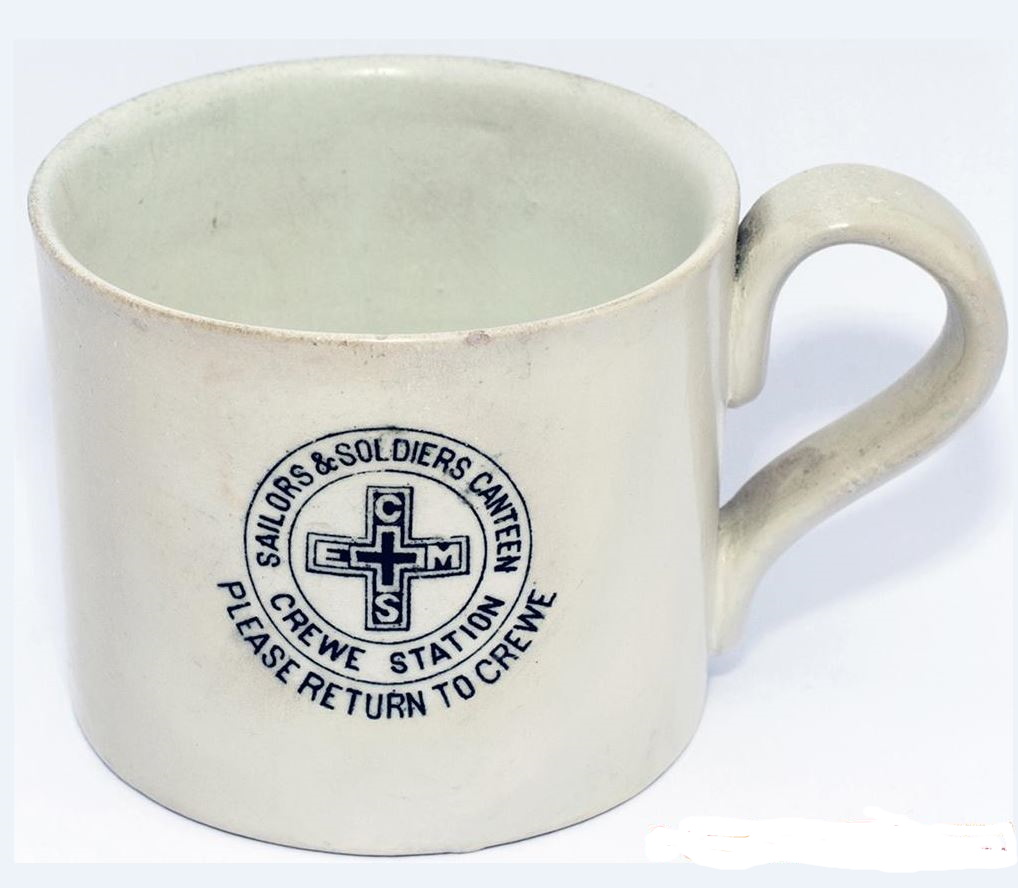
Sailors from HMS Caesar, Dauntless, Valkyrie, Erin, Caledon, Conqueror, Lion, HM Submarine L17, Minesweeper Buckie, were calling at the Rest, no doubt for the endless supply of mugs of tea!

Prices of essential items from the Rest's records. 


The visitors books are a fascinating source of information on the aftermath of the Great War, and the time it took to disperse the troops since the Armistice; and so many of them were off to deal with other problems in the world, such as Ireland, India and Russia.

A number of Canadian troops based at Kinmel Park Dispersal Camp (near Rhyl), were passing though the station after having had a brief  break before sailing home. Several soldiers had died in early March in a riot at Kinmel, prompted by their frustration at the slow progress in repatriating them, which entailed  a complex business of medical testing, clothing and equipment issue, and long administrative form-filling, after which they were sent on leave before returning to Kinmel ready to set off for Canada.  

However on their return to camp they often found that their allocated sailing was cancelled because of strikes or unavailability of a ship (or even preference given to Americans, it was suggested).  The incidents in March had stemmed from their bitter frustration.


Comments from the Canadians included:
                                           
‘another week to stop in British Isles’

‘me for that next boat to Canada’

‘Coming back off last eight days leave with Big head to be Demob.’

‘Big Head before Demob’ (Big Head -?hangover?)

‘Returning to “Gods Country” next sailing’

Some of the Canadians signed themselves as being from the ‘Little Black Devils’ (Royal Winnipeg Rifles).

Several men from the 3rd battalion North Staffs Regiment Band were heading for the Curragh Army Camp, County Kildare to assist with the Irish troubles;  

‘Gassed at Mons’  

'The above is a photo of an aeroplane out of sight’

‘I wish I was a Corporal’

On June 24th and 25th a total of twelve men of the 2nd Battalion of Seaforth Highlanders signed the book, recording that they had arrived from Fort George in Inverness and were on escort duty for German soldiers being taken from Scapa Flow to an interment camp near Oswestry. There was some confusion amongst the allies as to what would be done with the German fleet, but rather than hand it to the enemy the Germans had ‘scuttled’ their vessels (sunk them) on June 23rd:


‘Escort Duty. Taking Jerry from Scapa Flow to Oswestry, Wales (some job)’


 Many men were from Prees Heath, the huge Army camp near Whitchurch, and one from the Royal Army Pay Corps noted:

'Diddled out of breakfast this morn at Prees Heath Dispersal Station due to usual Army muddling. Very glad I was diddled after enjoying your excellent fare in this establishment’.

From two Royal Enniskillen Fusiliers: ‘Get a new pen’ ; ‘Here Here a New Pen, yes’.  

And later the same day from an Australian: ‘Good…not the pen’ and from a Mons soldier ‘This is a fine place but a D….rotten pen’.

It’s interesting to note how often ‘civility’ is mentioned, as if the troops were not accustomed to it:

'First civility received since 1914’

'Civility, which is a lot’

'Respect & Civility at Crewe YMCA’  


‘It is a great pleasure to be in a civilised country’,  from a Corporal in the Royal Scots just returning from Russia, and from a Sergeant travelling with him ‘No Blockhouse, No Snow, No Bolos’ (a sort of machete much used in WW1)


A few random jottings:

‘Watching others get their ticket (official discharge) is good sport, some may say, but I don’t. You soon get stricken down with the latest disease “Dispersalitis”.

‘Dinkum, everything in tip-top order’ from a member of the Royal Australian Air Force Base in Queensland.

24th Battalion Machine Gun Corps ‘Badly Wants to get Home. London’

‘Good luck to the lady who gave us the dinner, her praises I shall sing for ever & ever’

‘Tired , hungry & broke but received a Hearty Welcome’

‘Demobbed today, plenty happy and glad’

‘Any volunteers for North Russia?’

‘A friend  in need after 36 hours. The Last lap’

‘Tray bonne’ ‘Tray bond’ ‘Dobra’ ‘On his way home Napoo’

‘Happy Though Married’  ‘Happy and not Married’ followed by ‘Lucky boy’

‘Going to see my girl’.


Friday, 24 May 2019

The Month of May 1919 in the Sailors and Soldiers Rest


Crewe: Soldiers' Sailors' Rest, Nantwich Road (ref. c00801)


The signing of the Armistice in November 1918 ended the major part of the hostilities of the First World War. However, it took many more months to organise the return of the vast numbers of men scattered across the globe. 

One of our previous blog posts, “Crewe Station - the Heart of Britain’s Railways in World War I”, focuses on the Sailors and Soldiers Rest at Crewe Station and the two Rest visitors’ books held at Cheshire Archives.

These books give a fascinating glimpse into the experiences of the men that stayed at the Rest. Many called in at the Rest for a cup of tea, a meal, or a bed for the night, while others killed time between trains. 

Their comments often included grateful remarks about the hospitality, their relief at being demobilized, or regret at having more time to serve after a spell of leave.


A copy of a local news magazine published in March 1916 by Eardleys, the major printing company in Crewe, is pasted into one of the visitor books and states:

“The crude verses the men have written, the sometimes misapplied quotations, and the slang methods of expression, form an interesting study and throw a curious light upon the varied personality of the visitors.”

Battles were said to be fought over again, trench incidents recounted, and, according to Eardley, “…one has an excellent opportunity of studying the tranquil humanity which makes Tommy and Jack conspicuous among the fighting units of the world”.

In the month of May 1919 over 2,000 men passing through Crewe signed the book, well illustrating the world-wide nature of the Great War. Destinations included Cape Town, New York, Miami, Victoria BC, Adelaide, Nicaragua, Johannesburg, Moose Jaw Saskatchewan, and Arkinsaw, and of course many places in Britain including Chester. 

Journeys had started in Germany, Italy, Palestine, France, Bulgaria, Malta, naval bases from Scapa Flow to Plymouth, and  RAF airfields including Shotwick, (a few miles from Chester), and RAF Shawbury in Shropshire.  Many were travelling to and from Prees Heath, a massive army camp near Whitchurch.

A number of the troops, including many from the Royal Field Artillery, were heading for North Russia, via Crewe, as part of the Russian Relief Force. This was partly to keep the Bolsheviks back whilst the allies were evacuated and also for other plans that Winston Churchill was said to have devised.


Some other messages from the troops included:

“Fed up waiting at Crewe 5 ½ hours”

"Is the bacon still rationed? Once more unto the breach”

"Treated extremely well at Crewe”

“Always open when others are closed”

"Waiting for an airship”

“Cymry am byth”

“Tray Bon”

“Puggled to the wide” (said more than once!)

“I wish the pubs were open, I am dry”

“Here all night without a pint” (the Rest was established by the Church of England Mens Society in a Temperance Union mission room...)


And from a member of the Field Survey Battalion, Royal Engineers:

“If on earth there is some bliss, It is this – It is this – It is this!”

It is interesting to attempt to trace the details of some of the men who stayed at the Rest using online resources. For instance, Acting Lance Corporal Walter Shard, formerly a joiner of Towers Cottages, Poynton, joined up in September 1914. 

He was a hospital orderly in the Royal Army Medical Corps for 3 ½ years and in August 1918 he contracted Trench Fever, resulting in pains around his heart and shortness of breath.

He left the following heartfelt phrase in the Visitors' Book: 

“Happiest day of my life viz:- FINAL DEMOB”


This blog was written and researched by one of our volunteers, Susan Chambers. Susan will be blogging more about the Sailors and Soldiers Rest in the coming months - check back soon to hear more stories from Crewe!


Monday, 1 April 2019

Crewe Station - the Heart of Britain’s Railways in World War I


Crewe Railway Station
(Cheshire Image Bank c10557)
Throughout the years of the Great War a vital role was played by Crewe Station in Britain’s battle to keep men and supplies moving to where they were needed, at home and abroad. The station was a scene of constant activity, bustling and busy, day and night.

Holyhead boat trains, Scottish expresses, the Irish Mail, the London, Plymouth and Dover trains, the Travelling Post Office, ambulance trains bringing the wounded to northern hospitals, all called at Crewe.  Navy men going north to the Fleet at Scapa Flow, Army men heading south towards the Front in France and Belgium, plus vast supplies of shells and armaments all went by rail. Around 300 trains a day used this vital link, being shunted, marshalled and watered, before they steamed out again.


Crewe: Soldiers' Sailors' Rest
(Cheshire Image Bank c00801)
At any one time hundreds of soldiers and sailors could be seen around the station, awaiting their connections, passing the time in ambling along the platforms, taking a nap in front of the waiting-room fires, and sometimes joining in a round of ‘Tipperary’ to an accordion accompaniment.


Book-stalls, telegraph offices and refreshment rooms were always open, and so, from spring 1915 was the famous Soldiers’ and Sailors’ Rest, next to the station, where a meal and a bed could be had anytime of the day or night. Later in the war a trolley service with urns was set up to visit the trains which were only stopping for a short time, and to provide the troops with a welcome mug of tea before they steamed off again to continue their vital journeys. The station rest and refreshment services for military personnel in transit were organised by CEMS, the Church of England Men’s Society.

Crewe: Soldiers' and; Sailors' Rest
(Cheshire Image Bank c00802)

In the photograph above, the Soldiers’ and Sailors’ Rest visitors’ book can be seen on a stand in the centre of the image.  Twelve visitors’ registers were signed by 130,000 men since April 1915; the final two registers, covering 1919, are lodged with us at Cheshire Record Office (reference D 4998). These are a fascinating record of a brief spell in the lives of thousands of men a hundred years ago, some being demobilised, some going on leave, and some back to their regiments, many on long journeys to far distant parts.

A sample index of over 1000 men adding their names to the visitors’ book in March-April 1919 has been compiled by our volunteers. We will be posting extracts from the book on Twitter over the coming weeks – follow us @CheshireRO to keep updated!