Pages

Showing posts with label Family History. Show all posts

Wednesday, 12 October 2022

Cheshire Railways: First Stop - The History

On 22nd August 1890, Richard Jones started work as a Wheelwright at Crewe Engineering Works. His name, date of birth and first day of employment were recorded in one of the works' large registers along with the names of thousands of others who were employed at the works over the years. Over 130 years later that register and piece of history still survives, along with many more railway records available to be viewed at the Record Office in Chester. Over the last couple of years, staff and volunteers have been working hard to catalogue this huge collection to make it fully accessible so the story of Richard Jones and many others like him can be discovered.


The history of the railway in Cheshire starts in the first half of the nineteenth century when Chester attracted the interest of various railway companies. The Chester and Birkenhead and Chester and Crewe Railways were the first to open their respective routes in 1840. This was followed by the construction of the Chester and Holyhead Railways which fully opened in 1850. Many more companies and lines followed. By the time Richard Jones started work several of these companies had merged and many became part of London and North Western Railway. 


In 1923, under the Railways Act 1921, the majority of railway companies were grouped into four main companies. It was the London Midland and Scottish Railway and the Great Western Railway who between them covered the Cheshire area. In 1948, with the nationalisation of the railways, these companies became part of British Railways under the London Midland Region and Western Region.

In 1986 it was decided by British Railways that the important archive records that told the story of history of railway in Britain would be put into the care of County Record Offices. Determining which Record Offices to house them in wasn’t a simple decision. Railways don’t stop at county boundaries. It was decided that they would be deposited in areas appropriate to the British Rail Regions and of the big four companies that came into being following the grouping of 1923. It was also decided that records of companies absorbed before 1921 would be offered to the County Record Office receiving the records of the absorbing company.


Cheshire Record Office received records of the following companies: London and North Western Railway Company, Great Central and North Western Railways Joint Committee, London Midland and Scottish Railway Company - Central Administration, Western Division (North), Western Division (South), London Midland and Scottish and Great Western Railways Joint Committee. It therefore follows that the area covered by these records often exceeds the boundaries of the County of Cheshire.


Over the course of future blogs we will explore two of the main series of records in the collection; employee records and railway plans. These have great research potential for local and family historians in Cheshire and beyond.

Look our for the Second Stop of this blog - Employee Records - coming soon!

These records and more are available to view at Cheshire Record Office in Chester.

Wednesday, 5 January 2022

A "New" Census!

Almost all family historians will have made use of the census at some point in their research. Censuses can tell you when and where your ancestors were born, the address where they were living, their occupations, and their relationships to people living in the same household. Later censuses may even tell you how long they’d been married, how many children they had, and even how many rooms were in their house. 

In England and Wales a census has been taken every ten years since 1801 (with one exception, which we’ll come to later). Were you asked last year to complete an online census form? We’ve come a long way since the very first census in 1801, when local parish officers were dispatched in order to, quite literally, count every man, woman and child, before posting the handwritten returns off to the census office in London, so that they could be collated and printed in large statistical volumes. 

From 1841 onwards the administration of the census passed to the General Register Office, which had been set up just four years previously to oversee the introduction of civil registration of births, marriages and deaths. This was the earliest census to officially record personal information, such as names and occupations (although, extremely rarely, draft notebooks with this information survive from 1831 or earlier). Every householder was asked to complete a form with details of everyone at home on census night; the details would later be copied by clerks into a separate series of books, and the original forms destroyed. However, this process didn’t always go entirely to plan. 


Although the 1841 is the earliest census we now have access to, it provides less information than its successors: the ages of everyone over 15 were supposed to have been rounded down to the nearest five years (although this rule wasn’t always strictly followed), and people weren’t asked for their exact place of birth: only whether they were born in the same county, in Scotland, Wales or Ireland, or overseas.

From 1851 onwards we usually find more precise information concerning ages and birthplaces, although it isn’t uncommon to find ancestors ageing rather more or less than ten full years in the intervening decades (sometimes even miraculously becoming younger from one census to the next!). People couldn’t always be relied upon to give accurate information, and I have one ancestor whose birthplace is different in every census in which he appeared. The census officials had no way to check whether the information they were given was correct, and people then were no less wary of providing their personal details to the authorities than they are today. For example, in the nineteenth century there was an incentive for people to claim that they were born in the same parish where they were living, since the poor laws of the time could see them returned to their ‘home’ parish if they fell on hard times.


In order to reassure the populace that the information given to census officers wouldn’t be used against them (provided it wasn’t intentionally wrong or misleading), guarantees were made that everyone’s details would remain confidential for 100 years; this undertaking became enshrined in law in 1920. 

During the twentieth century, the earliest censuses were therefore released to the public one hundred years after they were taken – usually in the January of the following year. Initially, researchers would have to travel to the Public Record Office (now The National Archives) in London to look at the original paper returns, which had been bound into thousands of large volumes. In the 1970s these were microfilmed and distributed around the country (and even around the world), to provide greater accessibility for the growing band of family historians. 

The 1891 census was the first to be released exclusively on microfiche, rather than the more cumbersome microfilm, while the 1901 and 1911 returns could be accessed through the internet shortly after their release. This was especially important in the case of the 1911 census, which came in a different format, showing each household on a separate page (in fact these were the original forms completed by each householder, now preserved for posterity). Thus the number of images from 1911 is vastly larger than for 1901. The earlier censuses back to 1841 have also now been digitised, and are accessible through various pay-per-view sites on the internet, where they can also be searched by name or address.  


No doubt you’ll have realised that the release of the 1921 census must be imminent - the launch date is 6 January 2022. Initially the returns for England and Wales will be available exclusively through Find My Past, who have been The National Archives’ commercial partner in carefully digitising and conserving over 20 million pages – containing almost 38 million names – in full colour, and all completely indexed. The 1921 censuses for Scotland and Northern Ireland will be released separately by their own national archives. 

The format of the England and Wales returns is very similar to the 1911 census, so we’ll be able to see the individual householders’ forms, in their own handwriting, which occupy more than a mile’s worth of shelving at The National Archives. The 1921 census also provides some extra details, such as the places where people worked (not just their occupation), and whether the parents of children under fifteen had died. Ages were also to be recorded in years and months, rather than to the nearest year as in previous censuses, hopefully making them a little more accurate. 


The census will be free to view online at The National Archives in London, at Manchester Central Library, and at the National Library of Wales in Aberystwyth. However, everywhere else you will need a personal Find My Past subscription, which will allow you to see the images on a pay-per-view basis. Until Find My Past have recouped the expense they incurred in their digitisation project, unfortunately you won’t be able to access the 1921 census free of charge at the Cheshire Record Office or in the county’s libraries, as you currently can with the earlier censuses and the rest of their collections. For full details see: 

If you’ve already traced your family back a few centuries, you may wonder whether it’s worth bothering with a source that’s so comparatively recent. But history can be full of surprises, and it’s only by collecting as much information as possible about our ancestors, or the places where we live, that we can piece together a complete picture of where we came from. 

Finally, if all this has made you giddy with excitement at the prospect of future census releases, then you may have to be a little patient. I mentioned that the census had been taken every decade except one – which was 1941, due to the Second World War, during which the returns for the whole of the 1931 census were completely destroyed by bombing. So the 1951 census will be the next to come out… and we’ll have to wait until January 2052 for that!

Friday, 26 March 2021

The Census Detective - What clues are you leaving behind?

It all started with the will of Mary Crewe, spinster, late of Watergate Street in Chester. What struck me was the fact that she had left quite substantial sums of money to her family and to charity but made her mark with an 'X' in her will. How did she have almost £20,000 in today's money but could not write her name?

The will of Mary Crewe, 1875

Intrigued, I decided to find out more about Mary's story. What followed was a detective trail involving several sources, highlighting the strengths – and weaknesses - of census returns as evidence.

A look on Cheshire BMD shows Mary’s death registered in 1875 and reveals her age as 82, which gives us a birth year of about 1793.

Entry showing the death of Mary Crewe in 1875 on Cheshire BMD

This approximate year of birth was my next step for a ‘quick look’ at the census returns for where she lived and who with. Not so quick! A search on Ancestry in the 1871 census for ‘Mary Crewe’(exact) born five years either side of 1793 in Chester gave no results.

However, widening the search for similar names and for places in ‘Cheshire’ instead of Chester provided a promising result. 

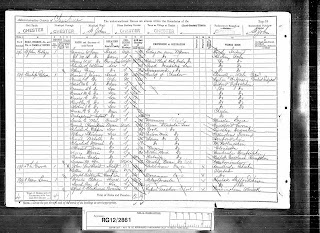
Mary ‘Creeve’, a 76 year-old cook born in Tilston, is living with her employer, Miss Maria Wynne, a ‘Lady’ and a 19 year-old housemaid, Phebe Williams.


The census return for 1871 showing Mary Crewe living with Miss Maria Wynne and Phebe Williams in Chester

A look back at Mary’s will reveals something interesting. Mary names Miss Wynne, spinster, as her executrix (a female executor). So Mary had appointed her employer to carry out her last wishes.

Extract from Mary's will showing Miss Wynne as her executrix

The same search using Find My Past correctly identifies Mary’s surname as ‘Crewe’ in the 1871 census. It also gives an entry in 1851 for her as a servant aged 55 in the household of Hugh Calveley and his niece, Miss Wynne, in Northgate Street, Chester. Both Hugh and Maria are described as ‘independent’.

I couldn’t find an entry in Find My Past for 1861 looking for Mary Crewe. However, she’s there in the entry for Miss Wynne and Hugh Calveley, now in Watergate Street. This entry for Mary Crewe aged 63 (born around 1798 at ‘Sellstone’) is picked up clearly by Ancestry, but with an obvious mistake in the index for her place of birth!

With the 1841 census, it’s only when I searched for Mary and Miss Wynne in vain that I found them in the household of Hugh Calveley. The 1841 census rounds ages up to the nearest five years, so Mary’s age here is given as 35 - now we've got a birth year around 1816!

1841 census return showing Mary Crewe living with  Hugh Calveley and Miss Wynne

Lessons learnt

·       Even when the name of a person or place seems clear, be aware that the census returns were transcribed by people with no local knowledge and there are mistakes

·       There are clearly differences in transcription between  Ancestry and Find My Past. If you can’t find an entry on one, try the other!

·       If the person you’re looking for doesn’t appear, try and find other members of the same household

·       Using ages can be tricky. Mary's birth year ranges from 1795 to 1816 according to the census. It could be deliberate or careless reporting, and perhaps the correct age of a domestic servant wasn't a matter for great accuracy?

Going back to Mary’s will and my original question for a moment …

Mary left £25 to each of her four great nephews and two donations of £19 19 shillings to charity. As a domestic servant, how was she so well provided for?

The answer lies in the will of Hugh Calveley, who leaves Mary the sum of £100 in 1868, with the condition that she is still in his service at the time of his death.

Extract from the will of Hugh Calveley, 1868

Miss Wynne’s will, made in 1868, leaves an annual allowance to Mary of £26 and a codicil, amending her will after Mary’s death, leaves £19 19 shillings to Phebe Williams, the housemaid). Curious that same amount appears in both wills, just under the £20 limit that you had to pay legacy dues to the taxman!

What does this indicate about long term employees and their employers?

Clearly both Hugh and Miss Wynne valued their staff, Mary Crewe in particular. There’s an entry in the Cheshire Observer on 11th December 1875 for Mary’s death, which describes her as ‘…for 60 years the faithful and attached servant of Miss Wynne’s family’.

Cheshire Observer, 11 December 1875

Another thing that struck me looking at this story – it is far from the full story! We see Mary’s life and circumstances as a glimpse every ten years and have to piece together what we can from the fragments the census returns give us (and not always willingly!).

Looking for Mary, we find Maria and her bachelor uncle, Hugh. How did they become a household for so long? What else can we discover about them?

Our Overleigh Cemetery database shows an entry for Mary and the UK Find a Grave database on Ancestry takes us to an image of Mary’s grave there. She’s buried with her brother, George and somebody called Hannah... but that is another story!

Think about the information we have provided on the census returns throughout our lives, what would a researcher far in the future make of our stories?


Friday, 26 February 2021

A Pub in Parkgate

Would you like to learn more about a local business or building from the comfort of your own home? This blog will take you through some of our online resources using the example of The Boat House, a pub in Parkgate at the end of The Parade.

Our first port of call is the Cheshire Tithe Maps website, available through the Cheshire Archives and Local Studies website. Cheshire Tithe Maps Online allows you to view and search almost 500 tithe maps and compare these alongside other historic mapping. Together with the information recorded in tithe apportionments, they are a unique record of land ownership, occupancy and use in Cheshire 150 years ago. The video clip below talks you through how to use the website for your research. 


The tithe maps website will also allow you to search by person or by plot, if you wanted to see what else was owned by the Mostyn family for example.

To delve deeper into this website please see our previous blog You are here! But who was before? Discover history on your doorstep using Cheshire Tithe Maps Online.

Now let’s see what we can find using the digitised trade directories available to view and search online via our website. Trade directories were the Yellow Pages of their day, produced from the 17th century onwards to meet an increased demand for information on commerce and industry. This video shows you where to find them and how we can use them in our research.


If you are interested in carrying out research into the history of the Johnson family using census records, then you can use your Cheshire library card to access the Ancestry website from your own device at home. Full free access is available at your local library, and at the record office itself. For more information on using Ancestry Library Edition, why not check out our beginner’s guide on our YouTube channel?

Next, using the Neston Borough Building Control Plans Database which is also available on our website, we can search for any information relevant to the Boat House, or the Pengwern Arms, between the years 1868 and 1950.


Lastly, let's visit the Cheshire Image Bank to see if any images of the Boat House have been digitised and available to view online.

The image bank is available through our website. We continually digitise and add new images to this online collection, bringing together pictures of Cheshire’s people, places and events, and we currently have nearly 31,000 images available online.

A search for “Parkgate” in the top right search box brings up 138 results, including several which will be of interest in our research, or you can follow the steps demonstrated in the below video clip.


If you were interested in obtaining a digital copy of an image, please click on “How to Obtain Prints” on the left-hand menu.


You may also like to visit our Flickr page, where we have further material digitised and grouped into albums.

We have now learned more about the history of The Boat House without even leaving our sofa! We have been able to find images of the pub, the names of its publicans and know that it stood on land owned by the Mostyn family. We know alterations were made over the years, that its name changed, and we have found its location on 19th century tithe and ordnance survey maps. Why not explore our online resources yourself, travel back in time and see what you can find out about your local area?! Keep curious!

Monday, 4 May 2020

Family History Detective Help Desk - the 1939 Register

If you have tracked down one of your ancestors born before 1920 in the UK you will probably be able to find them on the 1939 register.

The 1939 register was created just after the outbreak of the Second World War. It was very important in organising the war effort at home. It was kept up to date for over ten years to issue identity cards and organise food rations, and was used to set up registration for the new NHS in 1948.

This is what an entry from the 1939 register looks like.


What is the address of this household?

What is the surname of the family in this household? How many people were living there?
Can you see who the head of the household is? What was this person’s job?
Does anything about this record surprise you? 

To look at the 1939 Register yourself you can use the Ancestry website.
There are a number of boxes that you can fill out to find your ancestors on the 1939 register, the most important being their name, date or year of birth, and the street or town where they lived. 


If you don’t find them at first, try again using a different spelling of their name or widening your search to cover the entire county. This is where it helps to have an unusual name!

Friday, 14 February 2020

Absent Voters' Project—Katherine's rare and unusual ranks

After running for the past six years, with 1000's of hours of work put into it, we have finally completed an amazing project and are ready to share the results with you. The Cheshire First World War Servicemen's Index Spring 1919 Absent Voter's Lists online (or Absent Voter's Project for short) is now complete! The 1918 and 1919 Absent Voters' lists are an invaluable resource for anyone seeking ancestors serving in the First World War. Absent Voters' lists give names and addresses, details of individuals' service, service number, unit or ship. With the help of volunteers, these lists have been transcribed and are fully searchable.
You can find the site here and a walk through of how to use the site is on our YouTube channel here. These coming blogs are written by our volunteers who made this possible and give an insight into what they enjoyed about the project.

Working on the Absent Voters Lists for 1919 has immersed the volunteers in the world of the men and a few women, who were registered to vote during the First World War but who were not at home to do so. The database records names, addresses, ranks, regimental numbers and units for members of all the forces. This means that it should also be possible to search not just for the family member you are researching but other force members in their household at the time. Some families I transcribed sent three or four sons to war.


A section of the absent voters list showing three males from the same family in the military.
Three of the same family sent to war

Between the Cheshire Archive volunteers thousands of entries have been transcribed. Some of the most common ranks in Cheshire feature Private, Corporal, Lieutenant, Able Seaman, Air Mechanic and Gunner whilst the rarer ones are Artist, Writer and Bandsman. Some of the common units feature the Cheshire Regiment, Royal Engineers, Royal Field Artillery, Royal Garrison Artillery, Royal Army Medical Corps, the Royal Navy and the Royal Air Force. The less common ones that I transcribed were the Royal Canadian Horse Artillery, a camel corps and the Royal Inniskilling Fusiliers. The women, numbering less than five, that I transcribed, were nurses or matrons in the Royal Army Medical Corps. An overview of the Cheshire lists shows the enormous range of ranks and units from every corner, offering insight into the enormous contribution made by our county.  


A screenshot of the absent voters' website showing the details of a nurse serving in the war.
A nurse's details are listed


Being part of the Absent Voters project has been fascinating. Hopefully the newly transcribed records will provide vital information for anyone interested in researching a family member who served a hundred years ago, in the Great War.   


This project was funded by Cheshire East Reflects.

Absent Voters' Project— Mike and Military History

After running for the past six years, with 1000's of hours of work put into it, we have finally completed an amazing project and are ready to share the results with you. The Cheshire First World War Servicemen's Index Spring 1919 Absent Voter's Lists online (or Absent Voter's Project for short) is now complete! The 1918 and 1919 Absent Voters' lists are an invaluable resource for anyone seeking ancestors serving in the First World War. Absent Voters' lists give names and addresses, details of individuals' service, service number, unit or ship. With the help of volunteers, these lists have been transcribed and are fully searchable.
You can find the site here and a walk through of how to use the site is on our YouTube channel here. These coming blogs are written by our volunteers who made this possible and give an insight into what they enjoyed about the project.

LOOKING FOR A FIRST WORLD WAR SERVICEMAN'S RECORD?

When you first start to researching your ancestors military history during WWI, why is it so difficult to obtain their official service records? The conflict took place just over one hundred years ago; so surely these documents would be the most detailed set of records of an individual that you will find anywhere! Unfortunately even the resources of the modern internet do not provide this facility. The truth is that most soldiers’ service records dating from the First World War were sadly destroyed by Luftwaffe raids on the old Public Record Office during the London blitz. Only a few records survived the bombing and fire damage caused to the record office. Consequently information on ordinary servicemen’s files is very limited.

A section of an absent voters page, showing printed info and extra annotations
A sample of the extra information you can find in the lists

 
My Grandfather served as a soldier during the Great War of 1914 - 1918, but I had no information to start with; apart from his known address. I began my search with the Absent Voters List (AVL) at the Cheshire Record Office, and this document provided me with his rank, service number, unit and division in which he served. Eureka! This was the start of an unimaginable story of a hero. That is why I volunteered to help with transcribing the Absent Voters List.

Teaming up with other distance transcribers working on this project unlocks priceless data for both amateur and professionals alike. In the pursuit of military, family, and local history studies it has become a valuable asset as an online research tool.

A photo of Mike
Mike


Mike
Distance Transcriber.


This project was funded by Cheshire East Reflects.

Absent Voters' Project— Tina's Experience

After running for the past six years, with 1000's of hours of work put into it, we have finally completed an amazing project and are ready to share the results with you. The Cheshire First World War Servicemen's Index Spring 1919 Absent Voter's Lists online (or Absent Voter's Project for short) is now complete! The 1918 and 1919 Absent Voters' lists are an invaluable resource for anyone seeking ancestors serving in the First World War. Absent Voters' lists give names and addresses, details of individuals' service, service number, unit or ship. With the help of volunteers, these lists have been transcribed and are fully searchable.
You can find the site here and a walk through of how to use the site is on our YouTube channel here. These coming blogs are written by our volunteers who made this possible and give an insight into what they enjoyed about the project.

My name is Tina and I have been volunteering on the Absent Voters project for 2 years. As a qualified archivist I always get involved in as many projects as I can but I also have a keen interest in history of the World Wars and have volunteered on projects such as the Merchant Navy Crew List transcription project and Operation War Diaries, so this project really appealed to me.

A photo of Tina
Tina

I have submitted entries for mostly the Wirral parishes, starting with Irby, where I live. I was struck by the socio-economic information the pages offer for their parish. For example, Thurstaston had very few entries and there were several Officers, compared with larger towns where there many more entries with a wide variety of ranks, but a lot of Privates and Labourers

It was interesting spotting a few women included in the list serving in nursing roles such as Laura Ellen Tuson of Silverdale Road, Lower Bebington who was serving in an auxiliary hospital in Myrtle Street Liverpool, and Violet Baxter of Thornburn Road, New Ferry, who was serving at 1st Southern General Hospital, Birmingham.

I've enjoyed learning all of the units and regiments and ranks/roles in the British Armed Forces and seeing the wide variety of units Wirral and Cheshire men entered.

Cecil Arbuthnot St George Moore's absent voter entry
Cecil Arbuthnot St. George Moore


There were also some fantastic names. Cecil Arbuthnot St. George Moore, a Lieutenant in the Royal Engineers, was just one that I couldn't help researching further.


This project was funded by Cheshire East Reflects.

Wednesday, 14 June 2017

Monumental Inscriptions

A few months ago, whilst I was producing documents for customers in the searchroom, a customer ordered D5104 which the catalogue describes, accurately but somewhat drily, as “1 folder: Transcripts of monumental inscriptions made from tombs and printed sources, various Cheshire parishes, 17c-20c”

When I found the folder and opened it to check its contents it looked like hundreds of tiny typed copies of inscriptions in small bundles, each one held together by a paper clip.  Unsurprisingly, not all the paper clips were still in the right place. Using the description and numbers of items in each theme from the full paper catalogue that the customer had seen here http://discovery.nationalarchives.gov.uk/browse/r/h/8005a51f-0e4c-4234-a3a4-361fd9eed21d it didn't take long to make sense of the jumbled slips, and present the customer with what she expected. To prevent this happening again and to make the experience of reading them a little less chaotic in future, we decided to copy the slips onto A4 sheets by theme, which gave us the chance to experience a little flavour of what lay within!


We’ll start with the benevolent Joseph Bleamire, Coachman, 1760 (buried in Barthomley):


Coachman to/JOHN CREWE Esq./left by his last Will and /Testament
the Sum of Sixty/Pounds the Interest of which/to be laid out
weekly in brown/Bread of the value of two/Pence per Loaf and to
be/distributed in the Parish Church of Barthomley/
every/ Sunday immediately after/morning Service to the Poor/of
the Township of Crewe.


Then, how about the somewhat productive Sir Henry Bunbury (17th Century, from Thornton-le-Moors):


He married two Wives: first Anne/by whom he had yssue 3 sonnes
And 6 daughters/and Martha by whom he had/yssue 7 sonnes and 3
daughters.


And the even more eye watering Lady Katherine Clegg from Heswall:
She was married on the 22nd July 1650 and died on the 26th
August 1666 aged 39. She bore 15 children, 13 sons and two
daughters.


Next how about poor Latitia Leyland, Born and Died October 1st 1837 in Cheadle:
Sweet Babe, she glanc’d into our world to see
A sample of our misery,
Then turn’d away her languid eye,
To drop a tear or two and die
The cup of life to her lips she press’d
Found the taste bitter and refus’d the rest.
Sweet Babe no more but Seraph now
Before the shrine behold her bow,
Adore the grace that brought her there
Without a wish – without a care,
That wash’d her soul in Calvary’s stream
That shorten’d life’s distressing dream.
Short pain – short grief – dear Babe was thine
Now joys eternal and divine.


If you’ve managed to compose yourself again after reading that one, we can return to issues of mind boggling productivity with Ann Barker of Middlewich:
Here lies Ann, Wife of Daniel
Barker, who died July 3, 1778,
Aged 77
Some have children and some have none,
But here lies the Mother of Twenty one
Time for reflection in Church Lawton where “it is said that an iron tombstone by the main gate of the churchyard bore the following inscription (long since illegible)”:
He was a brute of a husband and
led me a shocking life
Another desperately dispiriting pair now, firstly Martha Clark of Bidston who died in 1846, aged 21:
Nineteen years/a Maid/Two years a Wife./Nine days/a Mother/And
then /Departed Life.


Secondly, here is poor William Pownall of Mobberley who died in 1864, aged 20:
All you that stop this Stone to see
Pray think how sudden death took me
I in my youth God call’d away
Just before my wedding day
More happily, it is pleasing to discover that some lived just a little longer. Joseph Watson, ‘Park-keeper’ died in 1753, aged 104 and is buried in Disley:
He was Park Keeper to Mr Peter Leigh, at Lyme,
more than 64 years and was ye first
that Perfected the Art of Driving ye Stags.
Here lyeth also the body of Elizabeth his wife,
aged 94 years, to whom
he had been married 75 years.
Reader, take notice, the longest life is short.


A note is added stating “He was born at Mosley Common in Lancashire.  He claimed that he drank a gallon of malt liquor every day for sixty years”.  Five other centenarians are also recorded, although, sadly perhaps, their level of alcohol consumption isn’t.
If you are interested in Monumental Inscriptions in a more structured sense then please note that a search on our catalogue for that term lists over 400 items in total.  Please also be aware that we have a large collection of individual volumes on open access in the public searchroom  that each relate to a different Parish in the County.

Wednesday, 10 August 2016

From Audlem to New York


Photographs can give amazing insight into the lives of the people of the past. At Cheshire Archives and Local Studies, cataloguing part of the glass plate negative collection unearthed a number of such images. These images are glass plate negatives depicting American life in the early 1880s. The only question was, why had we accepted items relating to an area so outside our collection policy? A theory arose that perhaps these people had links to Cheshire but had left to discover a new life in America. 


New York Garden- c11607 on Cheshire Image Bank

Upon inspection of the various boxes, it was found that some in fact were of areas around Audlem in Cheshire. The same hand had written the captions for both New York and Audlem; creating a link between the images and reinforcing the glass plates’ original grouping as a set.

We decided to research some of the names shown in the captions. Our Local Studies manager started on the trail of Brettel Gullen. She found out that his place of birth was listed as Brooklyn, America in October of 1884.


Marriage
After some further research, we came up with a discovery. Brettel’s parents had married in the Parish of Audlem the year before his birth (1883), and the newly married couple travelled to Brooklyn, USA where they began their lives together. Later records show that by 1894 three daughters had been added to the family- Margaret Emily; Agnes May and Edith Fernley Gullen.

1883 Marriage certificate of William Gullen and Emily Fernley from Find My Past


Jesse Fernley

Jesse Fernley is Brettel’s maternal grandfather and is listed on his daughter’s marriage certificate. In 1883 he is a school master, and Brettel’s mother (Emily Willoughby) plus two of her sisters followed in Jesse’s footsteps, becoming school mistresses.

“At this time,[1870-80s] Jessie Fearnley [sic] was the interesting headmaster of the C. of E. School, who lived at Moss Villa...” Marjorie Burton, Nineteenth Century Audlem.

Jesse stayed at Moss Villa until his death in 1924.


Moss Hall- copy from original by Jesse Fernley- c11618 on Cheshire Image Bank


The images we hold of Audlem in this collection are attributed to J.F (presumably Jesse Fernley) in 1875, copied onto glass plates by his son-in-law 17 years later.


Death
William Frederich Gullen (Brettel’s father) had copied these plates of Audlem, possibly to help him and his wife stave off homesickness. However, a mere two years afterwards she would be making her way back to the UK with her four children. The ship passenger list states that she is now a ‘widow’. Her husband had died close to his 40th birthday. Brettel was now the head of the family, aged 9.

1894 Passenger List Montreal to Liverpool from Ancestry


Later Life


Regardless of this setback, the remaining family’s fortune seemed to remain good over the next few years.

As Brettel grew up, he studied in both Leeds and London as a railway carriage draftsman and continued in his work with the railway throughout his life. Multiple passenger lists show him going between Southampton and Buenos Aires repeatedly. A lot of British companies were buying up Argentinian rail networks around this time which could explain Brettel’s presence there.

1933 Passenger list Buenos Aires to Southampton from Ancestry


All the family except Brettel show up in the 1911 Wales census, with an address in Cardiff. It shows us that the daughters have all followed in their mother’s and grandfather’s footsteps and become teachers. The address here and the address found 22 years later on Brettel’s passenger list (above) are under a 45 minute walk from each other. We don’t know if Brettel moved away or they all moved and continued to live together not far down the road.

1911 Wales Census from Ancestry


Despite Brettel and his siblings losing their father at a young age, they got to meet their Cheshire Grandfather for the first time and had the chance to experience two different ways of life and we have some amazing photographs to show for it.


The whole Gullen family (inc. a 5th child who died in infancy) with pet bird- c11613 on Cheshire Image Bank


If you want to see more about this family and their life in America, the whole set of images have been digitised and are available on Cheshire Image Bank now.

N.B Previously we had said Mr Gullen was from America but he was in fact from Walsall, later moving to Liverpool and then to America before his marriage.