Pages

Showing posts with label research. Show all posts

Friday, 27 January 2023

Parkside Asylum Case Books - Not just names on a page…

The history of Parkside Asylum can be found on-line today (Parkside - County Asylums) but what do we know about the patients who were admitted there? Who were they? Where did they live? Why were they admitted? How long did they stay? Where can we find their stories?

At Cheshire Archives, we are just beginning to explore the wealth of incredible material found within Parkside’s case books. Technology is supporting the information shift from these original leather-bound books into a searchable, accessible on-line research goldmine. With that transformation, our insight into the lives of those living within its walls magnifies and we start to gather information beyond the medical…These patients were real people, with real lives, in a time when we were just learning about mental health.

Where did they come from? 

Parkside Asylum was in Macclesfield; however, its patients came from all over the United Kingdom. The case books are an incredible source of address and place information, which helps us delve even further and join the dots with sources already available to us – censuses, births, marriages and deaths indexes, electoral registers.

What did they do before they came to Parkside? 

The occupations of the Parkside patients are incredibly diverse – from actresses to accountants, cloggers to cooks, shepherds to schoolmasters, paupers, and private patients alike. Parkside treated patients from every walk of life.


Could these be the only images of your ancestors? 

The casebooks contain small passport-sized images of many of the patients. Putting a face to a name and their story. An interesting observation is although there are a few from the 1870’s, these photographs are generally much more common during the 1880’s onwards.

Happenstance or hereditary…

The detailed case notes, medical terms and diagnoses of Parkside’s patients will help us to better understand mental illness and its treatment in the 19th century. Why were patients admitted? How were they treated? What was their diagnosis? Some patients were admitted many, many times. Can we find out why? Although some died at the Asylum, others were discharged, some were transferred to other asylums or hospitals. With the right connections, perhaps one day we can build a timeline of what happened to them. After all, wouldn’t you want to know what happened to your great Aunt or great-great Grandmother?

The use of different sources, like the census, comes in handy as interpreting the copperplate writing from the original books is sometimes a challenge! Were they a Boden, Bowden, or Bodan? Is that a T, a J, or an S – occupation Tailor, Jailor, or a Sailor?



Prepare to be shocked…there was no holding back with how medics described their patients in the 1870’s. Some of the terminology used then, we certainly wouldn’t use now. Medical terms and names of diseases are vast and varied. Do you know what Mania a potu is, for example?

We have 40 years of detailed case books and - with the help of our amazing volunteers – we will continue to build and develop this incredibly valuable information source for us all.
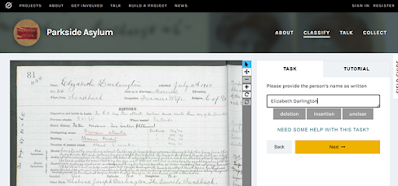

So, you see, the patients of Parkside Lunatic Asylum are not just names on a page, and we’re starting to tell their stories…


Our team of remote volunteers are helping Cheshire Archives index the Parkside case notes. This means the data can easily be searched and analysed by the public and researchers alike.

Want to be a part of it? You can! Email us for more information or join up straight away on the Zooniverse website


Wednesday, 12 October 2022

Cheshire Railways: First Stop - The History

On 22nd August 1890, Richard Jones started work as a Wheelwright at Crewe Engineering Works. His name, date of birth and first day of employment were recorded in one of the works' large registers along with the names of thousands of others who were employed at the works over the years. Over 130 years later that register and piece of history still survives, along with many more railway records available to be viewed at the Record Office in Chester. Over the last couple of years, staff and volunteers have been working hard to catalogue this huge collection to make it fully accessible so the story of Richard Jones and many others like him can be discovered.


The history of the railway in Cheshire starts in the first half of the nineteenth century when Chester attracted the interest of various railway companies. The Chester and Birkenhead and Chester and Crewe Railways were the first to open their respective routes in 1840. This was followed by the construction of the Chester and Holyhead Railways which fully opened in 1850. Many more companies and lines followed. By the time Richard Jones started work several of these companies had merged and many became part of London and North Western Railway. 


In 1923, under the Railways Act 1921, the majority of railway companies were grouped into four main companies. It was the London Midland and Scottish Railway and the Great Western Railway who between them covered the Cheshire area. In 1948, with the nationalisation of the railways, these companies became part of British Railways under the London Midland Region and Western Region.

In 1986 it was decided by British Railways that the important archive records that told the story of history of railway in Britain would be put into the care of County Record Offices. Determining which Record Offices to house them in wasn’t a simple decision. Railways don’t stop at county boundaries. It was decided that they would be deposited in areas appropriate to the British Rail Regions and of the big four companies that came into being following the grouping of 1923. It was also decided that records of companies absorbed before 1921 would be offered to the County Record Office receiving the records of the absorbing company.


Cheshire Record Office received records of the following companies: London and North Western Railway Company, Great Central and North Western Railways Joint Committee, London Midland and Scottish Railway Company - Central Administration, Western Division (North), Western Division (South), London Midland and Scottish and Great Western Railways Joint Committee. It therefore follows that the area covered by these records often exceeds the boundaries of the County of Cheshire.


Over the course of future blogs we will explore two of the main series of records in the collection; employee records and railway plans. These have great research potential for local and family historians in Cheshire and beyond.

Look our for the Second Stop of this blog - Employee Records - coming soon!

These records and more are available to view at Cheshire Record Office in Chester.

Thursday, 29 September 2022

Joel's Record Office Resumé

This blog was written by one of our work experience students, Joel, who spent a week with us over the summer.  Thank you for your work Joel! 

Being at the Record Office for four days, I learnt a lot of different things, from research skills to conservation, as well as what goes on behind the scenes. The tour of the building right at the start of my time there really gave a good insight into the various jobs that happen in the archives, as well as allowing me to enter one of the strong rooms where all the records are kept. I also attended two Microsoft Teams meetings in which the new archive buildings were discussed and upcoming events were planned out. In total I worked on three big projects for the archives.

The first main project I worked on was looking at a scrapbook made by the various mayors of Chester between 1936 to 1979. Continuing where Archie left off, [Archie's Archives Experience blog can be found here] I looked at the entries made between 1947 to 1957. One of the most interesting things I found was that there was a great difference in the entries, including a letter relating to the death of King George VI, menus and table plans for luncheon at the Grosvenor Hotel, Christmas Cards, an invite to a Turner exhibition in the Town Hall, a programme for the presentation of new colours to the Cheshire Regiment and (perhaps most strangely) an invite to the 51st Annual Conference of the Llay Angling Society on Northgate Street. 


The randomness of these events is fascinating to me, and they give a really good indication of the duties undertaken by the mayor of Chester. The work on the scrapbook also gave me the opportunity to have a go at the conservation process and learn how the Record Office preserve their archived materials.

As well as the scrapbook, I was also given the chance to work with the Local Studies team. My work for them involved looking at photographs of Chester and seeing whether or not they were on the online image bank. For those that were not, I was given the task of creating online descriptions and catalogues for them. Some of these included photos of The Church of St. John the Baptist in Guilden Sutton, The Suspension Bridge by the Groves from the 1920’s, The Blue Bell on Northgate Street, King Charles Tower and Children in Fancy Dress from the 1910’s. Seeing how the city has changed over time (and how things have stayed the same) was really interesting to me.


The third and final of my projects was related to the Parkside Asylum, which was located in Macclesfield. The first part of it involved using Zooniverse, which gives you a case note to answer questions on. Though it was tricky to begin with (due to handwriting being difficult to read) I soon got the hang of it. After finishing the Zooniverse tasks, I began to look at Parkside case notes on the online catalogue in order to log the diagnosis of individuals (death, transfer, recovery etc) and to see if the case notes came with a photograph of the individual. Seeing photographs of real patients brought a greater connection between me and the work.

One of the highlights of the four days was the people working and volunteering at the records office, all of whom were passionate about what they do. They were also extremely helpful and happy to answer any questions I had or to talk to me about what they were all doing.

In the future, I wish to be a historical researcher for television, films, and video games, and I believe the skills that I have acquired at the Record Office will help me with this aim.


The documents and photographs Joel worked with are available to view at Cheshire Record Office in Chester. 

Friday, 26 February 2021

A Pub in Parkgate

Would you like to learn more about a local business or building from the comfort of your own home? This blog will take you through some of our online resources using the example of The Boat House, a pub in Parkgate at the end of The Parade.

Our first port of call is the Cheshire Tithe Maps website, available through the Cheshire Archives and Local Studies website. Cheshire Tithe Maps Online allows you to view and search almost 500 tithe maps and compare these alongside other historic mapping. Together with the information recorded in tithe apportionments, they are a unique record of land ownership, occupancy and use in Cheshire 150 years ago. The video clip below talks you through how to use the website for your research. 


The tithe maps website will also allow you to search by person or by plot, if you wanted to see what else was owned by the Mostyn family for example.

To delve deeper into this website please see our previous blog You are here! But who was before? Discover history on your doorstep using Cheshire Tithe Maps Online.

Now let’s see what we can find using the digitised trade directories available to view and search online via our website. Trade directories were the Yellow Pages of their day, produced from the 17th century onwards to meet an increased demand for information on commerce and industry. This video shows you where to find them and how we can use them in our research.


If you are interested in carrying out research into the history of the Johnson family using census records, then you can use your Cheshire library card to access the Ancestry website from your own device at home. Full free access is available at your local library, and at the record office itself. For more information on using Ancestry Library Edition, why not check out our beginner’s guide on our YouTube channel?

Next, using the Neston Borough Building Control Plans Database which is also available on our website, we can search for any information relevant to the Boat House, or the Pengwern Arms, between the years 1868 and 1950.


Lastly, let's visit the Cheshire Image Bank to see if any images of the Boat House have been digitised and available to view online.

The image bank is available through our website. We continually digitise and add new images to this online collection, bringing together pictures of Cheshire’s people, places and events, and we currently have nearly 31,000 images available online.

A search for “Parkgate” in the top right search box brings up 138 results, including several which will be of interest in our research, or you can follow the steps demonstrated in the below video clip.


If you were interested in obtaining a digital copy of an image, please click on “How to Obtain Prints” on the left-hand menu.


You may also like to visit our Flickr page, where we have further material digitised and grouped into albums.

We have now learned more about the history of The Boat House without even leaving our sofa! We have been able to find images of the pub, the names of its publicans and know that it stood on land owned by the Mostyn family. We know alterations were made over the years, that its name changed, and we have found its location on 19th century tithe and ordnance survey maps. Why not explore our online resources yourself, travel back in time and see what you can find out about your local area?! Keep curious!

Wednesday, 6 May 2020

D-lightful lists!

Whilst the Record Office has been closed to the public, staff have still been busy working on projects and finding new ways for people to discover our collections online.  One project has been to improve the online listing of our D collections.

As our regular visitors know, we have paper listings available in the search room which break down our collections into individual items that can be requested by archive users.
However, many collections in these lists aren’t yet fully described on the online catalogue.  

The "D" paper list is one such example. It contains collections ranging from family papers and private correspondence to plans and crime and punishment logs. A quick search of “D” on the catalogue brings up over 21,000 entries!


We have been transcribing the detailed paper lists onto spreadsheets ready to be transferred onto the online catalogue:


Our regular users will be familiar with the catalogue. It has a hierarchical “tree” structure, with each descending level describing smaller and smaller parts of the collection in increasing detail.

It starts with a description giving the researcher an overview of the entire collection, known as “Fonds”:


The next level down, Section (Sub-fonds) divides the fonds into groupings of related records:

The fonds are then subdivided into multiple Series, for example deeds, maps, or in some cases "miscellaneous"!

Finally, the narrowest level is “Item”. This contains information such as the title, date and extent of the item as well as a concise description of what is contained within it.


Putting the D list collections onto the online catalogue in this way serves several important purposes: 

  • It makes detailed information about the collections more widely accessible to members of the public than before. 
  • It allows archive users to find individual items in a collection using the keyword search and assists them in planning their visit and requesting the exact items they wish to look at. 
  • Finally, it enables researchers to zoom in on the parts of a collection they are interested in without losing track of their relationship to the whole.

Whilst transcribing the paper lists we have come across many interesting collections and items. Over a series of blog posts we will be sharing with you some of these archives.

Wednesday, 11 January 2017

Buzzing about books

I spent around a year working on the rare book collection as a volunteer for Cheshire Archives & Local Studies. The aim of the project was to describe all the items in detail so they could be catalogued and made available to anybody who wants to look at them.  The books themselves are varied to say the least.  There are of course a large amount of books that relate to the county of Cheshire, and so many about Chester that if you read them all you could be considered the number one expert! 

Some unusual things have also found their way into the exclusive club that is the rare book collection.  I came across ‘Clog Shop Chronicles’ by John Ackworth, containing stories about life in a fictional Lancashire village and written in 19th century Bolton dialect. My favourite book, however, has to be ‘Buzz a Buzz, or The Bees’ by W. C. Cotton (Vicar of Frodsham), complete with gorgeous illustrations and a humorous story. I admit I forgot my volunteering duties and spent a good thirty minutes reading it!

The Queen Bee                                                        Ref: 014097

It was wonderful to volunteer for such a fantastic project and getting to touch and browse the marvelous array of materials is something that I don’t have the opportunity to do normally.  However it was so much more than looking at pretty pictures, stunning maps and reading interesting facts - it was the chance to acquire new skills.  By giving up four hours of my time every fortnight I had the opportunity to acquire cataloguing skills and experience, which will help me in my future career as a librarian.

I would encourage anyone to browse the local studies catalogue for rare books and see what wonderful gems pop up that might be useful for your research, or to simply while away an afternoon reading.
by Jennifer Davies (CALS Volunteer)


Many thanks to our volunteers Jen Davies, Susan Jones, and Kathy Jones for preparing and listing over 600 items in the Rare Books Collection. The work of our volunteers is invaluable to projects like this and greatly appreciated!

The collection includes published material about Cheshire between the 16th and 20th Centuries, as well as early works by Cheshire authors such as:
             Ranulph Higden  Polycronycon (1527, 3rd edition)
John Speed  The historie of Great Britaine under the conquests of the Romans, Saxons, Danes and Normans (1632, 3rd edition)
John Gerard  The Herball or Generall Historie of Plantes (1633, 2nd edition)
Daniel King  The Vale-Royall of England or the County Palatine of Chester  (1656)
Peter Leycester  Historical antiquities in two books… (1673)
Randle Holme  Academy of armory and blazon (1688)
John Broster  History of the siege of Chester during the Civil Wars in the time of King Charles I (1790)
J. H. Hanshall  History of the County Palatine of Chester. Parts 1-22 (1817-1823)

                                                                                                                       Ref: 227941