Pages

Showing posts with label conservation. Show all posts

Wednesday, 15 March 2023

Behind the Scenes in Conservation: Drawings of the Heraldic Coats of Arms for Queens Park Suspension Bridge


There’s nothing that gets our hearts racing more than being presented with a box of dirty, torn, and tatty plans and being asked to Conserve them! In this instance, a map box containing ten rolled bundles of drawings of the Heraldic Coats of Arms for the ‘new’ Queens Park Suspension Bridge in Chester (ref. ZCR/715/1-10).


What are the drawings of?

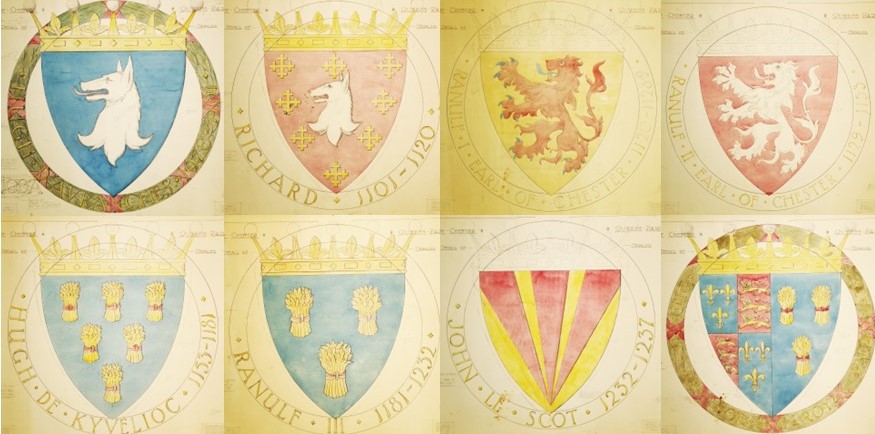
The first suspension bridge from the Groves to the new housing at Queens Park was built in 1852. This first bridge was replaced in 1923 by the Corporation at a cost of £7,000. These drawings are of the heraldic coats of arms of eight Norman Earls of Chester which decorate the arches above the bridge. The drawings are by architects F.A. Roberts and P.H. Lawson of 88 Foregate Street, Chester.

Why conserve these plans when we have so many others that need our care?

Events, activities and exhibitions are being organised to celebrate the one hundred year anniversary of Queens Park suspension bridge during May and June of this year. These plans, along with other related material, have been chosen by our Archivists’ to support this work.


How were the drawings made and what condition are they in?

An outline of the heraldic shield encircled by a wreath was printed onto paper and used as a template for the drawings. The designs have been hand drawn at full scale and coloured. There are eight completed designs with a set of additional pencil drafts of the designs on tracing paper. Media used for the drawings include pencil (for outline and shading), water colour paint and ink.


Once unrolled, we can assess the condition. Much of the damage has been caused historically by poor handling and storage. We find surface dirt, tears, missing areas (lacunae) and areas of paper degradation, especially along the top and bottom edges.

The conservation treatment consists of cleaning, flattening and repairing the plans so that they can be handled safely, without causing further damage, digitised and exhibited.


How do we remove the surface dirt?

The bread and butter of any Paper Conservators’ work is cleaning, and lots of it! It looks simple, but it takes years of experience (and sore fingers) to develop techniques that work effectively and that don’t cause damage to the original material.


These drawings were especially challenging to clean as the artist has used pencil for outlining and shading. We need to remove the general surface dirt whilst being careful not to remove the actual pencil. Using thin wedges of vinyl eraser we are able to carefully work around the pencil and remove the surface dirt.


How do we get them flat?

Next, we need to ‘flatten’ the rolled plans so that we can repair them. The drawings are placed in a large ‘damp-pack’ to introduce water vapour into the paper in a very controlled and gentle way. This in turn will ‘relax’ the individual paper fibres and make the paper more pliable. Once damp, they are placed under thick sheets of blotting paper and covered with sheets of Perspex, then weighted down to flatten them.


The humidification chamber (damp pack) we use is made up of a layer of clear polyester, a wet layer of capillary matting and a layer of Sympatex (a breathable waterproof membrane) on the top. The same three layers are then placed over that in reverse order, and the document placed in the middle to receive the water vapour and ‘relax’!

How do we mend the tears and fill in the lacunae?

Most of the drawings have some minor tears that need repairing, but a few of them, including ZCR/715/4 for Ranulf I, Earl of Chester, 1101–1120, have suffered more substantial damage. This long horizontal tear was likely to have been caused by someone attempting to unroll the plan. This sort of damage is commonly seen in large paper documents such as maps and plans that have been stored rolled.


The process begins with cooking some fresh wheat starch paste to use as an adhesive for the paper repairs, which we prepare in the Conservation studio. After cooking and cooling the paste, we sieve it three times to create a super smooth and sticky, but fully reversible paste.


It can be difficult realigning long tears so that the image area joins up accurately, even when the paper appears perfectly flat. Paper can be affected by levels of high humidity, so any exposure in the past, and during the humidification process can alter the placement of paper fibres making it difficult and sometimes impossible to join them perfectly.


We apply paste using a small brush to the edges of the tear, working on the image side (the recto) to check on alignment, and work along a small section at a time. This is sometimes called ‘Chasing the tear’! When the edges are joined, we turn the drawings over and adhere a section of Japanese repair paper to support this area from the back (the verso).

How do we consolidate these repairs?

Adding a support layer on the verso is essential when repairing tears as it adds strength to weak and degraded areas and allows the repaired paper to flex normally without any further damage being caused. We select a Japanese paper (Kozo Shi) of lighter weight but similar colour to the original document. The repaired areas need to be clearly visible but also be sympathetic to the original material.


Handmade Japanese papers are ideal as they have long fibres and keep their strength when wetted out. We use a mattress needle to score the repair paper to the shape and size we need, wet with a water brush and tear the support out. The resulting long fibred edges make for a strong and sympathetic support layer once pasted down.


What about the lacunae?

We add repair paper to infill and strengthen missing areas. This also includes replacing original material that has become detached. Using a heavier Japanese paper (Bunkoshi) that equals or is a bit lighter than the original and working on a light (illuminated) table; we score the exact area missing with a mattress needle.


We then soften the paper fibres using a Rotring pen filled with water and tear out the infill, add paste to the reverse and adhere in place to fill in the missing area. The repair to this plan is finally complete after the repairs have dried and trimmed with a sharp scalpel. As a final protective measure they are placed into transparent polyester sleeves.


We still have a bit of work to do until they are all conserved and accessible, but they will be ready in plenty of time for the upcoming events and activities. We wait, in eager anticipation, for the next box of tatty items to appear in our conservation studio!


To hear about future events subscribe to our newsletter at www.cheshirearchives.org.uk 


Wednesday, 14 December 2022

The Journey of a Local Studies Donation

Earlier this year we received a fantastic collection of photographs of Crewe in the 1890s, kindly donated to us by one of our volunteers, Susan. We thought this blog would be a great opportunity to showcase the collection, as well as thank Susan for her donation, and to highlight all the staff and volunteers involved with the donation and cataloguing process.

First a bit more about the photographs, and why Susan decided to donate it to us. Richard Baxter Booth was a Crewe dental surgeon, and this photograph collection was compiled by him in the 1890s.

Susan says “I found the album for sale on eBay, and Baxter Booth’s granddaughter has been shown the images; her father, Walter (Baxter Booth’s son) was also a dentist and keen photographer. This is album number two; number one is lost unfortunately. Baxter Booth’s dental surgery was in the row of buildings on Crewe Market Square that was replaced by Marks & Spencer, it was the last one on the left on the corner of what is now Queensway. After his marriage he lived at Oaklands in Haslington; he was an active member of the Crewe Cycling Club, the Crewe Alexandra Cricket Club, and Crewe Golf Club. All the images are 'Kodak no. 2' prints”. Baxter Booth had previously lived at Fields Farm, Haslington, rented from the Crewe Estate.

Once we had received the collection and Susan had completed our donation form, the photographs were passed to one of our conservators, Angela.

Angela says, “The original binding had completely failed, so the loose album pages were cleaned with a plastic eraser and placed into custom made polyester sleeves and then put into an acid free folder. These preservation measures will protect the album pages and photographs when they are being handled and also protect them from dust and any fluctuating environmental conditions they may encounter.”


Next, the collection was looked at in more detail by our Local Studies Librarian, Heather. She tells us, “The collection was added to CALM, our collections management system, so that it could be found by staff, researchers, and members of the public online. CALM generated a unique 6-digit reference code for the item, 231804. It was also given a class number of VPH96, which helps to locate the item in our visual collection. Here I am storing the collection away in one of our strongrooms, in an archive box, and where temperature and humidity levels are monitored.”


Another of our volunteers, Helen, was tasked with looking at each individual photograph and indexing it onto a spreadsheet.

Helen says “I am currently a volunteer working on the photographic archives at Duke Street, finding out any extra information about the subjects of the photographs and then entering all the information onto a spreadsheet. These spreadsheets, such as the one I worked on for the Richard Baxter Booth collection, will allow the public to access the information online, widening public access to the contents of the archives.”

This should help any researcher interested in the collection to find the exact photograph most useful to them. Helped by Susan’s knowledge of the area at the time, and of the photographer Richard Baxter Booth, this task is now complete. Please speak to a member of staff if viewing this spreadsheet would be helpful to your research.


We have not yet digitised the whole collection, but a selection of our favourites are featured below. The album contains scenes and events in Crewe, such as the Crewe Flower Show and a football match, as well as buildings (the Mechanics Institute, Town Hall, pubs, churches), and also features the residences of other doctors/medical men in Crewe such as Dr Atkinson’s residence “Mirion House” on Earle Street. The photographer also used his friends, family, and pets as his subjects.


The next step will be to have more of this fantastic album digitised and available on the Cheshire Image Bank website. 

If this blog has inspired you to consider donating an item or collection to us, then we would love to hear from you. Please do contact us first, as we can then check that the item fits with our collection policy and is not something we already have. You can get in touch with us via our website, telephone 01244 972574 or email recordoffice@cheshiresharedservices.gov.uk.  

All of these photographs and more are available to view at Cheshire Record Office in Chester.

Thursday, 29 September 2022

Joel's Record Office Resumé

This blog was written by one of our work experience students, Joel, who spent a week with us over the summer.  Thank you for your work Joel! 

Being at the Record Office for four days, I learnt a lot of different things, from research skills to conservation, as well as what goes on behind the scenes. The tour of the building right at the start of my time there really gave a good insight into the various jobs that happen in the archives, as well as allowing me to enter one of the strong rooms where all the records are kept. I also attended two Microsoft Teams meetings in which the new archive buildings were discussed and upcoming events were planned out. In total I worked on three big projects for the archives.

The first main project I worked on was looking at a scrapbook made by the various mayors of Chester between 1936 to 1979. Continuing where Archie left off, [Archie's Archives Experience blog can be found here] I looked at the entries made between 1947 to 1957. One of the most interesting things I found was that there was a great difference in the entries, including a letter relating to the death of King George VI, menus and table plans for luncheon at the Grosvenor Hotel, Christmas Cards, an invite to a Turner exhibition in the Town Hall, a programme for the presentation of new colours to the Cheshire Regiment and (perhaps most strangely) an invite to the 51st Annual Conference of the Llay Angling Society on Northgate Street. 


The randomness of these events is fascinating to me, and they give a really good indication of the duties undertaken by the mayor of Chester. The work on the scrapbook also gave me the opportunity to have a go at the conservation process and learn how the Record Office preserve their archived materials.

As well as the scrapbook, I was also given the chance to work with the Local Studies team. My work for them involved looking at photographs of Chester and seeing whether or not they were on the online image bank. For those that were not, I was given the task of creating online descriptions and catalogues for them. Some of these included photos of The Church of St. John the Baptist in Guilden Sutton, The Suspension Bridge by the Groves from the 1920’s, The Blue Bell on Northgate Street, King Charles Tower and Children in Fancy Dress from the 1910’s. Seeing how the city has changed over time (and how things have stayed the same) was really interesting to me.


The third and final of my projects was related to the Parkside Asylum, which was located in Macclesfield. The first part of it involved using Zooniverse, which gives you a case note to answer questions on. Though it was tricky to begin with (due to handwriting being difficult to read) I soon got the hang of it. After finishing the Zooniverse tasks, I began to look at Parkside case notes on the online catalogue in order to log the diagnosis of individuals (death, transfer, recovery etc) and to see if the case notes came with a photograph of the individual. Seeing photographs of real patients brought a greater connection between me and the work.

One of the highlights of the four days was the people working and volunteering at the records office, all of whom were passionate about what they do. They were also extremely helpful and happy to answer any questions I had or to talk to me about what they were all doing.

In the future, I wish to be a historical researcher for television, films, and video games, and I believe the skills that I have acquired at the Record Office will help me with this aim.


The documents and photographs Joel worked with are available to view at Cheshire Record Office in Chester. 

Wednesday, 6 July 2022

Archie's Archives Experience!

This blog post was written by one of our work experience students, Archie, who spent a week with us in June. Thanks for all of your work Archie!

During my work experience at Cheshire Record Office, I discovered plenty of new and genuinely interesting things I didn’t know existed.

On my first day I was able to sit in on a staff meeting and learn about how Cheshire Archives and Local Studies were partnering with local communities, finding them photos, documents and anything else they wanted so that they could hold their own events about themselves. 

I spent some time reading, cleaning and documenting the Mayors Scrapbook from 1936-1979. Not only did I learn about how to properly take care of precious archives and how to keep them in the best condition so other people can view them later on, but I was able to read these small snippets of history, whether they were simple invites to tea from the Mayor and Mayoress in 1941, or a New Year’s card with a quote hoping for peace and an end to the war. It felt like I was there, experiencing it myself. Even just small things told a story, like a letter from the Royal household explaining that the Mayor and his wife wouldn’t be able to get a congratulations letter for their Golden Jubilee for their marriage, which was received on December 25th.


I also helped to check photographs and see if they were on the Cheshire Image Bank or not. If they weren't on the site then I indexed them onto a spreadsheet, and did some research around the people, places and events photographed. Looking at a photograph of a local blacksmith taken in the 19th century, it can only make you wonder who those people were, what they’d experienced themselves and what they did after the photo was taken. These small bits of history, which in the greater scale of things didn’t mean much, represented normal people who lived, grew up and died well before I was born, like a window into the past.


I also used Zooniverse, a website where you can transcribe articles and documents from hundreds of subjects. I was moving information over from patient records from the Parkside Asylum. Stuff like this can be used for studies relating to anything, and could help countless people in research. (You can get involved in the Parkside Asylum project here!)

The people who work at the Record Office are genuinely some of the most dedicated people I’ve met, you can see that they have a huge interest in what they do, and that they want others to be able to know about what they do and use the records they hold.


Monday, 13 July 2020

Swapping Conservation Tools for a Mouse: My Conservation Lockdown Story

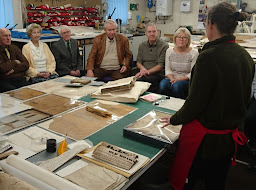
                In the archive conservation studio

I started writing this blog back in May, before my ancient but trusted laptop decided it didn’t like working from home, preferring to support me with online shopping, researching upcoming hill walks and most importantly safeguarding my precious digital photographs.

It just couldn’t cope with the world of digital Archives; handling metadata, Zooming (albeit with sound only!), Trello and Zooniverse. After a fortnight of trying to revive it, it gave up and took my work with it!

Six weeks later and armed with an updated and fully functioning PC, I’ve resumed my blog and have been reflecting on what has been an extraordinary few months for all of us.


                                              “Computer says no”

The Announcement

I felt a bit like my old laptop on the evening of 23rd March after the Prime Minister advised us to all “Stay at Home”. We had set up a work What’s App group in preparation and received a message instructing us not to come into work again until further notice. We needed to work from home.

“Can I pop in and get some work?” I asked desperately. I needed the security of at least having my conservation tools close by, we had no idea how long this would last. The reply was understandably, a resounding “No”. This was not going to be an easy adjustment for me.

Conservators


We are a bit of an anomaly in the Archives, us Conservators (myself and my colleague and friend Rachel). When there is a power outage and everyone else is running around desperately trying to get back onto their PC’s, we remain calm and carry on. Our work is predominantly hands on and there are always documents in the archive to care for.          

 
Rachel giving a talk in our studio    

Rachel had decided to set up her own makeshift studio in her new, but mostly undecorated house and would have access to the building to collect work and to monitor the environment in our strong rooms.

(You can read Rachel's fab blog here!)


But what was I going to do?

I had spent the odd day working from home, usually the result of a train strike. Living in Shrewsbury, and the archive being in Chester this means I can’t get into work. It’s a good opportunity to catch up with paperwork and plan events and training sessions. But this was going to be for much longer than a single day.

I was definitely at a disadvantage; I don’t drive, I live in a small flat, own a 13 year old laptop, my only broadband access is via an old limited data mobile device and my PC skills are definitely out of date.

But I didn’t have much choice. I would have to get with the programme and go digital!


Desktop working

Our What’s App group proved to be a godsend, especially at the start, as we were all having difficulties accessing our work accounts from home. As events had moved so fast, our IT help desk were overwhelmed with requests so it took time for all of our issues to be resolved, but eventually they were. And we all settled into what is now known as ‘the new norm’.


Initial steps

My introduction to home working came in the guise of ‘Trello’ our virtual staff information board. This would become the hub of our work activity, a place for us to keep track of and to reply to public enquiries, record project activity and generally act as a digital platform to exchange ideas and give feedback.

Now, I just had to jump in and assign myself a job.


Cheshire Image Bank

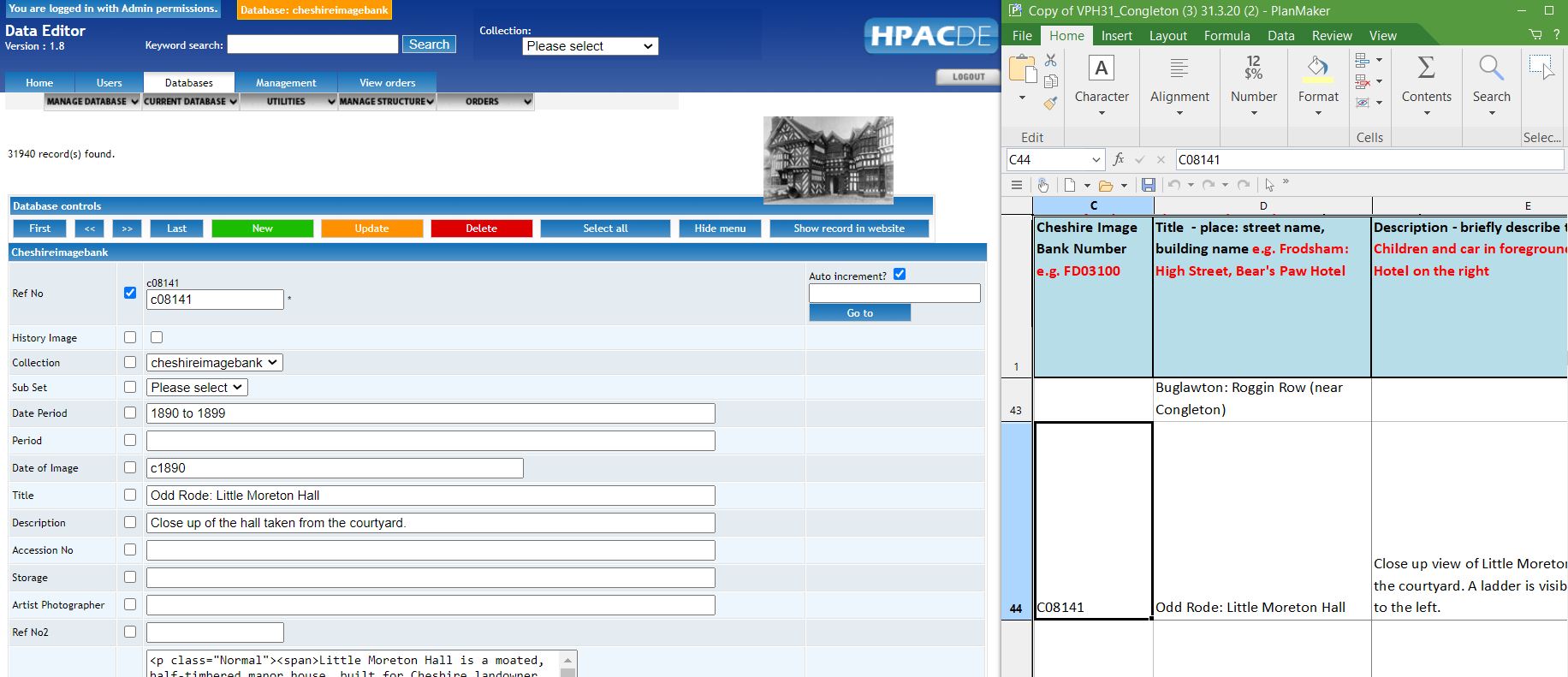
Katie, our Local Studies Adviser was looking for staff to help with their Image Bank Metadata Project; which involved adding and editing information collated by our volunteers onto the Cheshire Image Bank.

Who doesn’t love working with old photographs?

                                                             "What’s Zoom?”

To get us started, Katie ran a training session via Zoom. I had never even heard of Zoom, but it was easy and fun to use. I was put to work on a series of images of the Wolverhampton Corrugated Iron Works in Ellesmere Port from the early 1900s and later on some beautiful images of Congleton from c1890 through to the 1960s.


Little Moreton Hall c.1890

It was a great place to start.


Zooniverse - Parkside Asylum Project

Staff were also needed to test run an exciting new project using digitised copies of casebooks from the old County Lunatic Asylum in Macclesfield, also known as Parkside Asylum. Using the ‘people-powered research platform’ Zooniverse, volunteers will be able to work remotely from anywhere in the world to help make this vast resource of information more accessible for researchers.

                                                                “What’s Zooniverse?”

I found these records absolutely fascinating to work with and as a digital project newbie felt that I was able to contribute some really useful feedback. 


                                                            Working from home!

Online learning


Alongside getting involved in various digital projects, I participated in some online courses and webinars, which we were all encouraged to do. Once again, this was new to me and I was amazed by just how much was available and free to access.

I really enjoyed the Institute of Conservation (ICON) series of webinars: Together at home. These really made me feel connected to the conservation community, not just in the UK but internationally. Rita Udino’s talk from Barcelona on the ‘Conservation of oiled or impregnated tracing paper’ introduced me to a new treatment technique that I will definitely experiment with when I get back to the studio.

Herre de Vries webinar from Amsterdam on ‘The identification of ‘Shark Skin’ on bookbindings as Leather or Parchment’ will have me searching through our volumes to see if I can find any ‘Shagreen’ bindings in our collection.

I also participated in a couple of longer courses on Future Learn. The first was ‘The History of the Book’, a 4 week course run by Trinity College Dublin took me all the way from the origins of printing in the 1540s through to how the storming of the Bastille in 1789 was chronicled. 


 In light of anti-racist protests taking place here and across the world I decided to take Purdue University’s ‘Understanding Diversity and Inclusion’ course. I have just completed Week 2 of 3 and so far have found it very informative and thought provoking. There is a very strong element of reflection and participation in this course and I must say that sharing thoughts and feelings with an international group of students from such diverse backgrounds has been the most rewarding and powerful aspect of it.

Time for reflection


The Quarry Park in Shrewsbury

I think many of us have had more time to reflect during this lockdown and have perhaps reordered our priorities. If someone had asked me 3 months ago what I would miss doing most during this period, hill walking would have been at the very top of my list, closely followed by my regular Sunday visits to ‘Ginger & Co Coffee’ for tea and toast!

To be honest, I’ve not really missed either. I have been constantly amazed by just how much there has been to discover and enjoy on my own doorstep. My fear of falling apart, physically and mentally without hillwalking has proved unfounded. My love of walking and nature has been sustained by my daily perambulation along the River Severn and my fitness by a series of workouts for the over 50s and an old set of dumbbells!

A few of my regular companions


13 weeks into Lock-down

We have all come a long way since the start of the lock down back in March and have had to be flexible and adapt to new ways of working. I really don’t think any of us envisaged it going on for quite so long. Some hundred and odd days later and I have a fancy new PC, fibre broadband and quite a lot of new skills and knowledge in my toolkit.