Pages

Showing posts with label Cheshire Image Bank. Show all posts

Wednesday, 6 July 2022

Archie's Archives Experience!

This blog post was written by one of our work experience students, Archie, who spent a week with us in June. Thanks for all of your work Archie!

During my work experience at Cheshire Record Office, I discovered plenty of new and genuinely interesting things I didn’t know existed.

On my first day I was able to sit in on a staff meeting and learn about how Cheshire Archives and Local Studies were partnering with local communities, finding them photos, documents and anything else they wanted so that they could hold their own events about themselves. 

I spent some time reading, cleaning and documenting the Mayors Scrapbook from 1936-1979. Not only did I learn about how to properly take care of precious archives and how to keep them in the best condition so other people can view them later on, but I was able to read these small snippets of history, whether they were simple invites to tea from the Mayor and Mayoress in 1941, or a New Year’s card with a quote hoping for peace and an end to the war. It felt like I was there, experiencing it myself. Even just small things told a story, like a letter from the Royal household explaining that the Mayor and his wife wouldn’t be able to get a congratulations letter for their Golden Jubilee for their marriage, which was received on December 25th.


I also helped to check photographs and see if they were on the Cheshire Image Bank or not. If they weren't on the site then I indexed them onto a spreadsheet, and did some research around the people, places and events photographed. Looking at a photograph of a local blacksmith taken in the 19th century, it can only make you wonder who those people were, what they’d experienced themselves and what they did after the photo was taken. These small bits of history, which in the greater scale of things didn’t mean much, represented normal people who lived, grew up and died well before I was born, like a window into the past.


I also used Zooniverse, a website where you can transcribe articles and documents from hundreds of subjects. I was moving information over from patient records from the Parkside Asylum. Stuff like this can be used for studies relating to anything, and could help countless people in research. (You can get involved in the Parkside Asylum project here!)

The people who work at the Record Office are genuinely some of the most dedicated people I’ve met, you can see that they have a huge interest in what they do, and that they want others to be able to know about what they do and use the records they hold.


Monday, 24 January 2022

18 Months of Mystery Image Mondays

Perhaps you are familiar with our regular twitter campaign #MysteryImageMonday? Mystery Image Mondays started life 18 months ago, to crowd-source information about images held at Cheshire Archives and Local Studies puzzling our Local Studies Librarian. Over 200 images later, Mystery Image Mondays are drawing to a close as a regular feature (they’ll still pop up from time to time when we have more images we need help with!), so what better time to review those mysteries you’ve helped us solve, and those which still elude us…? 

The first Mystery Image Monday went live on Monday 29th June 2020. Two images were used: c09050 and c10383. The tweet generated much interest, and both images were successfully identified; The Crewe Arms in Spurstow, and the Verdin Baths at Northwich respectively. 


At the time of writing (4th January 2022), 211 mystery images have now been posted on twitter for all those budding detectives out there. Of these 129 went on to be successfully identified. Many include Cheshire places and buildings not previously covered by the Cheshire Image Bank (CIB) collection and are now available to view online, such as Gibbet Mill at Great Saughall (c13383) and Hale Cemetery (c08809). 


Other resolved images include a salt arch in Northwich (c06765), the Mainwairing Arms in Over Peover (c11936), St. Luke’s Church Winnington (c06534), and Benger’s Foods Limited Head Office in Holmes Chapel (c12939). The art deco frontage of Benger’s Food Ltd. is shown below, located on London Road. Benger's Foods, originally Mottershead and Company of Manchester, occupied the purpose-built premises in Holmes Chapel from 1938, designed by J.H Andrews and Butterworth of Manchester. Benger's manufactured a food supplement that at one time was regarded as essential in the care of young children and expectant mothers. In 1947 Benger's Food was bought out by Fisons Limited, who based their pharmaceutical division in Holmes Chapel, and then later Sanofi Aventis. The building was demolished in August 2015. Also pictured is the Mainwairing Arms, Stocks Lane, Over Peover, c1911, with a sign just visible listing John Street as licensee. He is listed as such in the 1911 census, aged 52. It is now called the Whipping Stocks Inn. At first, we thought “John Street” might be the name of the road, but thanks to the detective work of a twitter follower we now know the true location! 


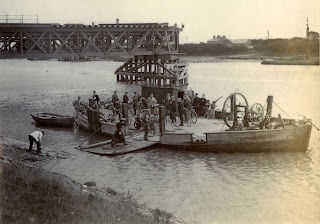
One of our favourite resolved images has to be an image of the River Dee at Queensferry, taken from the Cheshire side of the river in March 1897 (c13297). Thanks to members of the Anfield Bicycle Club who contacted us, we now know the location of this image, with the telescopic Victoria Bridge pictured, partially retracted, with the Anfield Bicycle Club on the ferry. The Anfield Bicycle Club spent Easter 1897 in Wales, riding there and back via Wirral and Liverpool. 


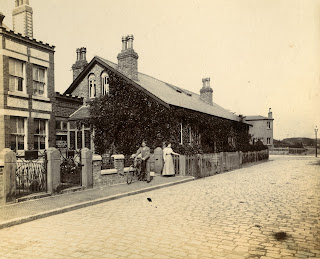
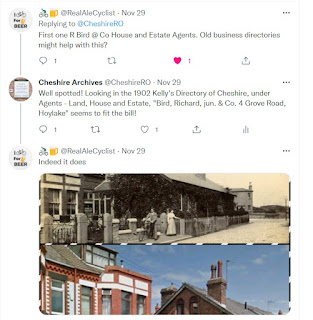
Recently we were able to identify c13331 as being Grove Road, Hoylake at the turn of the 20th century, thanks to a keen-eyed twitter follower. @RealAleCyclist spotted a small sign on one of the buildings and pointed out “First one R Bird @ Co House and Estate Agents. Old business directories might help with this?” Our Local Studies Librarian used our online trade directories and in the 1902 Kelly's Directory of Cheshire, under Agents - Land, House and Estate, found "Bird, Richard, jun. & Co. 4 Grove Road, Hoylake", which seemed to fit the bill nicely! @RealAleCyclist agreed and included a screenshot from Google Maps showing the right location. Another mystery solved! 


We do however have numerous images which remain a mystery. These include a group photograph outside an office (c06768) and the ruins of a country house or castle (c11948). You can peruse more online at our Flickr album “Mystery Images Unresolved” and on the Mystery Images Popular Collection on the Cheshire Image Bank. If you identify anything then please do let us know via RecordOffice@cheshiresharedservices.gov.uk


Lastly, we continue to digitise more of our visual collection, which will no doubt unearth more mystery images. So, follow us @CheshireRO on twitter and @cheshire_archives on Instagram, test your detective skills and knowledge of the Cheshire area, and take part in future #MysteryImageMondays!

Monday, 2 August 2021

A student's virtual experience at Cheshire Archives!

We always enjoy playing host to work experience students during the summer holidays, and last year we were disappointed not to be able to offer any placements as a result of the pandemic. This year,  equipped with a lot more experience of remote working, we were able to offer our first ever online work experience placements!  Read on to hear what student Noah thought of his placement...

As someone who loves history, my work experience with the Cheshire Archives has been a great experience. I have had a chance to contribute to the archives which has been quite rewarding and it has also left me with a few questions and ideas that I can now go away and consider.

My week started with indexing Parkside Asylum cases and noting down any interesting cases that I came across. The main challenge here was deciphering the handwriting. For each new page there was different handwriting and so each case took some time to figure out what the letters were in the different scripts. On top of this, some of the spelling was questionable at times. However, after some time I did get used to this new style of writing and became much more efficient at understanding what was being said. Many of the cases were sad to read because it was clear that the majority of the people had mental health problems and were by no means “lunatics”. Some had depression, or as they termed it “melancholia”, others had delusions about religion amongst other things.

One of the cases that stood out to me was that of 19-year-old Thomas James Lloyd. His “attack” as they called it had been going on for “several years” which would make him younger than me when he began to experience problems. I think that the text speaks for itself:

"Had in his hand a small horn which he said was sanctified. Continually blowing it (sounding the Bugle as he termed it) and he was struggling to win all nations for Queen Victoria's sake. Had a plan for poisoning the Devil. That he had sanctified the school his bed and bedclothes. That the Lord had told him by trances and wisdom what to do. Moses Samuel Brickhill, one of the Labor Masters who informed me that he would suddenly leave his work move a few paces, tear the grass and lift it high: implacing a blessing upon it. That he put a chamber utensil on his head and poured its contents down his back."

Photograph of Thomas James Lloyd

Extract of Thomas James Lloyd's case notes, reference NHM 8/2/6/124a-e.
View the full case notes here.


As with many of the cases that I saw, though with this one in particular, I wondered what caused this to happened and what their life was like after being in the asylum. Whilst they are given names, I could not necessarily get an understanding of what they were like as a person. This is perhaps therefore a limitation of records such as these. As with a lot of history, maybe these questions that I have about
who that person was may go unanswered.

Chester: River Dee, Queens Park Bridge. Ken Evans. Copyright 2020 Chester Chronicle. 

The second project that I did was sorting out photographs taken by Ken Evans, a photographer for the Chester Chronicle. The photographs covered a long time period, from the late 1940s to the 1990s. My first job was to date as best we could the photograph. I went about this by looking at the clothes, the age of people if they were known and looking at the whole image with a holistic approach to get an idea which decade it was from. This was made easier if on the back of the photograph (this was accessible by the photograph’s accession number) there was further information. The accession number also helped with my next job which was to title the image. For this I had to find out where it was and who was in the photograph if anyone. Sometimes this was virtually impossible because the background was some unidentifiable building or trees. However, this was a very fun part of this project. If there were some unique buildings, say a church, I could Google “churches in x” and various images would come up and I would be able to cross-reference the photograph with other photographs. Moreover, I could go onto Google Maps and find out what orientation the photograph was in which led me to walk about Chester on Google street view.


Chester: River Dee, 1953. Ken Evans. Copyright 2020 Chester Chronicle.

The next job was to write a brief description of the photograph. This could be one line or several, depending on how much was going on in the photograph. However, a rough guide to this was to describe people, places and events. After this I needed to find out some further information on what was going on in the photograph. This needed to be generally related to Cheshire and fortunately if it was a famous person, for example Prince Charles, I could look up other photographs of them in the Cheshire Image Bank and look at what other people wrote about them. My final two tasks were to note if the photograph could be put in a popular collection (I had a few royal visitors) and to write down any keywords that related to the photograph. This would make it easier for people to find a picture on a particular topic, say the Groves.


Chester: The Cross and Eastgate Street. Ken Evans 1951. Copyright 2020 Chester Chronicle. 

With that, that was my final task. Some parts of the work experience were easier than others, though I had to always be conscientious knowing that whatever I wrote had to be accurate in order to be able to be useful.

Some questions that this experience has left me are:

  • What are the limitations and positive attributes of different types of documents?
  • How have the terms used to describe mental health problems changed over time?
  • How can we work with the fact that we do not have access to all information?

I would like to finish by thanking all those working at the Cheshire Archives who put this together despite the coronavirus!


Thank you Noah for all of your hard work during your placement!

Friday, 22 May 2020

Every Picture Tells A Story

Over a series of blog posts we will be sharing with you what we have been doing whilst working from home, and giving you an insight into some of the interesting collections and items we have come across whilst the Record Office has been closed.

When Cheshire Record Office is open, our Local Studies department works with volunteers to sort, catalogue and improve storage of the Local Studies Visual Collection, and make it available to the public at our search room and online. Since we have been closed, a team of Archives Assistants and a Conservator have continued this work by using an online data editing system at home to add photographs and information to the Cheshire Image Bank.

The Image Bank is a collection of over 30,000 digital images created from original material - photographs, postcards, print slides and negatives – and can be viewed and searched online at CheshireImageBank.org.uk. It also offers over twenty Popular Collections to browse, including the First and Second World Wars, Royal Visitors, Fashion and The Salt Industry. Image Bank content covers anywhere that lies or once lay within the Cheshire county boundary.

This lockdown project has involved writing a brief description of each of the photos assigned to us on the data editor; doing online research to provide further information about each image; adding key words to ensure they will appear in an online search; and providing standardised details of the location, title and date of the images. We have also added extra information to a small number of photos that already appeared on the Image Bank. The Local Studies staff have been adding more key word options to make it easier for people to search the site, and also had the task of moderating our work to ensure accuracy and consistency.

So far, 500 extra images have been added to the Image Bank as a result of this work. A wide range of themes has been covered: industrial, with hundreds of images from George L. Scott & Co and Wolverhampton Corrugated Iron Works, both based in Ellesmere Port; and military, such as a Cheshire Royal Engineers photo album from the 1890s. There is an early album of buildings, people and landscapes by amateur photographer George Davies, who lived in Alderley and took numerous photographs of the surrounding area, and some photographs are of the Duke of Westminster’s Eaton estate; there is a large collection of images from the village of Disley; and some from Macclesfield cover the celebrations of Queen Victoria’s 1887 Golden Jubilee. There are others showing places of interest across Cheshire.

Some of the photographs that have captured our attention include a busy street scene at Chester Cross (c13284) where the buildings are still recognisable but the horse-drawn trams are long gone.

Another is a murder stone from the 1820s (c13248). These were historic markers erected at the site of famous murders to commemorate the victim or warn of the consequences of committing such acts. And this photograph of Disley Golf Club (c08283) was already on the Image Bank but has had further information added - it was taken at the official opening of the club in 1889 and there were 47 pro golfers present when it was taken. 

 
On the industrial side, c13186 shows a group of steelworkers moving a stack of flat iron sheeting with an overhead crane system at an ironworks in the 1920s, and c13164 is of a woman using machinery at an engineering company in the 1950s. Additional information provided on the Image Bank tells us she was using a ‘stator notching machine’, and that George L. Scott Ltd. was an electrical steel stampers company with offices and warehouses in Ellesmere Port. The business later became a general engineering company.

Work on the next two images is almost complete, and they are due to be put online shortly. The first shows the Cheshire Yeomanry in the 1890s, assembling for annual exercises at the Roodee Racecourse in Chester (c13348), and the second is a street parade from around 1895 showing massed uniformed ranks of the Second Cheshire Royal Engineers, who were also known as the Crewe Railway Volunteers (c13213).


In the very early days of photography, equipment was cumbersome and photographers were usually limited to studio settings, but with the invention of film in the 1880s it became easier and we started to see the rise of amateur photographers like George Davies of Alderley. We have many of his photographs taken from the 1870s to 1890s, including buildings like churches, mills, country houses and pubs; landscapes around the eastern border of Cheshire; and agricultural scenes from ploughing to harvest work. A small selection is shown below.


This project has posed a few challenges along the way. As well as an unexpected technical issue early on, it has sometimes been difficult to identify the images - so some will have to remain hidden from view until we can do some more research with the originals at the Record Office. There are both opportunities and challenges with the Visual Collection more widely: the collection is constantly being added to with new donations, and there is a large number of uncatalogued photographs in storage yet to be looked at. Potentially, there are thousands more images that could be added to the Image Bank in the future, but it is also a time-consuming and costly undertaking.

Nonetheless, this lockdown work has enabled us to add more images to our Popular Collections section on the Cheshire Image Bank, particularly those on the First World War, Fashion, Eaton Hall and Little Moreton Hall. Some of the newly digitised images will be showcased in the All New Images section, as well as on social media.

The next steps of the project will be to identify entries already on the Image Bank that may require further information (then researching and adding it) and we also have data from more volunteers’ spreadsheets to match to the relevant images online. There is plenty to keep us busy!

Tuesday, 28 January 2020

Game, set and match!

With the Australian Open Tennis Championships in full swing and Six Nations Rugby about to begin, we’ve been inspired to look at sport-related items at Cheshire Archives and Local Studies.  We are fortunate to hold archive material from sports clubs across the county, featuring items from athletics to yachting (we don’t have any sports beginning with Z!)  This includes photographs of people taking part in everything from tennis and rugby to early examples of gymnastics and even roller-hockey.  In addition, Cheshire Image Bank is a collection of over 30,000 digital images of Cheshire people, places and events from anywhere that lies, or once lay, within the county boundary.  It can be viewed and searched online at www.cheshireimagebank.org.uk and the web site is a treasure trove for images of sport.

  As tennis and rugby have prompted us to look through our sporting records, here are some Cheshire Image Bank photographs of each of those sports.  They show members of the Alexandrea Park Tennis Club in Hoole, Chester, during the 1930s (reference: P1620) and an early picture of Runcorn Rugby Football Club in the 1890s (ref: C02914).

Football is recognised as this country’s most popular sport, and many people remember photos of their school football team - this one from the Image Bank will surely prompt some memories.  It is of Blacon Junior School football team in Chester, from 1954 (ref: CH 9243).  There are many different football teams featured on the Image Bank and in our archives, but this one comes from Birkenhead Police, taken in 1923 (ref: D 7271).


We hold a much earlier record relating to football as well.  This document (ref: EDC 5/1608/70) is from Consistory Court papers of 1608, and concerns a libel case brought against a John Loram and a John Howell for playing at football in the churchyard at Dodleston on Easter Monday with brawling and fighting.


For those who don’t read seventeenth century English, it is just possible to make out the words football, Dodleston, quarrel and brawl! 


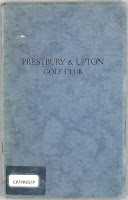
It could be argued that cricket is the UK’s national sport.  As well as items such as team photographs and fixture lists, our cricket-related collections include these rules from Shrigley Vale Cricket Club in 1872 (ref: D 6265/37). We like rule number five which declares “that no fielder be allowed to lie down, or smoke during a game” as well as rule 10, “that any member swearing, using coarse language, or making himself disagreeable by his conduct on the field, shall be fined sixpence”.  Similar rules and etiquette can be found in some of our golfing records: this handbook from Prestbury and Upton Golf Club in the 1950s recommends the strict observance of a list of “unwritten laws” which “marks the finished Golfer and adds to the pleasure of one and all on the Links” (ref: 229413).


Athletics seems to have been popular for many years.  This 1899 programme from the Alexandra Athletics Club of Crewe celebrates their twenty-third annual athletic festival, and shows that the club was founded in 1866 (ref: 221494). We have various photographs of athletes: this early 20th century one is of Middlewich Athletics team - the number of medals some of the members are wearing suggests they were quite successful! (ref: D 7164) 

 
Other team photographs include these from a scrapbook of the Royal Chester Rowing Club (ZCR 419/3).  The one on the left is the club's 2nd VIII taking part in the North of England Head of the River Race in March 1957, on the River Dee.  We also like the one on the right, an old car loaded with a canoe captioned 'Henley 1937'.  Members of the rowing club certainly took part in the Henley Regatta - but whether that car was driven there from Chester, we do not know!
Amongst the records of the Knutsford Gas and Waterworks Company there is archive material related to horse racing at Knutsford.  This race card, giving details of the horses in each race and the jockey colours, is from 1854 (ref: D 4222/25) - and the photograph featuring the racecourse grandstand dates from the 1870s (ref: D 4222/26).
We also have photographs of some more unusual sports.  This is the Neston Quoits Team, photographed in 1895 (ref: D 6278/1).  And the impressive displays on the right (ref: CH1720) are by the Gymnastic Group of the Cheshire Regiment, photographed in 1902.
Along with many early photographs of men’s sports, we were pleased to find some of women’s teams as well.  A favourite is this one taken in 1915, of Widnes Ladies' Swimming Club (ref: C00344).


And finally, this picture taken between 1900 and 1909 is of the ladies roller-skating hockey team at the Empire Rink in Widnes (ref: C00342).  Roller-skating in those Edwardian dresses must have been quite a challenge!


Records relating to a range of sports can be searched in the Cheshire Archives and Local Studies catalogue on our web site at http://catalogue.cheshirearchives.org.uk/calmview/ and can be viewed in our search room in Chester.  And for any local football fans, there will soon be a new exhibition in our search room display case.  From 4th February 2020, it will feature archive material from Chester City Football Club going back to the 19th century.  Why not come in and take a look?