Pages

Showing posts with label photographs. Show all posts

Wednesday, 14 December 2022

The Journey of a Local Studies Donation

Earlier this year we received a fantastic collection of photographs of Crewe in the 1890s, kindly donated to us by one of our volunteers, Susan. We thought this blog would be a great opportunity to showcase the collection, as well as thank Susan for her donation, and to highlight all the staff and volunteers involved with the donation and cataloguing process.

First a bit more about the photographs, and why Susan decided to donate it to us. Richard Baxter Booth was a Crewe dental surgeon, and this photograph collection was compiled by him in the 1890s.

Susan says “I found the album for sale on eBay, and Baxter Booth’s granddaughter has been shown the images; her father, Walter (Baxter Booth’s son) was also a dentist and keen photographer. This is album number two; number one is lost unfortunately. Baxter Booth’s dental surgery was in the row of buildings on Crewe Market Square that was replaced by Marks & Spencer, it was the last one on the left on the corner of what is now Queensway. After his marriage he lived at Oaklands in Haslington; he was an active member of the Crewe Cycling Club, the Crewe Alexandra Cricket Club, and Crewe Golf Club. All the images are 'Kodak no. 2' prints”. Baxter Booth had previously lived at Fields Farm, Haslington, rented from the Crewe Estate.

Once we had received the collection and Susan had completed our donation form, the photographs were passed to one of our conservators, Angela.

Angela says, “The original binding had completely failed, so the loose album pages were cleaned with a plastic eraser and placed into custom made polyester sleeves and then put into an acid free folder. These preservation measures will protect the album pages and photographs when they are being handled and also protect them from dust and any fluctuating environmental conditions they may encounter.”


Next, the collection was looked at in more detail by our Local Studies Librarian, Heather. She tells us, “The collection was added to CALM, our collections management system, so that it could be found by staff, researchers, and members of the public online. CALM generated a unique 6-digit reference code for the item, 231804. It was also given a class number of VPH96, which helps to locate the item in our visual collection. Here I am storing the collection away in one of our strongrooms, in an archive box, and where temperature and humidity levels are monitored.”


Another of our volunteers, Helen, was tasked with looking at each individual photograph and indexing it onto a spreadsheet.

Helen says “I am currently a volunteer working on the photographic archives at Duke Street, finding out any extra information about the subjects of the photographs and then entering all the information onto a spreadsheet. These spreadsheets, such as the one I worked on for the Richard Baxter Booth collection, will allow the public to access the information online, widening public access to the contents of the archives.”

This should help any researcher interested in the collection to find the exact photograph most useful to them. Helped by Susan’s knowledge of the area at the time, and of the photographer Richard Baxter Booth, this task is now complete. Please speak to a member of staff if viewing this spreadsheet would be helpful to your research.


We have not yet digitised the whole collection, but a selection of our favourites are featured below. The album contains scenes and events in Crewe, such as the Crewe Flower Show and a football match, as well as buildings (the Mechanics Institute, Town Hall, pubs, churches), and also features the residences of other doctors/medical men in Crewe such as Dr Atkinson’s residence “Mirion House” on Earle Street. The photographer also used his friends, family, and pets as his subjects.


The next step will be to have more of this fantastic album digitised and available on the Cheshire Image Bank website. 

If this blog has inspired you to consider donating an item or collection to us, then we would love to hear from you. Please do contact us first, as we can then check that the item fits with our collection policy and is not something we already have. You can get in touch with us via our website, telephone 01244 972574 or email recordoffice@cheshiresharedservices.gov.uk.  

All of these photographs and more are available to view at Cheshire Record Office in Chester.

Tuesday, 1 November 2022

Merry Movember!

Movember is an annual event, founded in 2003, to raise awareness of men’s health issues. It encourages men (known as ‘Mo Bros’) to grow moustaches during the month of November to raise money for male cancers and mental health.

Here at Cheshire Archives and Local Studies, we often come across photographs of gentlemen from bygone days who had impressive facial hair. So, in honour of Movember, here are some of our favourites: our Top Ten Mo Bros of the past!

At number 10, our countdown starts with a portrait from a Victorian photo album (ref: 231320). Taken around 1868, we think the moustache is an excellent finishing touch to this man’s smart uniform! 


In at number 9 is a group of businessmen photographed in Wilmslow in the 1910s (Cheshire Image Bank ref: c10067).  Apart from just one clean-shaven gentleman in the centre, it's a
n impressive range of moustaches - particularly in the back row!


Number 8 is an example of an early police ‘mug shot’. It is taken from police records of criminals charged and convicted in Chester in the 1860s and 70s (ref: ZDPO 2/15) and shows John Williams. He was sentenced to 14 days hard labour in 1870 for stealing an umbrella.


Number 7 is a portrait is of an unknown group, perhaps a family, from the 1890s (Cheshire Image Bank ref: c08811). It’s from our ‘Mystery Images Unresolved’ collection – can anyone help us identify the Mo Bro in the centre?


The image below is from document ZCR 86A/481, a folder containing portraits of staff and students at the University of Chester from 1857 to 1890. We aren’t sure who this man was, but his moustache has made it to number 6 of our countdown!


Number 5 is taken from a photograph album of the Second Cheshire Royal Engineers, also known as the Crewe Railway Volunteers, c.1895 (ref: 230725). Those without facial hair look younger – it may be coincidence, or could a moustache have indicated a more senior rank?


Number 4 is another police mug shot (ref: ZDPO 2/27). It shows Thomas Cross who was sentenced to two months in prison in December 1871 for stealing leather. Read more about him in our blog from April this year, The Thomas Cross Affair: Hard Times in the Chester Leather Industry.


Into the top 3, this is an unknown group of men photographed in Ellesmere Port during the 1910s. An impressive selection of Mo Bros – can anyone shed any light on who they were?


At 2, we love this image of a soldier, taken from the same Victorian photograph album as our friend at number 10 (ref: 231320). Do you think he grew the moustache to match his bearskin hat, or did he choose a profession where the uniform matched his ‘tache?!


Finally, in first place is an image from our Cheshire Fire Brigades collection: it is a formal photograph of Winsford Fire Department (ref: D7474/59) from the early 20th century - a fine group of Mo Bros, we hope you’ll agree!


We hope you like this small selection. Do let us know if you have a favourite - and we wish you a Merry Movember!

All of these images and more are available to view at Cheshire Record Office in Chester.

Tuesday, 19 July 2022

Holiday Snaps!

Is your phone full of photos that you haven’t got round to printing yet? Before the advent of smartphones, most of us kept collections of holiday snaps - and since photography became popular and accessible from the late 19th century, our ancestors did too. 

Cheshire Archives and Local Studies has a large collection of photographs - many available on Cheshire Image Bank. Here is a selection of our photographs of holidays, from luxury overseas travel in the early 20th century, to the traditional British seaside break. 

These early ‘staycations’ of days out on the beach were taken on Wallasey beach on the Wirral. The photograph below left shows children enjoying the seaside during the 1890s, and below right an unknown group is pictured on the same beach during the 1910s. 


Do you remember having a donkey ride on the beach as a child? These donkeys (below left) were pictured on Hoylake beach in 1911. They took visitors – some in carriages – over to Hilbre Island. The colour image below right is a scene from West Kirby beach, taken during the 1910s. We can just make out some donkeys standing in the background! 


Some people were fortunate to undertake extensive travel abroad, and we have a record of one such family from over a hundred years ago. The Bates family of Hinderton Hall near Neston kept a journal of a motoring holiday in France, Spain and Portugal in 1908. They had their car shipped to Lisbon via La Rochelle and planned to,
“return home in the aforesaid motor via Boulogne, Folkestone and other ports and/or places on the way, having liberty to call at ports in any order and to sail or travel with or without pilots or chauffeurs, until the said motor should arrive at Hinderton Hall Neston Cheshire England and so end the voyage.” 


Here is a photograph from the journal showing their car being loaded onto a ship: 


The journal contains photographs of the places they visited, some of which are still popular destinations today - such as the harbour at La Rochelle and the chateau at Blois in France; the town of Leiria and the hermits cells of Bussaco in Portugal; and the famous Cathedral of Santiago de Compostela on the Camino de Santiago pilgrimage in Spain. 


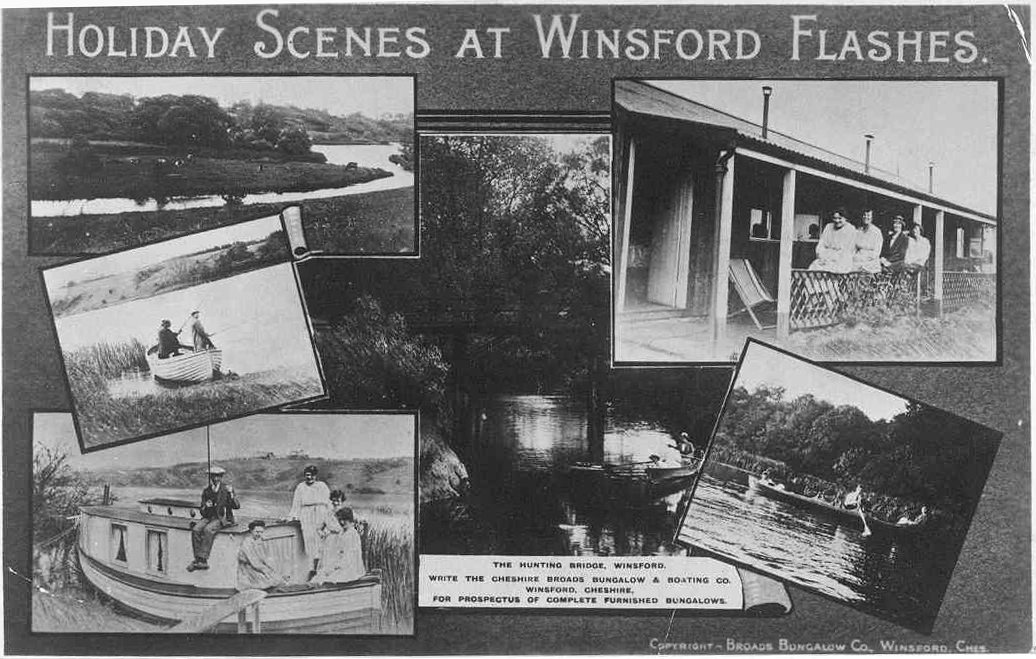
Other holidays were taken much closer to home. The images below were taken on the Cheshire Broads near Winsford. On the left is an advertisement from 1930 for holiday bungalows at the edge of the Flashes near Wharton; and on the right is a group holidaying at the bungalows around that time. 


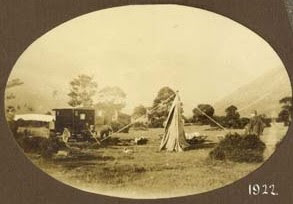
Camping and caravanning holidays started to become popular in the early twentieth century, and we have photos of them in one of our collections - the records of the Baker family of Runcorn. Chemist and university lecturer Harry Baker (1859-1935) was a prolific amateur photographer from the 1880s to the 1920s, and his collection includes images of his family on holidays, including going camping:


Don’t forget Cheshire Archives and Local Studies also holds a wide range of holiday images from before people had access to cameras, including sketches and paintings of holidays scenes, and travel diaries.  A selection can be seen in our Travel Plans blog. 

If you’re going away this summer, don’t forget to take some photos – and then print them out! We wish you a happy holiday. 


All these images and more can be viewed at Cheshire Record Office in Chester. Cheshire Image Bank is available at www.CheshireImageBank.org.uk 

Wednesday, 6 July 2022

Archie's Archives Experience!

This blog post was written by one of our work experience students, Archie, who spent a week with us in June. Thanks for all of your work Archie!

During my work experience at Cheshire Record Office, I discovered plenty of new and genuinely interesting things I didn’t know existed.

On my first day I was able to sit in on a staff meeting and learn about how Cheshire Archives and Local Studies were partnering with local communities, finding them photos, documents and anything else they wanted so that they could hold their own events about themselves. 

I spent some time reading, cleaning and documenting the Mayors Scrapbook from 1936-1979. Not only did I learn about how to properly take care of precious archives and how to keep them in the best condition so other people can view them later on, but I was able to read these small snippets of history, whether they were simple invites to tea from the Mayor and Mayoress in 1941, or a New Year’s card with a quote hoping for peace and an end to the war. It felt like I was there, experiencing it myself. Even just small things told a story, like a letter from the Royal household explaining that the Mayor and his wife wouldn’t be able to get a congratulations letter for their Golden Jubilee for their marriage, which was received on December 25th.


I also helped to check photographs and see if they were on the Cheshire Image Bank or not. If they weren't on the site then I indexed them onto a spreadsheet, and did some research around the people, places and events photographed. Looking at a photograph of a local blacksmith taken in the 19th century, it can only make you wonder who those people were, what they’d experienced themselves and what they did after the photo was taken. These small bits of history, which in the greater scale of things didn’t mean much, represented normal people who lived, grew up and died well before I was born, like a window into the past.


I also used Zooniverse, a website where you can transcribe articles and documents from hundreds of subjects. I was moving information over from patient records from the Parkside Asylum. Stuff like this can be used for studies relating to anything, and could help countless people in research. (You can get involved in the Parkside Asylum project here!)

The people who work at the Record Office are genuinely some of the most dedicated people I’ve met, you can see that they have a huge interest in what they do, and that they want others to be able to know about what they do and use the records they hold.


Monday, 24 January 2022

18 Months of Mystery Image Mondays

Perhaps you are familiar with our regular twitter campaign #MysteryImageMonday? Mystery Image Mondays started life 18 months ago, to crowd-source information about images held at Cheshire Archives and Local Studies puzzling our Local Studies Librarian. Over 200 images later, Mystery Image Mondays are drawing to a close as a regular feature (they’ll still pop up from time to time when we have more images we need help with!), so what better time to review those mysteries you’ve helped us solve, and those which still elude us…? 

The first Mystery Image Monday went live on Monday 29th June 2020. Two images were used: c09050 and c10383. The tweet generated much interest, and both images were successfully identified; The Crewe Arms in Spurstow, and the Verdin Baths at Northwich respectively. 


At the time of writing (4th January 2022), 211 mystery images have now been posted on twitter for all those budding detectives out there. Of these 129 went on to be successfully identified. Many include Cheshire places and buildings not previously covered by the Cheshire Image Bank (CIB) collection and are now available to view online, such as Gibbet Mill at Great Saughall (c13383) and Hale Cemetery (c08809). 


Other resolved images include a salt arch in Northwich (c06765), the Mainwairing Arms in Over Peover (c11936), St. Luke’s Church Winnington (c06534), and Benger’s Foods Limited Head Office in Holmes Chapel (c12939). The art deco frontage of Benger’s Food Ltd. is shown below, located on London Road. Benger's Foods, originally Mottershead and Company of Manchester, occupied the purpose-built premises in Holmes Chapel from 1938, designed by J.H Andrews and Butterworth of Manchester. Benger's manufactured a food supplement that at one time was regarded as essential in the care of young children and expectant mothers. In 1947 Benger's Food was bought out by Fisons Limited, who based their pharmaceutical division in Holmes Chapel, and then later Sanofi Aventis. The building was demolished in August 2015. Also pictured is the Mainwairing Arms, Stocks Lane, Over Peover, c1911, with a sign just visible listing John Street as licensee. He is listed as such in the 1911 census, aged 52. It is now called the Whipping Stocks Inn. At first, we thought “John Street” might be the name of the road, but thanks to the detective work of a twitter follower we now know the true location! 


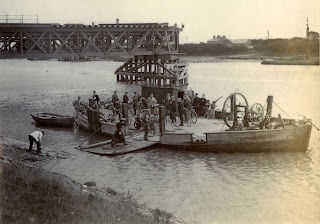
One of our favourite resolved images has to be an image of the River Dee at Queensferry, taken from the Cheshire side of the river in March 1897 (c13297). Thanks to members of the Anfield Bicycle Club who contacted us, we now know the location of this image, with the telescopic Victoria Bridge pictured, partially retracted, with the Anfield Bicycle Club on the ferry. The Anfield Bicycle Club spent Easter 1897 in Wales, riding there and back via Wirral and Liverpool. 


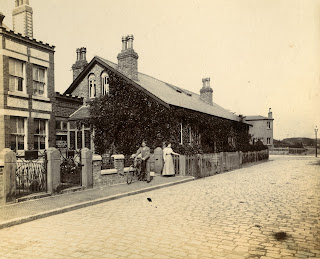
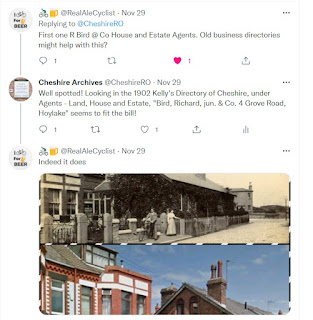
Recently we were able to identify c13331 as being Grove Road, Hoylake at the turn of the 20th century, thanks to a keen-eyed twitter follower. @RealAleCyclist spotted a small sign on one of the buildings and pointed out “First one R Bird @ Co House and Estate Agents. Old business directories might help with this?” Our Local Studies Librarian used our online trade directories and in the 1902 Kelly's Directory of Cheshire, under Agents - Land, House and Estate, found "Bird, Richard, jun. & Co. 4 Grove Road, Hoylake", which seemed to fit the bill nicely! @RealAleCyclist agreed and included a screenshot from Google Maps showing the right location. Another mystery solved! 


We do however have numerous images which remain a mystery. These include a group photograph outside an office (c06768) and the ruins of a country house or castle (c11948). You can peruse more online at our Flickr album “Mystery Images Unresolved” and on the Mystery Images Popular Collection on the Cheshire Image Bank. If you identify anything then please do let us know via RecordOffice@cheshiresharedservices.gov.uk


Lastly, we continue to digitise more of our visual collection, which will no doubt unearth more mystery images. So, follow us @CheshireRO on twitter and @cheshire_archives on Instagram, test your detective skills and knowledge of the Cheshire area, and take part in future #MysteryImageMondays!