Pages

Showing posts with label Travel. Show all posts

Tuesday, 19 July 2022

Holiday Snaps!

Is your phone full of photos that you haven’t got round to printing yet? Before the advent of smartphones, most of us kept collections of holiday snaps - and since photography became popular and accessible from the late 19th century, our ancestors did too. 

Cheshire Archives and Local Studies has a large collection of photographs - many available on Cheshire Image Bank. Here is a selection of our photographs of holidays, from luxury overseas travel in the early 20th century, to the traditional British seaside break. 

These early ‘staycations’ of days out on the beach were taken on Wallasey beach on the Wirral. The photograph below left shows children enjoying the seaside during the 1890s, and below right an unknown group is pictured on the same beach during the 1910s. 


Do you remember having a donkey ride on the beach as a child? These donkeys (below left) were pictured on Hoylake beach in 1911. They took visitors – some in carriages – over to Hilbre Island. The colour image below right is a scene from West Kirby beach, taken during the 1910s. We can just make out some donkeys standing in the background! 


Some people were fortunate to undertake extensive travel abroad, and we have a record of one such family from over a hundred years ago. The Bates family of Hinderton Hall near Neston kept a journal of a motoring holiday in France, Spain and Portugal in 1908. They had their car shipped to Lisbon via La Rochelle and planned to,
“return home in the aforesaid motor via Boulogne, Folkestone and other ports and/or places on the way, having liberty to call at ports in any order and to sail or travel with or without pilots or chauffeurs, until the said motor should arrive at Hinderton Hall Neston Cheshire England and so end the voyage.” 


Here is a photograph from the journal showing their car being loaded onto a ship: 


The journal contains photographs of the places they visited, some of which are still popular destinations today - such as the harbour at La Rochelle and the chateau at Blois in France; the town of Leiria and the hermits cells of Bussaco in Portugal; and the famous Cathedral of Santiago de Compostela on the Camino de Santiago pilgrimage in Spain. 


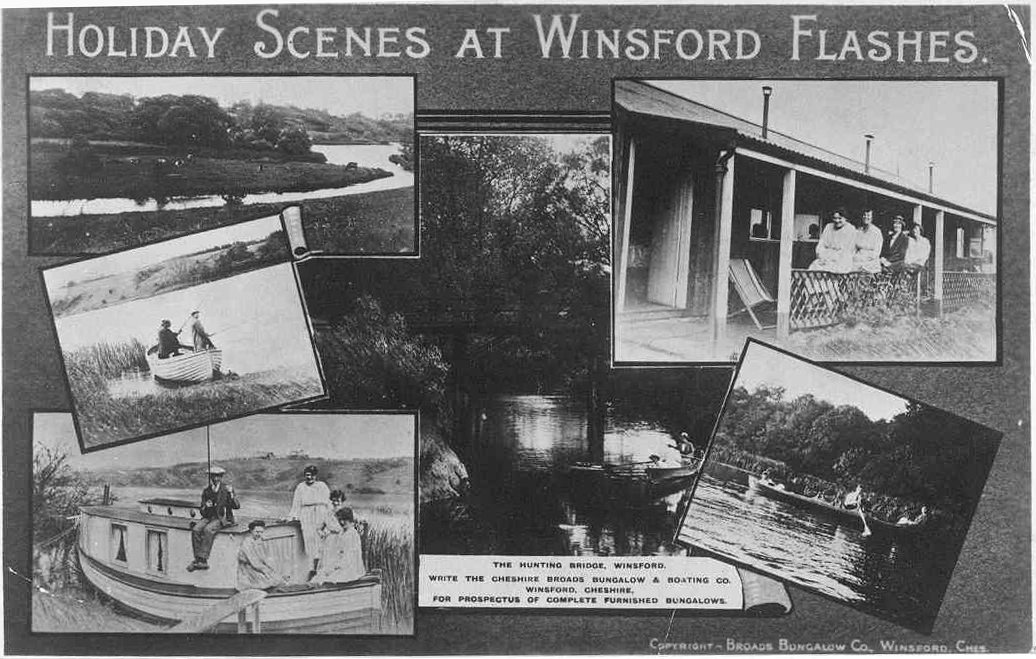
Other holidays were taken much closer to home. The images below were taken on the Cheshire Broads near Winsford. On the left is an advertisement from 1930 for holiday bungalows at the edge of the Flashes near Wharton; and on the right is a group holidaying at the bungalows around that time. 
 

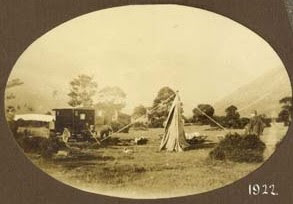
Camping and caravanning holidays started to become popular in the early twentieth century, and we have photos of them in one of our collections - the records of the Baker family of Runcorn. Chemist and university lecturer Harry Baker (1859-1935) was a prolific amateur photographer from the 1880s to the 1920s, and his collection includes images of his family on holidays, including going camping:


Don’t forget Cheshire Archives and Local Studies also holds a wide range of holiday images from before people had access to cameras, including sketches and paintings of holidays scenes, and travel diaries.  A selection can be seen in our Travel Plans blog. 

If you’re going away this summer, don’t forget to take some photos – and then print them out! We wish you a happy holiday. 


All these images and more can be viewed at Cheshire Record Office in Chester. Cheshire Image Bank is available at www.CheshireImageBank.org.uk 

Thursday, 30 August 2018

Travel Plans

As the summer holiday season draws to a close, at Cheshire Record Office we've been looking through our travel-related archives and thinking about travel plans from yesteryear.

Holiday planning in 2018 often starts with an internet search for ideas of where to visit, but of course this was not an option for our ancestors.  An 1878 catalogue of travel literature from the Chester Free Public Library may have provided some inspiration.  The Voyages, Travels and Adventures section covered all the continents of the world, but also included trips not too far from Chester such as Dr Samuel Johnson's Diary of a Journey into North Wales, in the year 1744, or Rev. Richard Warner's Tour through the Northern Counties of England and the Borders of Scotland.  For something further afield, readers could have looked at Lady Grosvenor's Yacht Voyage to the Mediterranean and those thinking of travelling east may have been interested in Narrative of a Three Month's Voyage in India.  The author was 'The wife of an Officer in the 16th Foot' - her actual name was sadly not recorded!


Once the destination has been decided on, it's always worth checking your travel documents. Anyone who has endured the nail-biting wait for a passport renewal in time for a last-minute booking will know this well!  We have some beautiful examples of passports granted to travellers in centuries past, such as 'English Gentlemen' Samuel Hill and Daniel Lombard who wished to travel to Savoy in France in 1711, or one for another 'Gentilhomme Anglais', a Mr Hallowes, whose passport was signed at Downing Street in 1824 decorated with a large detailed drawing of a crest.


France is an ever-popular holiday destination for British people, and with Eurostar, Eurotunnel and hour-long ferry crossings we are spoiled for choice on how to get there.  Compare this with the slower experience of a traveller in 1719, whose journal begins:
After a four Dayes waiting at Dover for a wind, we at last found a favourable one that brought us in 5 Hours thence to Calais.


Cheshire Record Office holds countless other documents about travellers' journeys.  The journals and letters of Francis Dicken Brocklehurst of Macclesfield include a lyrical account of his voyage across the Pacific Ocean, from California to Australia, Ceylon, China, Japan and India in 1860.  11th February 1860 seemed to start well:
The wind continues good.  We are on the same latitude with the Sandwich Islands about one thousand miles east of the same.

But later in the day conditions changed:
7 o'clock p.m. Strong wind blowing, black angry clouds drifting swiftly across the heavens, a few stars glimmering fitfully here and there, the ship heeling uncomfortably over on the starboard side as she ploughs her way steadily through the heaving and surging billows which roar with a threatening and somewhat onimous sound that almost drowns the thin but plaintive tones of a concertina, which the first mate is playing forward on deck somewhere.
When Mr Brocklehurst arrived at Melbourne the following month however, anyone who has ever been disappointed with their hotel or been tormented by tropical insects will understand his feelings.  He notes on 28th March that,
the hotels are scarecely third rate and infested with mosquitos,
and goes on to complain the day after that,
the beds in all the Hotels in Town are infested with bugs. Had to sleep on the floor in my travelling blankets last night in consequence.
By 2nd April he finally admits defeat:
the Bugs and Mosquitos have fairly driven me from the Criterion Hotel and I have now located myself at the Prince of Wales.
If we're holidaying abroad, currency exchange rates can make it tricky to keep track of spending money.  Lord Egerton of Tatton was careful to keep an eye on what he spent and made notes in the back of his travel journal for hotel, rail and luggage expenses, but also the cost of tea, how much he tipped the porter and more than one purchase of Eau de Cologne! We have also found an early reference to currency exchange rates in a diary printed in 1871An Average Value in English Currency was given for 'foreign money' including the French Franc and Sou and Austrian Florin and Ducat, as well as the interesting-sounding Spanish Hard Dollar and Doubloon and Turkish Gold Sequin.


At the end of our holidays we all like to look back on our holiday snaps but before we all had cameras on our mobile phones, travellers and holidaymakers had to be a little more creative.  The notebooks of Lord Egerton feature sketches as varied as cathedral stained glass windows, a statue of Buddha and local characters such as one captioned the Landlord of the Trierscher Hof, waiting at Table d'Hote. 


Drawings and even paintings feature in the Brocklehurst family papers.  Examples from T.U. Brocklehurst's travels include a painting of Mont Blanc and a picturesque view of Mexico City.


There is also a detailed painting of something he saw in a Mexican museum in 1881, captioned:


Teoyamaqui, Aztec Goddess of Death, found at Puebla, 3 feet 10 inches high.  It is a stone idol and has been painted.  The holes around the head were originally filled with hair.  Her skirt is made of plaited snakes and the hands are disproportionately large to indicate her power.

As far as we know, it wasn't brought home as a souvenir!

All of these items and more are available to view at Cheshire Record Office in Chester. 


Friday, 9 June 2017

A honeymoon tour to remember!

Who has kept a diary? I have – with a birthday at Christmas time and growing up in the seventies there was every chance I would receive at least one diary, usually with matching pen, every year – but even the most attractive of them (purple velvet) still didn’t inspire me much beyond February. Then there were the teenage years  ... And the last diary I kept? Recording a trip to Japan in my early twenties I supposed I wouldn’t make again.

The wonderful thing about diaries in Cheshire's archive collections is that we can recognise all of this and ourselves in them. For International Archives Day 2017 and #archivestourism here are extracts from a young woman's honeymoon diary.

Wednesday July 13th 1892

We were to travel by a train which left Alderley Edge soon after half past three in the afternoon – Leo and I. The express which Leo had decided on to take us up to London would not stop for us at Alderley, though most politely requested to do so; but brides and bridegrooms were things it was very accustomed to, and its iron heart was not to be moved. The express left Manchester at a quarter past four, so we had a good half hour to wait at Crewe. Leo put me in the waiting room to rest before the journey. He came to summon me presently, and took me to the express which had come in, and finding his name on the window of a coupe, he opened the door. We reached Euston about half past eight. Leo got a cab and we packed in with our luggage, my box and Leo’s portmanteau and he had a hat box, and I a handbag, and set off for the Victoria Hotel in Northumberland Avenue.  We were expected, and our room was waiting for us. It is a very fine hotel, the largest I have yet been in.
Of course we were much too late for dinner, and we were too tired to care for a private one, so Leo ordered cutlets and tea, as the most refreshing things he could think of, to be ready immediately. Leo, who knew the hotel, made his way to the coffee room, where our tea was to be laid, a handsome room, but oh so hot and close! Our tea came soon, cutlets, chip potatoes, tea and toast, and very good and refreshing it was, but I was not sorry to leave the hot room as soon as possible, and as we were both very tired, we went straight away to bed. I do not seem to have much to say about today, but it is not a day one would choose to write about.

Thursday July 14th

I am ashamed to say what time it was when we got up, but Leo had slept badly, having had toothache, which was very unromantic, but true nevertheless. 

We went down to breakfast (I might say at last), and Leo ordered coffee, and fried soles, and toast, which was very nice, but the room was as close as ever, and my new morning frock pinched so dreadfully round the neck, that I unhooked it, and furtively fastened the brooch in again over a good gap of collar. (Otherwise, it is a very nice blue serge, and in my heart I rather admire it, with collar and cuffs.) 

Our newly weds have the best part of a day to kill before their train to the coast and the boat for Rotterdam.  They would both have liked Kew (Frances will become an expert gardener) but it’s too far out and museums or galleries seem like hard work …

So Leo proposed that we should go and see ‘Venice’ at Olympia, as a good lazy way of passing the time, for as we know that there were canals and gondolas, we naturally thought that they must be in gardens. In other respects, we knew nothing at all about it.

The gardens were creations of our own wild imagination … the glass-making was in progress at certain hours, but we did not see it …. We went to see the – I know not what to call it – say, spectacle. Presently the play began, a hash-up of all sorts of things, the whole thing was sung; and we were too far away to hear anything of words. 

And on to the boat at Harwich, and perhaps the reasons for Frances’ growing dissatisfaction becomes clear … Leo predicts a calm night …

We did not want any supper, after the long dinner we had had, but I was very anxious to be allowed to pass the night on the saloon couches; the cabins looked so full and close, and I don’t care to be sick before strangers, in a box. At first we were told that I could and Leo went away cheerfully to look after his own berth. But by and by came the stewardess to me, and said that it could only be allowed if all the berths were taken up. When Leo came back he had found a berth, and an old lacrosse acquaintance. I waited awhile, but I was doomed to disappointment; the stewardess came and bore me off to a berth, in a cabin containing four. The whole place was about as big as a very small dining table and it already contained three Americans. I climbed into my top berth, half undressed and lay down. Presently came the stewardess and dealt out basins. ‘Prevention is better than cure’ she said with a pleasing smile. My heart sank right to the bottom end of my berth. The abominable Adelaide began to roll almost immediately after leaving Harwich, and one of the Americans succumbed early, and kept it up all night. If this were any consolation to me I had the pleasure of lying and listening to it, until the small hours, when I too succumbed. 

Friday July 15th

Not to have slept till morning, and not much then, does not conduce to general briskness, to say nothing of the horrors of seasickness and a close cabin. Soon after six I roused up altogether, for the stewardess came in and said that we were later than usual, for we had had a very rough passage. And that was Leo’s calm night.


Frances Crompton was born near Prestbury in 1866, and lived in Wilmslow, where she met and married bank manager John Leopold Walsh. They later lived in Holmes Chapel and Chelford. She published 29 children’s stories, was a skilled painter and kept her Gardening Diary begun in 1915. She died in 1952 and her daughter deposited her diaries in the archives. The collection reference is D 5453.

With thanks to volunteer Hilary Morris for transcribing diary extracts.

Wednesday, 10 August 2016

From Audlem to New York


Photographs can give amazing insight into the lives of the people of the past. At Cheshire Archives and Local Studies, cataloguing part of the glass plate negative collection unearthed a number of such images. These images are glass plate negatives depicting American life in the early 1880s. The only question was, why had we accepted items relating to an area so outside our collection policy? A theory arose that perhaps these people had links to Cheshire but had left to discover a new life in America. 


New York Garden- c11607 on Cheshire Image Bank

Upon inspection of the various boxes, it was found that some in fact were of areas around Audlem in Cheshire. The same hand had written the captions for both New York and Audlem; creating a link between the images and reinforcing the glass plates’ original grouping as a set.

We decided to research some of the names shown in the captions. Our Local Studies manager started on the trail of Brettel Gullen. She found out that his place of birth was listed as Brooklyn, America in October of 1884.


Marriage
After some further research, we came up with a discovery. Brettel’s parents had married in the Parish of Audlem the year before his birth (1883), and the newly married couple travelled to Brooklyn, USA where they began their lives together. Later records show that by 1894 three daughters had been added to the family- Margaret Emily; Agnes May and Edith Fernley Gullen.

1883 Marriage certificate of William Gullen and Emily Fernley from Find My Past


Jesse Fernley

Jesse Fernley is Brettel’s maternal grandfather and is listed on his daughter’s marriage certificate. In 1883 he is a school master, and Brettel’s mother (Emily Willoughby) plus two of her sisters followed in Jesse’s footsteps, becoming school mistresses.

“At this time,[1870-80s] Jessie Fearnley [sic] was the interesting headmaster of the C. of E. School, who lived at Moss Villa...” Marjorie Burton, Nineteenth Century Audlem.

Jesse stayed at Moss Villa until his death in 1924.


Moss Hall- copy from original by Jesse Fernley- c11618 on Cheshire Image Bank


The images we hold of Audlem in this collection are attributed to J.F (presumably Jesse Fernley) in 1875, copied onto glass plates by his son-in-law 17 years later.


Death
William Frederich Gullen (Brettel’s father) had copied these plates of Audlem, possibly to help him and his wife stave off homesickness. However, a mere two years afterwards she would be making her way back to the UK with her four children. The ship passenger list states that she is now a ‘widow’. Her husband had died close to his 40th birthday. Brettel was now the head of the family, aged 9.

1894 Passenger List Montreal to Liverpool from Ancestry


Later Life


Regardless of this setback, the remaining family’s fortune seemed to remain good over the next few years.

As Brettel grew up, he studied in both Leeds and London as a railway carriage draftsman and continued in his work with the railway throughout his life. Multiple passenger lists show him going between Southampton and Buenos Aires repeatedly. A lot of British companies were buying up Argentinian rail networks around this time which could explain Brettel’s presence there.

1933 Passenger list Buenos Aires to Southampton from Ancestry


All the family except Brettel show up in the 1911 Wales census, with an address in Cardiff. It shows us that the daughters have all followed in their mother’s and grandfather’s footsteps and become teachers. The address here and the address found 22 years later on Brettel’s passenger list (above) are under a 45 minute walk from each other. We don’t know if Brettel moved away or they all moved and continued to live together not far down the road.

1911 Wales Census from Ancestry


Despite Brettel and his siblings losing their father at a young age, they got to meet their Cheshire Grandfather for the first time and had the chance to experience two different ways of life and we have some amazing photographs to show for it.


The whole Gullen family (inc. a 5th child who died in infancy) with pet bird- c11613 on Cheshire Image Bank


If you want to see more about this family and their life in America, the whole set of images have been digitised and are available on Cheshire Image Bank now.

N.B Previously we had said Mr Gullen was from America but he was in fact from Walsall, later moving to Liverpool and then to America before his marriage.