Pages

Showing posts with label photos. Show all posts

Tuesday, 19 July 2022

Holiday Snaps!

Is your phone full of photos that you haven’t got round to printing yet? Before the advent of smartphones, most of us kept collections of holiday snaps - and since photography became popular and accessible from the late 19th century, our ancestors did too. 

Cheshire Archives and Local Studies has a large collection of photographs - many available on Cheshire Image Bank. Here is a selection of our photographs of holidays, from luxury overseas travel in the early 20th century, to the traditional British seaside break. 

These early ‘staycations’ of days out on the beach were taken on Wallasey beach on the Wirral. The photograph below left shows children enjoying the seaside during the 1890s, and below right an unknown group is pictured on the same beach during the 1910s. 


Do you remember having a donkey ride on the beach as a child? These donkeys (below left) were pictured on Hoylake beach in 1911. They took visitors – some in carriages – over to Hilbre Island. The colour image below right is a scene from West Kirby beach, taken during the 1910s. We can just make out some donkeys standing in the background! 


Some people were fortunate to undertake extensive travel abroad, and we have a record of one such family from over a hundred years ago. The Bates family of Hinderton Hall near Neston kept a journal of a motoring holiday in France, Spain and Portugal in 1908. They had their car shipped to Lisbon via La Rochelle and planned to,
“return home in the aforesaid motor via Boulogne, Folkestone and other ports and/or places on the way, having liberty to call at ports in any order and to sail or travel with or without pilots or chauffeurs, until the said motor should arrive at Hinderton Hall Neston Cheshire England and so end the voyage.” 


Here is a photograph from the journal showing their car being loaded onto a ship: 


The journal contains photographs of the places they visited, some of which are still popular destinations today - such as the harbour at La Rochelle and the chateau at Blois in France; the town of Leiria and the hermits cells of Bussaco in Portugal; and the famous Cathedral of Santiago de Compostela on the Camino de Santiago pilgrimage in Spain. 


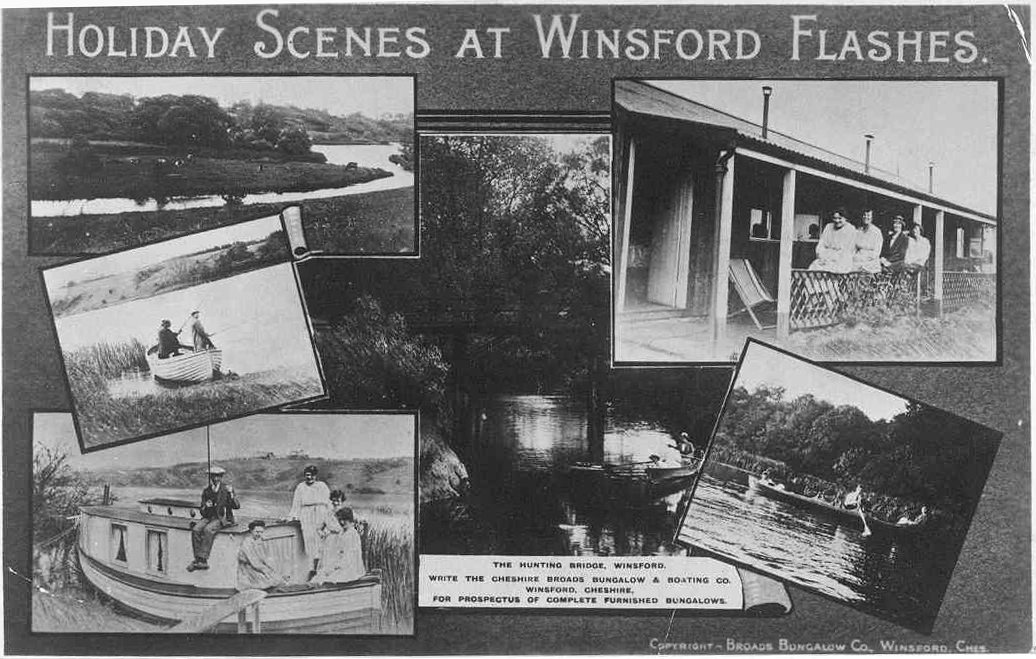
Other holidays were taken much closer to home. The images below were taken on the Cheshire Broads near Winsford. On the left is an advertisement from 1930 for holiday bungalows at the edge of the Flashes near Wharton; and on the right is a group holidaying at the bungalows around that time. 
 

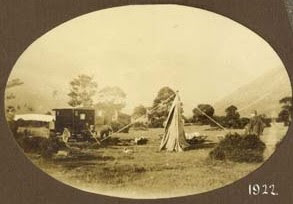
Camping and caravanning holidays started to become popular in the early twentieth century, and we have photos of them in one of our collections - the records of the Baker family of Runcorn. Chemist and university lecturer Harry Baker (1859-1935) was a prolific amateur photographer from the 1880s to the 1920s, and his collection includes images of his family on holidays, including going camping:


Don’t forget Cheshire Archives and Local Studies also holds a wide range of holiday images from before people had access to cameras, including sketches and paintings of holidays scenes, and travel diaries.  A selection can be seen in our Travel Plans blog. 

If you’re going away this summer, don’t forget to take some photos – and then print them out! We wish you a happy holiday. 


All these images and more can be viewed at Cheshire Record Office in Chester. Cheshire Image Bank is available at www.CheshireImageBank.org.uk 

Friday, 22 May 2020

Every Picture Tells A Story

Over a series of blog posts we will be sharing with you what we have been doing whilst working from home, and giving you an insight into some of the interesting collections and items we have come across whilst the Record Office has been closed.

When Cheshire Record Office is open, our Local Studies department works with volunteers to sort, catalogue and improve storage of the Local Studies Visual Collection, and make it available to the public at our search room and online. Since we have been closed, a team of Archives Assistants and a Conservator have continued this work by using an online data editing system at home to add photographs and information to the Cheshire Image Bank.

The Image Bank is a collection of over 30,000 digital images created from original material - photographs, postcards, print slides and negatives – and can be viewed and searched online at CheshireImageBank.org.uk. It also offers over twenty Popular Collections to browse, including the First and Second World Wars, Royal Visitors, Fashion and The Salt Industry. Image Bank content covers anywhere that lies or once lay within the Cheshire county boundary.

This lockdown project has involved writing a brief description of each of the photos assigned to us on the data editor; doing online research to provide further information about each image; adding key words to ensure they will appear in an online search; and providing standardised details of the location, title and date of the images. We have also added extra information to a small number of photos that already appeared on the Image Bank. The Local Studies staff have been adding more key word options to make it easier for people to search the site, and also had the task of moderating our work to ensure accuracy and consistency.

So far, 500 extra images have been added to the Image Bank as a result of this work. A wide range of themes has been covered: industrial, with hundreds of images from George L. Scott & Co and Wolverhampton Corrugated Iron Works, both based in Ellesmere Port; and military, such as a Cheshire Royal Engineers photo album from the 1890s. There is an early album of buildings, people and landscapes by amateur photographer George Davies, who lived in Alderley and took numerous photographs of the surrounding area, and some photographs are of the Duke of Westminster’s Eaton estate; there is a large collection of images from the village of Disley; and some from Macclesfield cover the celebrations of Queen Victoria’s 1887 Golden Jubilee. There are others showing places of interest across Cheshire.

Some of the photographs that have captured our attention include a busy street scene at Chester Cross (c13284) where the buildings are still recognisable but the horse-drawn trams are long gone.

Another is a murder stone from the 1820s (c13248). These were historic markers erected at the site of famous murders to commemorate the victim or warn of the consequences of committing such acts. And this photograph of Disley Golf Club (c08283) was already on the Image Bank but has had further information added - it was taken at the official opening of the club in 1889 and there were 47 pro golfers present when it was taken. 

 
On the industrial side, c13186 shows a group of steelworkers moving a stack of flat iron sheeting with an overhead crane system at an ironworks in the 1920s, and c13164 is of a woman using machinery at an engineering company in the 1950s. Additional information provided on the Image Bank tells us she was using a ‘stator notching machine’, and that George L. Scott Ltd. was an electrical steel stampers company with offices and warehouses in Ellesmere Port. The business later became a general engineering company.

Work on the next two images is almost complete, and they are due to be put online shortly. The first shows the Cheshire Yeomanry in the 1890s, assembling for annual exercises at the Roodee Racecourse in Chester (c13348), and the second is a street parade from around 1895 showing massed uniformed ranks of the Second Cheshire Royal Engineers, who were also known as the Crewe Railway Volunteers (c13213).


In the very early days of photography, equipment was cumbersome and photographers were usually limited to studio settings, but with the invention of film in the 1880s it became easier and we started to see the rise of amateur photographers like George Davies of Alderley. We have many of his photographs taken from the 1870s to 1890s, including buildings like churches, mills, country houses and pubs; landscapes around the eastern border of Cheshire; and agricultural scenes from ploughing to harvest work. A small selection is shown below.


This project has posed a few challenges along the way. As well as an unexpected technical issue early on, it has sometimes been difficult to identify the images - so some will have to remain hidden from view until we can do some more research with the originals at the Record Office. There are both opportunities and challenges with the Visual Collection more widely: the collection is constantly being added to with new donations, and there is a large number of uncatalogued photographs in storage yet to be looked at. Potentially, there are thousands more images that could be added to the Image Bank in the future, but it is also a time-consuming and costly undertaking.

Nonetheless, this lockdown work has enabled us to add more images to our Popular Collections section on the Cheshire Image Bank, particularly those on the First World War, Fashion, Eaton Hall and Little Moreton Hall. Some of the newly digitised images will be showcased in the All New Images section, as well as on social media.

The next steps of the project will be to identify entries already on the Image Bank that may require further information (then researching and adding it) and we also have data from more volunteers’ spreadsheets to match to the relevant images online. There is plenty to keep us busy!

Thursday, 30 August 2018

Travel Plans

As the summer holiday season draws to a close, at Cheshire Record Office we've been looking through our travel-related archives and thinking about travel plans from yesteryear.

Holiday planning in 2018 often starts with an internet search for ideas of where to visit, but of course this was not an option for our ancestors.  An 1878 catalogue of travel literature from the Chester Free Public Library may have provided some inspiration.  The Voyages, Travels and Adventures section covered all the continents of the world, but also included trips not too far from Chester such as Dr Samuel Johnson's Diary of a Journey into North Wales, in the year 1744, or Rev. Richard Warner's Tour through the Northern Counties of England and the Borders of Scotland.  For something further afield, readers could have looked at Lady Grosvenor's Yacht Voyage to the Mediterranean and those thinking of travelling east may have been interested in Narrative of a Three Month's Voyage in India.  The author was 'The wife of an Officer in the 16th Foot' - her actual name was sadly not recorded!


Once the destination has been decided on, it's always worth checking your travel documents. Anyone who has endured the nail-biting wait for a passport renewal in time for a last-minute booking will know this well!  We have some beautiful examples of passports granted to travellers in centuries past, such as 'English Gentlemen' Samuel Hill and Daniel Lombard who wished to travel to Savoy in France in 1711, or one for another 'Gentilhomme Anglais', a Mr Hallowes, whose passport was signed at Downing Street in 1824 decorated with a large detailed drawing of a crest.


France is an ever-popular holiday destination for British people, and with Eurostar, Eurotunnel and hour-long ferry crossings we are spoiled for choice on how to get there.  Compare this with the slower experience of a traveller in 1719, whose journal begins:
After a four Dayes waiting at Dover for a wind, we at last found a favourable one that brought us in 5 Hours thence to Calais.


Cheshire Record Office holds countless other documents about travellers' journeys.  The journals and letters of Francis Dicken Brocklehurst of Macclesfield include a lyrical account of his voyage across the Pacific Ocean, from California to Australia, Ceylon, China, Japan and India in 1860.  11th February 1860 seemed to start well:
The wind continues good.  We are on the same latitude with the Sandwich Islands about one thousand miles east of the same.

But later in the day conditions changed:
7 o'clock p.m. Strong wind blowing, black angry clouds drifting swiftly across the heavens, a few stars glimmering fitfully here and there, the ship heeling uncomfortably over on the starboard side as she ploughs her way steadily through the heaving and surging billows which roar with a threatening and somewhat onimous sound that almost drowns the thin but plaintive tones of a concertina, which the first mate is playing forward on deck somewhere.
When Mr Brocklehurst arrived at Melbourne the following month however, anyone who has ever been disappointed with their hotel or been tormented by tropical insects will understand his feelings.  He notes on 28th March that,
the hotels are scarecely third rate and infested with mosquitos,
and goes on to complain the day after that,
the beds in all the Hotels in Town are infested with bugs. Had to sleep on the floor in my travelling blankets last night in consequence.
By 2nd April he finally admits defeat:
the Bugs and Mosquitos have fairly driven me from the Criterion Hotel and I have now located myself at the Prince of Wales.
If we're holidaying abroad, currency exchange rates can make it tricky to keep track of spending money.  Lord Egerton of Tatton was careful to keep an eye on what he spent and made notes in the back of his travel journal for hotel, rail and luggage expenses, but also the cost of tea, how much he tipped the porter and more than one purchase of Eau de Cologne! We have also found an early reference to currency exchange rates in a diary printed in 1871An Average Value in English Currency was given for 'foreign money' including the French Franc and Sou and Austrian Florin and Ducat, as well as the interesting-sounding Spanish Hard Dollar and Doubloon and Turkish Gold Sequin.


At the end of our holidays we all like to look back on our holiday snaps but before we all had cameras on our mobile phones, travellers and holidaymakers had to be a little more creative.  The notebooks of Lord Egerton feature sketches as varied as cathedral stained glass windows, a statue of Buddha and local characters such as one captioned the Landlord of the Trierscher Hof, waiting at Table d'Hote. 


Drawings and even paintings feature in the Brocklehurst family papers.  Examples from T.U. Brocklehurst's travels include a painting of Mont Blanc and a picturesque view of Mexico City.


There is also a detailed painting of something he saw in a Mexican museum in 1881, captioned:


Teoyamaqui, Aztec Goddess of Death, found at Puebla, 3 feet 10 inches high.  It is a stone idol and has been painted.  The holes around the head were originally filled with hair.  Her skirt is made of plaited snakes and the hands are disproportionately large to indicate her power.

As far as we know, it wasn't brought home as a souvenir!

All of these items and more are available to view at Cheshire Record Office in Chester.