Pages

Showing posts with label Cheshire. Show all posts

Tuesday, 14 February 2023

What Is Cheshire?

Cheshire Archives and Local Studies is one of hundreds of public record offices throughout the country, which carefully preserve and allow access to the historical archives of their local communities. These are often called “County Record Offices”, although in practice the areas they serve can be far smaller (or occasionally even bigger) than a county. Which raises the question… what is the county of Cheshire? Well, the answer depends on the date and the type of records you’re looking for. 

The “Cestrescire” recorded in the Domesday Book of 1086 was one of 34 ‘shires’ that the Saxons established in England and Wales well before the Norman Conquest. Its boundaries then appear to have extended into what later became south Lancashire and most of Flintshire. However, the boundaries of the shires remained fluid and continued to evolve over the next few centuries. 

From 1254 to 1545 the County Palatine of Chester had its own parliament, consisting of nobles from the county serving under the Earl of Chester. This was abolished by the Chester and Cheshire (Constituencies) Act 1542, and thereafter the county was represented at Westminster by two Knights of the Shire, while the city of Chester was separately represented by two burgesses. 

Speaking of the city of Chester, in 1238 this had been granted the status of a “county corporate”, effectively making it independent from the rest of Cheshire, with its own completely separate system of local government. This was officially styled as the City and County of Chester, to distinguish it from the County of Chester (referring to the rest of Cheshire). These potentially confusing descriptions could still be found in some official sources until as late as 1974. 


By the mid-16th century, Cheshire had assumed its familiar ‘teapot’ shape, with the Rivers Mersey and Tame marking its northern extent, and the River Dee delimiting most of its western boundary with Wales. This area is often referred to as the Ancient County of Cheshire, and it remained largely unchanged until the Victorian period, when new systems of local government were required to cope with the demands of an increasingly large and industrialised population. 

The Registration County of Cheshire was formed from groups of poor law unions set up in 1835, under which groups of parishes would combine to care for their poor and infirm residents. When a new civil registration system for births, marriages and deaths was established in July 1837, most of the poor law unions doubled as “registration districts”, with the poor-law overseers becoming local registrars. However, unions and registration districts didn’t always respect county boundaries, with the parishes of Hawarden (Flintshire), Biddulph (Staffordshire), and Heaton Norris and Reddish (both Lancashire) being included in Cheshire districts, while the Cheshire parishes of Disley, Mottram in Longdendale and Malpas were originally placed with districts in Derbyshire, Lancashire and Denbighshire respectively. When searching the national indexes for our ancestors’ births, marriage or death certificates, this can mislead us into disregarding entries which seem to be in the ‘wrong’ county. These boundary anomalies persisted until 1937. 

The Victorian period also saw the introduction of local boards of health, to improve conditions in the towns and cities. From 1872 these became “urban sanitary districts”, with the remaining parts of each poor law union becoming “rural sanitary districts”, and they gradually took on more and more responsibility for local affairs (the “sanitary” part of the name was dropped in 1894). Several of these districts inconveniently extended into two or more counties: for example, Stockport, Stalybridge, Warrington, Ashton under Lyne and Mossley, each of which comprised parts of Cheshire and Lancashire (with Mossley including parts of Yorkshire for good measure). To remedy this problem the Local Government Act 1888 created a system of Administrative Counties, by placing each district in the county where it had the largest population. Although the administrative county of Cheshire was a little smaller than the ancient county, it contained a larger population. 


Although the 1888 Act made it clear that administrative counties were intended to exist alongside (rather than replace) the ancient counties, the latter became increasingly redundant for purposes of local government, especially after a new system of county councils and county boroughs was established in 1889 by the same legislation. This meant that certain large towns and cities functioned as counties in their own right: in Cheshire these were Chester, Birkenhead and Stockport (joined later by Wallasey in 1913). 

This system of local government was swept away when the Non-Metropolitan County of Cheshire was created in April 1974. The urban areas on the Wirral peninsula, and to the south and west of Manchester were transferred to the new metropolitan counties of Merseyside and Greater Manchester respectively, while Cheshire gained the towns of Warrington and Widnes from Lancashire in compensation. All the county boroughs were abolished, with the city of Chester at the centre of one of eight new districts making up the county, all overseen by a reformed Cheshire County Council. 

In 1998, two of these districts, Halton and Warrington, became “Unitary Authorities”, granting them the powers of a county council. In 2009, the remaining parts of the county were divided into two more unitary authorities – Cheshire West and Chester, and Cheshire East – with the result that Cheshire County Council ceased to exist. However, Cheshire itself lives on as a Ceremonial County, established under the Lieutenancies Act 1997, now comprising the boroughs of Cheshire East, Cheshire West and Chester, Halton, and Warrington. 


We should also mention the Diocese of Chester, which at its foundation in 1541 extended as far north as Cumberland and Westmorland, taking in almost the whole of Lancashire, and parts of north east Wales. During the nineteenth century the area of the diocese was steadily reduced to roughly correspond to the ancient county of Cheshire, as it still remains to this day. 

Cheshire Archives holds records relating to all the Diocese of Chester and the former county authorities, although some collections for places outside present-day Cheshire have been transferred to neighbouring record offices – for examples, wills for Lancashire residents proved in the Diocese of Chester before 1858 are now at Lancashire Archives. So if you aren’t sure whether we have the records you need then please ask us before you visit, or consult our online catalogue and guides.

Wednesday, 14 December 2022

The Journey of a Local Studies Donation

Earlier this year we received a fantastic collection of photographs of Crewe in the 1890s, kindly donated to us by one of our volunteers, Susan. We thought this blog would be a great opportunity to showcase the collection, as well as thank Susan for her donation, and to highlight all the staff and volunteers involved with the donation and cataloguing process.

First a bit more about the photographs, and why Susan decided to donate it to us. Richard Baxter Booth was a Crewe dental surgeon, and this photograph collection was compiled by him in the 1890s.

Susan says “I found the album for sale on eBay, and Baxter Booth’s granddaughter has been shown the images; her father, Walter (Baxter Booth’s son) was also a dentist and keen photographer. This is album number two; number one is lost unfortunately. Baxter Booth’s dental surgery was in the row of buildings on Crewe Market Square that was replaced by Marks & Spencer, it was the last one on the left on the corner of what is now Queensway. After his marriage he lived at Oaklands in Haslington; he was an active member of the Crewe Cycling Club, the Crewe Alexandra Cricket Club, and Crewe Golf Club. All the images are 'Kodak no. 2' prints”. Baxter Booth had previously lived at Fields Farm, Haslington, rented from the Crewe Estate.

Once we had received the collection and Susan had completed our donation form, the photographs were passed to one of our conservators, Angela.

Angela says, “The original binding had completely failed, so the loose album pages were cleaned with a plastic eraser and placed into custom made polyester sleeves and then put into an acid free folder. These preservation measures will protect the album pages and photographs when they are being handled and also protect them from dust and any fluctuating environmental conditions they may encounter.”


Next, the collection was looked at in more detail by our Local Studies Librarian, Heather. She tells us, “The collection was added to CALM, our collections management system, so that it could be found by staff, researchers, and members of the public online. CALM generated a unique 6-digit reference code for the item, 231804. It was also given a class number of VPH96, which helps to locate the item in our visual collection. Here I am storing the collection away in one of our strongrooms, in an archive box, and where temperature and humidity levels are monitored.”


Another of our volunteers, Helen, was tasked with looking at each individual photograph and indexing it onto a spreadsheet.

Helen says “I am currently a volunteer working on the photographic archives at Duke Street, finding out any extra information about the subjects of the photographs and then entering all the information onto a spreadsheet. These spreadsheets, such as the one I worked on for the Richard Baxter Booth collection, will allow the public to access the information online, widening public access to the contents of the archives.”

This should help any researcher interested in the collection to find the exact photograph most useful to them. Helped by Susan’s knowledge of the area at the time, and of the photographer Richard Baxter Booth, this task is now complete. Please speak to a member of staff if viewing this spreadsheet would be helpful to your research.


We have not yet digitised the whole collection, but a selection of our favourites are featured below. The album contains scenes and events in Crewe, such as the Crewe Flower Show and a football match, as well as buildings (the Mechanics Institute, Town Hall, pubs, churches), and also features the residences of other doctors/medical men in Crewe such as Dr Atkinson’s residence “Mirion House” on Earle Street. The photographer also used his friends, family, and pets as his subjects.


The next step will be to have more of this fantastic album digitised and available on the Cheshire Image Bank website. 

If this blog has inspired you to consider donating an item or collection to us, then we would love to hear from you. Please do contact us first, as we can then check that the item fits with our collection policy and is not something we already have. You can get in touch with us via our website, telephone 01244 972574 or email recordoffice@cheshiresharedservices.gov.uk.  

All of these photographs and more are available to view at Cheshire Record Office in Chester.

Thursday, 17 November 2022

Cheshire Railways: Third Stop - Maps and Plans

"A map says to you. Read me carefully, follow me closely, doubt me not… I am the earth in the palm of your hand."
If this quote from aviator and adventurer Beryl Markham is to be true, then Cheshire Archives holds huge swathes of Cheshire’s earth, and beyond, in the hundreds of maps and plans in our railway collection. Plans of tracks, stations, bridges, tunnels, foot bridges, signalling, derailments, engine sheds, schools, goods yards, waiting rooms, lines that were built, lines that were never built - even the Station Master’s bathroom in Bebington. 

Over the last few years lots of work has been carried out to list, organise and repackage these plans to make them available for the public to view. So join us in this exploration of Cheshire’s railways and hold the earth, or at least some of it, in the palm of your hand.

First stop - understanding the plans

For some of the plans it is clear why they were made and what they are trying to show. The plans of Runcorn Bridge, for instance, are easy to understand. They show the bridge from various angles and different sections and elevations, and it doesn’t require knowledge of railway engineering to appreciate them. 

Other plans are more complex. The estate plans of lines with lots of handwritten annotations are difficult to understand. Was the line built, or not? What is the date? Sometimes a date is clearly stamped, but it is obvious that these were working plans and the annotations were added over years or even decades. But take from them what you can. The estate plans are full of wonderful details outlining ownership of parcels of land adjacent to the lines. They can include details that may not be found between census records, Ordnance Survey maps or other well-used family and local history records. 

The plans were made for many different reasons.  Some reasons are clear - such as to plan the construction of a bridge or the planning of a railway line - but for other plans it is less clear what the purpose is for. In listing and organising the collection, we have tried to make it clear on our catalogue what information can be taken from them - even when the purpose of the plan is less clear. As with all archives, the information contained within them can far exceed the purpose for which it was captured.


Second stop - understanding the types of plans

Firstly, there are plans that were created by the Engineering Department. These include buildings such as stations, waiting rooms, engineering sheds and goods yards. They show what the building would have looked like externally and internally - often in great detail. They show measurements and exist in various scales. Sometimes they show the area around the building and its location in relation to the wider station plan. 


There are plans of bridges, tunnels, culverts and viaducts. These are very similar in detail to the plans of the buildings, but often include mile points that indicate their position on the railway line. Engineering plans also include inspection sketches and signalling with details of alterations to tracks, signalling, sidings and junctions. There are also many more varied plans of engineering works such as drainage, line widening, and track plans.


The second series of records are those created by the Estate Department. These are more complex and can be difficult to understand. They largely consist of plans showing the full line or a section of a line. In their most basic sense, they show the routes and the land around them. They are full of details such who owned the land adjacent to the line. This is great if you are researching a nearby property or piece of land, especially if no other mapping exists for that point in time. 

The plans are drawn to various scales but the most common are the 2 chains to 1 inch surveys (1 chain=22 yards). They can be individual plans of a section of a line, or can be many plans bound together in large unwieldly volumes. They are often annotated with details that sometimes can be easy to understand or sometimes complex and technical. They are often stamped with details of different railway companies and have clearly been used over many years. They have been listed on our catalogue with the start and end point of the line, with details in the description of the stations in between which are featured.

Third stop - understanding the scope

The lines didn’t stop at county boundaries and neither do the railway plans. As such, it follows that a lot of the plans go beyond the scope of Cheshire. There are many plans for neighbouring counties but also many from much further afield including lines in Ireland and Wales. The plans are listed in good detail on our catalogue, so a search for the place of interest should be easily found.


Final destination - the catalogue

The plans on our online catalogue are arranged under three sections; engineering plans, estate plans, and deposited parliamentary plans. The deposited parliamentary plans are a shorter series and compliment those deposited plans in our Quarter Session records (see QDP). Within each section they are sub-divided into types of plans such as ‘stations and buildings’, ‘line sections’ etc. Within each series they are listed alphabetically by place. A further guide is in progress that will allow researchers to identify which line a station or structure sat on and if we hold plans. Watch this space for further details on this.

The railways covered a lot of earth and the plans cover a large portion of this. Search our catalogue to discover the full extent and arrange a visit to the Record Office to hold them in the palm of your hand.


All of these items are available to view at Cheshire Record Office in Chester.  Part 1 of this blog is First Stop - The History and Part 2 is Second Stop - Employee Records.  

Thursday, 20 October 2022

Cheshire Railways: Second Stop - Employee Records

Cheshire Railways: First Stop - The History is available here.

When the railways emerged in the nineteenth century there was very quickly a need for workers to build, repair, operate and make the railways run smoothly. Engineers such as Brunel designed the railways, but who were the people that kept the lines in operation?


In Ellesmere it was platelayers such as James Bagnall that inspected and maintained the lines, or in Birkenhead it was shunters such as Thomas Bayliss that took on the dangerous work of connecting and disconnecting engines. Porters such as Alfred Pryce Jones carried travellers’ luggage in Spital, and gatewoman E Alford operated the level crossing in Minsterley. There were many, many more jobs on the railways such as ticket collectors, signalmen, waiting room attendants, guards, foremen, lamp lads, breaksmen, station masters and many more besides.


All these jobs created records: staff registers, wages books, record cards, accident report books and workmen compensation books. It is rare that employee records survive in business collections because they were routinely destroyed when they were no longer needed by the company. Thankfully, in our NPR railway collection many have survived that contain priceless information on the people who worked on the railways such as James Bagnall, Thomas Bayliss, Alfred Pryce Jones and E Alford. The records are in no way complete and coverage is patchy, however, if you had an ancestor who worked on the railways then read on, we may well hold some of their records.


The history of the railways is one of company mergers and shared lines and therefore to find the records of your ancestors you need to know which railway company they worked for. They may have worked for two companies in the case of the London & North Western and Great Western Joint Railway. Each company also had many departments and job roles, so it is also useful to know the type of job your ancestor may have had. The staff registers that survive cover the following companies: London & North Western and Great Western Joint Railway, Cambrian Railways, London & North Western Railway, Great Western Railway, North Staffordshire Railway (latterly London Midland and Scottish Railway), Crewe Engineering Works and Earlestown Wagon Works.


These registers cover railway staff working over a large area including Cheshire, Shropshire, Herefordshire and nine counties in Wales. The information within them provides a summary of each railway employee’s career, the actual details varying slightly between one register and another. The registers were compiled from the late 1860s up to c1920 although many staff were in service earlier, some from the earliest years of the railway line itself (1840s).

In the case of the Cambrian and Great Western registers further details are provided of those staff who remained in service after 1920, usually restricted to wage or salary statements, and some of these extend into the 1950s era in British Rail days. Of the several railway departments the registers held here include employees in the coaching and traffic departments, those dealing with operations such as Porters, Signalmen and guards, and also salaried staff which include management and clerical workers such as Superintendents, Station Masters, booking and other Clerks. Among the other grades represented are Agents, Ticket Examiners, Left Luggage Office Staff, Van Drivers, Slip Boys (Horse Boys) and Weighing Machinemen. Seaman working on the River Mersey at Birkenhead - masters, mates and firemen - are featured, as well as waiting room attendants, gatekeepers and cleaners.


Two databases have been compiled as an index to these records. One covers the railway staff registers 1869-1950 and one covers the Crewe Railway Works c1890-1928. Other records not covered by the index can be searched on our online catalogue. Have a search and see what you can find - we may have a record of your ancestor that adds that crucial detail to your family history!


Look out for Third Stop - Railway Plans - coming soon!


All these records and more can be viewed at Cheshire Record Office in Chester.

Wednesday, 12 October 2022

Cheshire Railways: First Stop - The History

On 22nd August 1890, Richard Jones started work as a Wheelwright at Crewe Engineering Works. His name, date of birth and first day of employment were recorded in one of the works' large registers along with the names of thousands of others who were employed at the works over the years. Over 130 years later that register and piece of history still survives, along with many more railway records available to be viewed at the Record Office in Chester. Over the last couple of years, staff and volunteers have been working hard to catalogue this huge collection to make it fully accessible so the story of Richard Jones and many others like him can be discovered.


The history of the railway in Cheshire starts in the first half of the nineteenth century when Chester attracted the interest of various railway companies. The Chester and Birkenhead and Chester and Crewe Railways were the first to open their respective routes in 1840. This was followed by the construction of the Chester and Holyhead Railways which fully opened in 1850. Many more companies and lines followed. By the time Richard Jones started work several of these companies had merged and many became part of London and North Western Railway. 


In 1923, under the Railways Act 1921, the majority of railway companies were grouped into four main companies. It was the London Midland and Scottish Railway and the Great Western Railway who between them covered the Cheshire area. In 1948, with the nationalisation of the railways, these companies became part of British Railways under the London Midland Region and Western Region.

In 1986 it was decided by British Railways that the important archive records that told the story of history of railway in Britain would be put into the care of County Record Offices. Determining which Record Offices to house them in wasn’t a simple decision. Railways don’t stop at county boundaries. It was decided that they would be deposited in areas appropriate to the British Rail Regions and of the big four companies that came into being following the grouping of 1923. It was also decided that records of companies absorbed before 1921 would be offered to the County Record Office receiving the records of the absorbing company.


Cheshire Record Office received records of the following companies: London and North Western Railway Company, Great Central and North Western Railways Joint Committee, London Midland and Scottish Railway Company - Central Administration, Western Division (North), Western Division (South), London Midland and Scottish and Great Western Railways Joint Committee. It therefore follows that the area covered by these records often exceeds the boundaries of the County of Cheshire.


Over the course of future blogs we will explore two of the main series of records in the collection; employee records and railway plans. These have great research potential for local and family historians in Cheshire and beyond.

Look our for the Second Stop of this blog - Employee Records - coming soon!

These records and more are available to view at Cheshire Record Office in Chester.

Thursday, 8 September 2022

Cycling round Cheshire in the 1920s

Join the gang! We’re sharing one man’s love for eco-friendly transport in the 20s…the 1920s that is! We were recently donated a collection of 48 black and white photographs taken by a man called Robert (Bob) Leitch, as he cycled round the county of Cheshire with Rover Scouts. His companions included William (Bill) Lloyd and Harold Litherland, and now you!

We’re highlighting images from this collection, allowing you to view Cheshire through the eyes of these cycling chums one hundred years ago, including views of Lyme Park, Chester Cathedral, Chester Rows, Great Budworth, Mobberley, Siddington, Astbury, and Gawsworth, as well as panoramic views out across the Cheshire Plain.


Rover Scouting is the final stage in the Scouts’ Association, after Beavering, Wolf Cubbing, Scouting and Senior Scouting. Bob’s Rover Scouts can be seen here in Church Street, Great Budworth. The village pump can be seen on the right, the only source of drinking water for the whole community until 1934, when a piped supply was first connected. Can you spot the little dog edging in for a photobomb?

We’re not sure in what order Bob and his pals visited the Cheshire locations depicted in the collection, so we’ll start our tour with Chester and work our way further afield.


Here Bob has photographed Chester Cathedral west entrance from the top of St Werburgh Street where it joins Northgate Street. Pedestrians can be seen walking past the cathedral.


Two of the Rover Scouts survey the streets of Chester below them from the Rows. With the Rows and Chester Cathedral, Bob and his pals were visiting the same Chester tourist destinations in the 1920s that you can visit today in the 2020s. As well as the cathedral, Bob photographed several other religious buildings in Cheshire, some we have been able to identify, and others elude our Local Studies Librarian for the moment! Keep an eye on our twitter page (@CheshireRO) and our #MysteryImageMonday feature to see if you can help us identify any of these mystery locations.


All Saints Church, Siddington, is a Grade II* Listed Building, built on a site first consecrated in 1521. Originally all timber-framed, much of the building was replaced by brick in the 18th century. St Mary's Parish Church in Astbury is even older, dating from the 13th and 14th centuries. The spire which you can see here was struck by lightning and rebuilt in 1838.

As you can see, we have identified several images of Great Budworth, this seems a popular location with the Rover Scouts, so perhaps this is where they began or ended their cycling tour? Other destinations include Mobberley, and as far as Disley to visit Lyme Park, as well as pit-stops to admire the Cheshire Plain.

Lyme Park passed to the Leghs of Lyme by marriage in 1388 and stayed in the Legh family until it was given to the National Trust in 1946. The house dates from the latter part of the 16th century, with modifications made in the 1720s by Italian architect Giacomo Leoni and by British architect Lewis Wyatt in the 19th century.


We end our tour round Cheshire with a photograph of the group at an unknown location. They pause for a break from cycling on a grassy bank covered in crocus flowers, which tells us they were enjoying their cycling tour in spring.


Some of these images have been added to our Cheshire Image Bank, and we hope to add more soon as we continue to digitise and research the collection. We hope you have enjoyed this little tour - why not let us know your favourite places to cycle in Cheshire, or perhaps you’ve cycled round the same haunts as Bob and his buddies?

Lastly, if this blog has piqued your interest into what Cheshire was like in the 1920s, we have just curated a new Popular Collection on the Cheshire Image Bank called Cheshire in the 1920s which you might like to explore.


All of these images and more are available to view at Cheshire Record Office in Chester.

Tuesday, 19 July 2022

Holiday Snaps!

Is your phone full of photos that you haven’t got round to printing yet? Before the advent of smartphones, most of us kept collections of holiday snaps - and since photography became popular and accessible from the late 19th century, our ancestors did too. 

Cheshire Archives and Local Studies has a large collection of photographs - many available on Cheshire Image Bank. Here is a selection of our photographs of holidays, from luxury overseas travel in the early 20th century, to the traditional British seaside break. 

These early ‘staycations’ of days out on the beach were taken on Wallasey beach on the Wirral. The photograph below left shows children enjoying the seaside during the 1890s, and below right an unknown group is pictured on the same beach during the 1910s. 


Do you remember having a donkey ride on the beach as a child? These donkeys (below left) were pictured on Hoylake beach in 1911. They took visitors – some in carriages – over to Hilbre Island. The colour image below right is a scene from West Kirby beach, taken during the 1910s. We can just make out some donkeys standing in the background! 


Some people were fortunate to undertake extensive travel abroad, and we have a record of one such family from over a hundred years ago. The Bates family of Hinderton Hall near Neston kept a journal of a motoring holiday in France, Spain and Portugal in 1908. They had their car shipped to Lisbon via La Rochelle and planned to,
“return home in the aforesaid motor via Boulogne, Folkestone and other ports and/or places on the way, having liberty to call at ports in any order and to sail or travel with or without pilots or chauffeurs, until the said motor should arrive at Hinderton Hall Neston Cheshire England and so end the voyage.” 


Here is a photograph from the journal showing their car being loaded onto a ship: 


The journal contains photographs of the places they visited, some of which are still popular destinations today - such as the harbour at La Rochelle and the chateau at Blois in France; the town of Leiria and the hermits cells of Bussaco in Portugal; and the famous Cathedral of Santiago de Compostela on the Camino de Santiago pilgrimage in Spain. 


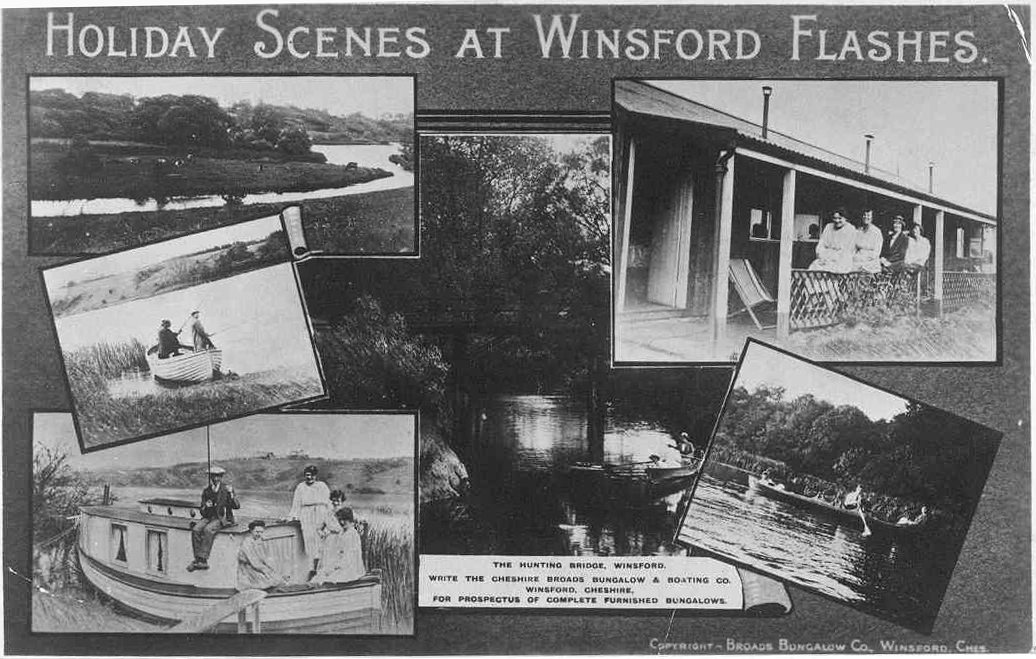
Other holidays were taken much closer to home. The images below were taken on the Cheshire Broads near Winsford. On the left is an advertisement from 1930 for holiday bungalows at the edge of the Flashes near Wharton; and on the right is a group holidaying at the bungalows around that time. 


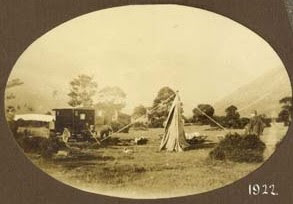
Camping and caravanning holidays started to become popular in the early twentieth century, and we have photos of them in one of our collections - the records of the Baker family of Runcorn. Chemist and university lecturer Harry Baker (1859-1935) was a prolific amateur photographer from the 1880s to the 1920s, and his collection includes images of his family on holidays, including going camping:


Don’t forget Cheshire Archives and Local Studies also holds a wide range of holiday images from before people had access to cameras, including sketches and paintings of holidays scenes, and travel diaries.  A selection can be seen in our Travel Plans blog. 

If you’re going away this summer, don’t forget to take some photos – and then print them out! We wish you a happy holiday. 


All these images and more can be viewed at Cheshire Record Office in Chester. Cheshire Image Bank is available at www.CheshireImageBank.org.uk