Pages

Showing posts with label Cataloguing. Show all posts

Wednesday, 14 December 2022

The Journey of a Local Studies Donation

Earlier this year we received a fantastic collection of photographs of Crewe in the 1890s, kindly donated to us by one of our volunteers, Susan. We thought this blog would be a great opportunity to showcase the collection, as well as thank Susan for her donation, and to highlight all the staff and volunteers involved with the donation and cataloguing process.

First a bit more about the photographs, and why Susan decided to donate it to us. Richard Baxter Booth was a Crewe dental surgeon, and this photograph collection was compiled by him in the 1890s.

Susan says “I found the album for sale on eBay, and Baxter Booth’s granddaughter has been shown the images; her father, Walter (Baxter Booth’s son) was also a dentist and keen photographer. This is album number two; number one is lost unfortunately. Baxter Booth’s dental surgery was in the row of buildings on Crewe Market Square that was replaced by Marks & Spencer, it was the last one on the left on the corner of what is now Queensway. After his marriage he lived at Oaklands in Haslington; he was an active member of the Crewe Cycling Club, the Crewe Alexandra Cricket Club, and Crewe Golf Club. All the images are 'Kodak no. 2' prints”. Baxter Booth had previously lived at Fields Farm, Haslington, rented from the Crewe Estate.

Once we had received the collection and Susan had completed our donation form, the photographs were passed to one of our conservators, Angela.

Angela says, “The original binding had completely failed, so the loose album pages were cleaned with a plastic eraser and placed into custom made polyester sleeves and then put into an acid free folder. These preservation measures will protect the album pages and photographs when they are being handled and also protect them from dust and any fluctuating environmental conditions they may encounter.”


Next, the collection was looked at in more detail by our Local Studies Librarian, Heather. She tells us, “The collection was added to CALM, our collections management system, so that it could be found by staff, researchers, and members of the public online. CALM generated a unique 6-digit reference code for the item, 231804. It was also given a class number of VPH96, which helps to locate the item in our visual collection. Here I am storing the collection away in one of our strongrooms, in an archive box, and where temperature and humidity levels are monitored.”


Another of our volunteers, Helen, was tasked with looking at each individual photograph and indexing it onto a spreadsheet.

Helen says “I am currently a volunteer working on the photographic archives at Duke Street, finding out any extra information about the subjects of the photographs and then entering all the information onto a spreadsheet. These spreadsheets, such as the one I worked on for the Richard Baxter Booth collection, will allow the public to access the information online, widening public access to the contents of the archives.”

This should help any researcher interested in the collection to find the exact photograph most useful to them. Helped by Susan’s knowledge of the area at the time, and of the photographer Richard Baxter Booth, this task is now complete. Please speak to a member of staff if viewing this spreadsheet would be helpful to your research.


We have not yet digitised the whole collection, but a selection of our favourites are featured below. The album contains scenes and events in Crewe, such as the Crewe Flower Show and a football match, as well as buildings (the Mechanics Institute, Town Hall, pubs, churches), and also features the residences of other doctors/medical men in Crewe such as Dr Atkinson’s residence “Mirion House” on Earle Street. The photographer also used his friends, family, and pets as his subjects.


The next step will be to have more of this fantastic album digitised and available on the Cheshire Image Bank website. 

If this blog has inspired you to consider donating an item or collection to us, then we would love to hear from you. Please do contact us first, as we can then check that the item fits with our collection policy and is not something we already have. You can get in touch with us via our website, telephone 01244 972574 or email recordoffice@cheshiresharedservices.gov.uk.  

All of these photographs and more are available to view at Cheshire Record Office in Chester.

Monday, 2 August 2021

A student's virtual experience at Cheshire Archives!

We always enjoy playing host to work experience students during the summer holidays, and last year we were disappointed not to be able to offer any placements as a result of the pandemic. This year,  equipped with a lot more experience of remote working, we were able to offer our first ever online work experience placements!  Read on to hear what student Noah thought of his placement...

As someone who loves history, my work experience with the Cheshire Archives has been a great experience. I have had a chance to contribute to the archives which has been quite rewarding and it has also left me with a few questions and ideas that I can now go away and consider.

My week started with indexing Parkside Asylum cases and noting down any interesting cases that I came across. The main challenge here was deciphering the handwriting. For each new page there was different handwriting and so each case took some time to figure out what the letters were in the different scripts. On top of this, some of the spelling was questionable at times. However, after some time I did get used to this new style of writing and became much more efficient at understanding what was being said. Many of the cases were sad to read because it was clear that the majority of the people had mental health problems and were by no means “lunatics”. Some had depression, or as they termed it “melancholia”, others had delusions about religion amongst other things.

One of the cases that stood out to me was that of 19-year-old Thomas James Lloyd. His “attack” as they called it had been going on for “several years” which would make him younger than me when he began to experience problems. I think that the text speaks for itself:

"Had in his hand a small horn which he said was sanctified. Continually blowing it (sounding the Bugle as he termed it) and he was struggling to win all nations for Queen Victoria's sake. Had a plan for poisoning the Devil. That he had sanctified the school his bed and bedclothes. That the Lord had told him by trances and wisdom what to do. Moses Samuel Brickhill, one of the Labor Masters who informed me that he would suddenly leave his work move a few paces, tear the grass and lift it high: implacing a blessing upon it. That he put a chamber utensil on his head and poured its contents down his back."

Photograph of Thomas James Lloyd

Extract of Thomas James Lloyd's case notes, reference NHM 8/2/6/124a-e.
View the full case notes here.


As with many of the cases that I saw, though with this one in particular, I wondered what caused this to happened and what their life was like after being in the asylum. Whilst they are given names, I could not necessarily get an understanding of what they were like as a person. This is perhaps therefore a limitation of records such as these. As with a lot of history, maybe these questions that I have about
who that person was may go unanswered.

Chester: River Dee, Queens Park Bridge. Ken Evans. Copyright 2020 Chester Chronicle. 

The second project that I did was sorting out photographs taken by Ken Evans, a photographer for the Chester Chronicle. The photographs covered a long time period, from the late 1940s to the 1990s. My first job was to date as best we could the photograph. I went about this by looking at the clothes, the age of people if they were known and looking at the whole image with a holistic approach to get an idea which decade it was from. This was made easier if on the back of the photograph (this was accessible by the photograph’s accession number) there was further information. The accession number also helped with my next job which was to title the image. For this I had to find out where it was and who was in the photograph if anyone. Sometimes this was virtually impossible because the background was some unidentifiable building or trees. However, this was a very fun part of this project. If there were some unique buildings, say a church, I could Google “churches in x” and various images would come up and I would be able to cross-reference the photograph with other photographs. Moreover, I could go onto Google Maps and find out what orientation the photograph was in which led me to walk about Chester on Google street view.


Chester: River Dee, 1953. Ken Evans. Copyright 2020 Chester Chronicle.

The next job was to write a brief description of the photograph. This could be one line or several, depending on how much was going on in the photograph. However, a rough guide to this was to describe people, places and events. After this I needed to find out some further information on what was going on in the photograph. This needed to be generally related to Cheshire and fortunately if it was a famous person, for example Prince Charles, I could look up other photographs of them in the Cheshire Image Bank and look at what other people wrote about them. My final two tasks were to note if the photograph could be put in a popular collection (I had a few royal visitors) and to write down any keywords that related to the photograph. This would make it easier for people to find a picture on a particular topic, say the Groves.


Chester: The Cross and Eastgate Street. Ken Evans 1951. Copyright 2020 Chester Chronicle. 

With that, that was my final task. Some parts of the work experience were easier than others, though I had to always be conscientious knowing that whatever I wrote had to be accurate in order to be able to be useful.

Some questions that this experience has left me are:

  • What are the limitations and positive attributes of different types of documents?
  • How have the terms used to describe mental health problems changed over time?
  • How can we work with the fact that we do not have access to all information?

I would like to finish by thanking all those working at the Cheshire Archives who put this together despite the coronavirus!


Thank you Noah for all of your hard work during your placement!

Monday, 13 July 2020

Swapping Conservation Tools for a Mouse: My Conservation Lockdown Story

                In the archive conservation studio

I started writing this blog back in May, before my ancient but trusted laptop decided it didn’t like working from home, preferring to support me with online shopping, researching upcoming hill walks and most importantly safeguarding my precious digital photographs.

It just couldn’t cope with the world of digital Archives; handling metadata, Zooming (albeit with sound only!), Trello and Zooniverse. After a fortnight of trying to revive it, it gave up and took my work with it!

Six weeks later and armed with an updated and fully functioning PC, I’ve resumed my blog and have been reflecting on what has been an extraordinary few months for all of us.


                                              “Computer says no”

The Announcement

I felt a bit like my old laptop on the evening of 23rd March after the Prime Minister advised us to all “Stay at Home”. We had set up a work What’s App group in preparation and received a message instructing us not to come into work again until further notice. We needed to work from home.

“Can I pop in and get some work?” I asked desperately. I needed the security of at least having my conservation tools close by, we had no idea how long this would last. The reply was understandably, a resounding “No”. This was not going to be an easy adjustment for me.

Conservators


We are a bit of an anomaly in the Archives, us Conservators (myself and my colleague and friend Rachel). When there is a power outage and everyone else is running around desperately trying to get back onto their PC’s, we remain calm and carry on. Our work is predominantly hands on and there are always documents in the archive to care for.          

 
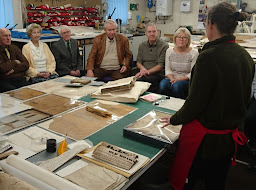
Rachel giving a talk in our studio    

Rachel had decided to set up her own makeshift studio in her new, but mostly undecorated house and would have access to the building to collect work and to monitor the environment in our strong rooms.

(You can read Rachel's fab blog here!)


But what was I going to do?

I had spent the odd day working from home, usually the result of a train strike. Living in Shrewsbury, and the archive being in Chester this means I can’t get into work. It’s a good opportunity to catch up with paperwork and plan events and training sessions. But this was going to be for much longer than a single day.

I was definitely at a disadvantage; I don’t drive, I live in a small flat, own a 13 year old laptop, my only broadband access is via an old limited data mobile device and my PC skills are definitely out of date.

But I didn’t have much choice. I would have to get with the programme and go digital!


Desktop working

Our What’s App group proved to be a godsend, especially at the start, as we were all having difficulties accessing our work accounts from home. As events had moved so fast, our IT help desk were overwhelmed with requests so it took time for all of our issues to be resolved, but eventually they were. And we all settled into what is now known as ‘the new norm’.


Initial steps

My introduction to home working came in the guise of ‘Trello’ our virtual staff information board. This would become the hub of our work activity, a place for us to keep track of and to reply to public enquiries, record project activity and generally act as a digital platform to exchange ideas and give feedback.

Now, I just had to jump in and assign myself a job.


Cheshire Image Bank

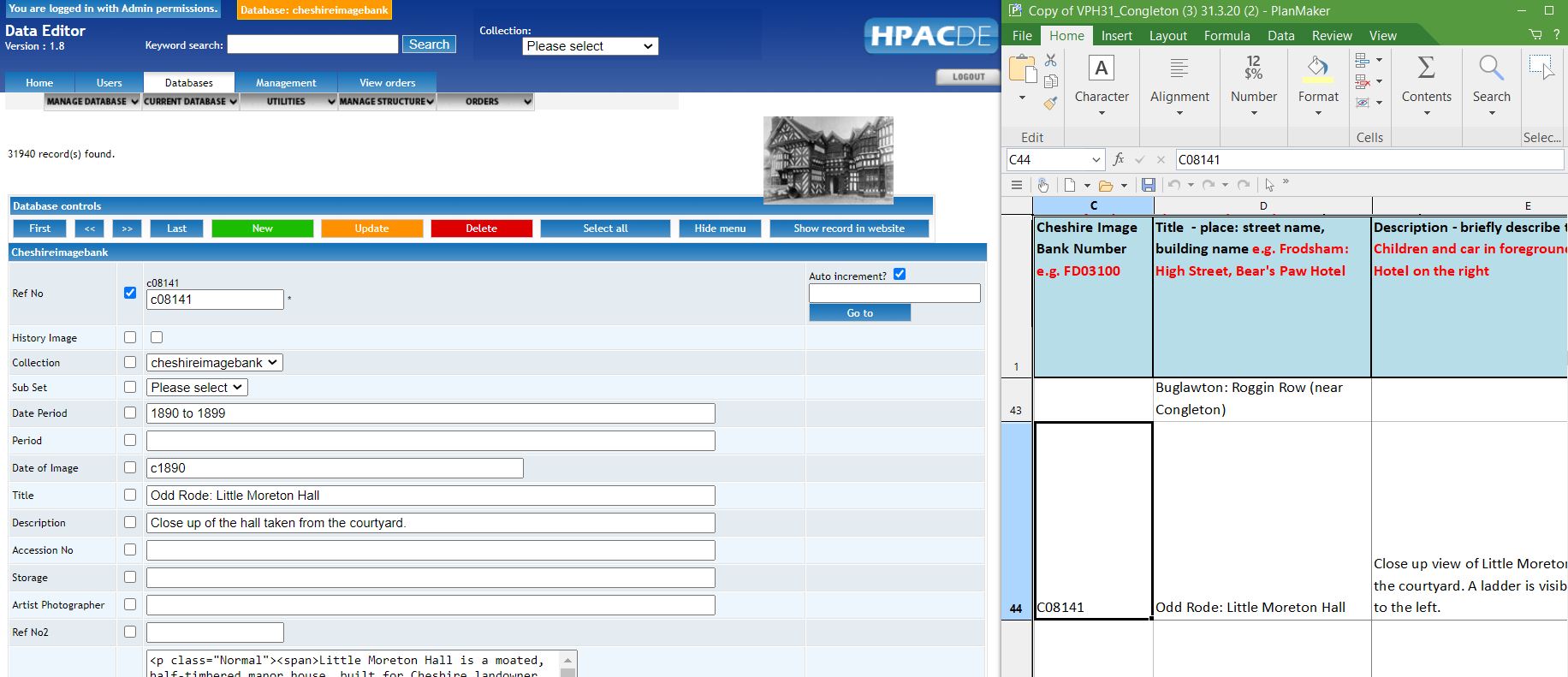
Katie, our Local Studies Adviser was looking for staff to help with their Image Bank Metadata Project; which involved adding and editing information collated by our volunteers onto the Cheshire Image Bank.

Who doesn’t love working with old photographs?

                                                             "What’s Zoom?”

To get us started, Katie ran a training session via Zoom. I had never even heard of Zoom, but it was easy and fun to use. I was put to work on a series of images of the Wolverhampton Corrugated Iron Works in Ellesmere Port from the early 1900s and later on some beautiful images of Congleton from c1890 through to the 1960s.


Little Moreton Hall c.1890

It was a great place to start.


Zooniverse - Parkside Asylum Project

Staff were also needed to test run an exciting new project using digitised copies of casebooks from the old County Lunatic Asylum in Macclesfield, also known as Parkside Asylum. Using the ‘people-powered research platform’ Zooniverse, volunteers will be able to work remotely from anywhere in the world to help make this vast resource of information more accessible for researchers.

                                                                “What’s Zooniverse?”

I found these records absolutely fascinating to work with and as a digital project newbie felt that I was able to contribute some really useful feedback. 


                                                            Working from home!

Online learning


Alongside getting involved in various digital projects, I participated in some online courses and webinars, which we were all encouraged to do. Once again, this was new to me and I was amazed by just how much was available and free to access.

I really enjoyed the Institute of Conservation (ICON) series of webinars: Together at home. These really made me feel connected to the conservation community, not just in the UK but internationally. Rita Udino’s talk from Barcelona on the ‘Conservation of oiled or impregnated tracing paper’ introduced me to a new treatment technique that I will definitely experiment with when I get back to the studio.

Herre de Vries webinar from Amsterdam on ‘The identification of ‘Shark Skin’ on bookbindings as Leather or Parchment’ will have me searching through our volumes to see if I can find any ‘Shagreen’ bindings in our collection.

I also participated in a couple of longer courses on Future Learn. The first was ‘The History of the Book’, a 4 week course run by Trinity College Dublin took me all the way from the origins of printing in the 1540s through to how the storming of the Bastille in 1789 was chronicled. 


 In light of anti-racist protests taking place here and across the world I decided to take Purdue University’s ‘Understanding Diversity and Inclusion’ course. I have just completed Week 2 of 3 and so far have found it very informative and thought provoking. There is a very strong element of reflection and participation in this course and I must say that sharing thoughts and feelings with an international group of students from such diverse backgrounds has been the most rewarding and powerful aspect of it.

Time for reflection


The Quarry Park in Shrewsbury

I think many of us have had more time to reflect during this lockdown and have perhaps reordered our priorities. If someone had asked me 3 months ago what I would miss doing most during this period, hill walking would have been at the very top of my list, closely followed by my regular Sunday visits to ‘Ginger & Co Coffee’ for tea and toast!

To be honest, I’ve not really missed either. I have been constantly amazed by just how much there has been to discover and enjoy on my own doorstep. My fear of falling apart, physically and mentally without hillwalking has proved unfounded. My love of walking and nature has been sustained by my daily perambulation along the River Severn and my fitness by a series of workouts for the over 50s and an old set of dumbbells!

A few of my regular companions


13 weeks into Lock-down

We have all come a long way since the start of the lock down back in March and have had to be flexible and adapt to new ways of working. I really don’t think any of us envisaged it going on for quite so long. Some hundred and odd days later and I have a fancy new PC, fibre broadband and quite a lot of new skills and knowledge in my toolkit.

Friday, 15 May 2020

The Enduring Morris Dance


This blog post was written by our volunteer Megan, who recently catalogued and repackaged our Lesley Edwards collection.

The collection is made up of research papers, photographs and articles relating to Morris dancing in Cheshire, and covers several Cheshire towns and parishes in great detail. You can see the full catalogue for these records here.

Read on to find out more about this intriguing folk dance that has been an English tradition for more than six hundred years!

Cheshire Image Bank (c01114): Godley Hill Royal Morris Men,
prior to the start of the Knutsford May Day procession in 1906.

  
The Morris dance is distinguished by a specific set of characteristics, including rhythmic stepping, folk music, regionally specific costumes, bell pads and the use of sticks and swords. These elements have cemented the Morris dance as a unique, vibrant spectacle and an entertaining recreation.

Cheshire Image Bank (c08403): Fidlers Fancy Morris Group,
Wilmslow Carnival 1970s.

What is truly significant about the tradition of Morris dance, especially with regard to local history, is the settings in which it was found and what it can reveal about the communities that shaped it. 

For example, Morris dancing is often considered to have four distinct geographical variations, identified as Cotswold, Border, Sword Dancing (Yorkshire) and North West; each form shaped by culturally significant regional differences. 

As the centuries moved on and Morris dancing moved from the court out into the parishes to become a staple aspect of community celebration, the Morris adopted a regional identity, and in the North West this was influenced by the mill population.

The North West Morris dance, found in Cheshire and Lancashire, was popular at May and rose festivals, wakes week fairs and notably the rush bearing ceremonies of the 17th century. During this time rushes were brought to local churches and strewn on the floor in an effort to make kneeling more comfortable.  These ceremonies became processional, with the rush bearing carts flanked by Morris dancers. 

Cheshire Image Bank (c11524): Postcard showing
the Morris dancers at the Helsby Rose Queen fete in 1911.

The locality not only determined the ceremonies in which the Morris dancing was performed but also the music, form of the dance and the dress (which was often dependent on what was available). The North West Morris, for example, is described as being performed in a military drill like style. 

Societal shifts are evident in the rise and fall of the Morris dance. Its decline took place throughout the years of the industrial revolution, with the migration of communities away from the rural villages and agricultural lifestyles that had been the lifeblood of the dance.

Cheshire Image Bank (p4772): Chester Morris Women,
Bridge Street 1989.

Throughout the 20th century the Morris dance has undergone various resurgences, demonstrating the durability of the traditional folk dance and underpinning the enduring collective memory that allows it to thrive. 

Much of the research that has supported these revivals has come from the first hand accounts and memories of past Morris Dancers. The Lesley Edwards collection at Cheshire Archives and Local Studies provides a wealth of information on the Cheshire Morris dance, from steps, to costume and music. It is through the collation of research like this that the finer details of the regional forms of Morris dance are remembered and sustained.                                                                                                                                                    
Finally a quote from Alderley and Wilmslow Advertiser gives a glimpse into the simple purpose of the enduring Morris dance by emphasising the joy it bought to Mayday summer celebrations:

‘‘Their peculiar mode of dancing is certainly very pretty. Their dresses are handsome in the extreme.’