Pages

Showing posts with label Conservator. Show all posts

Wednesday, 15 March 2023

Behind the Scenes in Conservation: Drawings of the Heraldic Coats of Arms for Queens Park Suspension Bridge


There’s nothing that gets our hearts racing more than being presented with a box of dirty, torn, and tatty plans and being asked to Conserve them! In this instance, a map box containing ten rolled bundles of drawings of the Heraldic Coats of Arms for the ‘new’ Queens Park Suspension Bridge in Chester (ref. ZCR/715/1-10).


What are the drawings of?

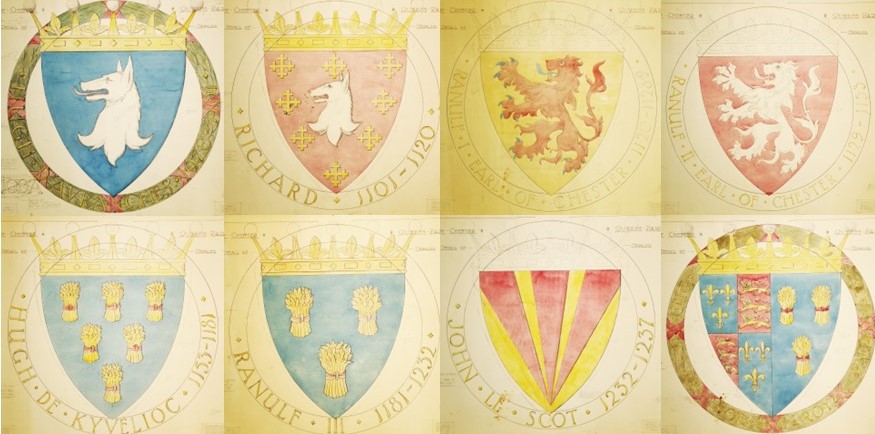
The first suspension bridge from the Groves to the new housing at Queens Park was built in 1852. This first bridge was replaced in 1923 by the Corporation at a cost of £7,000. These drawings are of the heraldic coats of arms of eight Norman Earls of Chester which decorate the arches above the bridge. The drawings are by architects F.A. Roberts and P.H. Lawson of 88 Foregate Street, Chester.

Why conserve these plans when we have so many others that need our care?

Events, activities and exhibitions are being organised to celebrate the one hundred year anniversary of Queens Park suspension bridge during May and June of this year. These plans, along with other related material, have been chosen by our Archivists’ to support this work.


How were the drawings made and what condition are they in?

An outline of the heraldic shield encircled by a wreath was printed onto paper and used as a template for the drawings. The designs have been hand drawn at full scale and coloured. There are eight completed designs with a set of additional pencil drafts of the designs on tracing paper. Media used for the drawings include pencil (for outline and shading), water colour paint and ink.


Once unrolled, we can assess the condition. Much of the damage has been caused historically by poor handling and storage. We find surface dirt, tears, missing areas (lacunae) and areas of paper degradation, especially along the top and bottom edges.

The conservation treatment consists of cleaning, flattening and repairing the plans so that they can be handled safely, without causing further damage, digitised and exhibited.


How do we remove the surface dirt?

The bread and butter of any Paper Conservators’ work is cleaning, and lots of it! It looks simple, but it takes years of experience (and sore fingers) to develop techniques that work effectively and that don’t cause damage to the original material.


These drawings were especially challenging to clean as the artist has used pencil for outlining and shading. We need to remove the general surface dirt whilst being careful not to remove the actual pencil. Using thin wedges of vinyl eraser we are able to carefully work around the pencil and remove the surface dirt.


How do we get them flat?

Next, we need to ‘flatten’ the rolled plans so that we can repair them. The drawings are placed in a large ‘damp-pack’ to introduce water vapour into the paper in a very controlled and gentle way. This in turn will ‘relax’ the individual paper fibres and make the paper more pliable. Once damp, they are placed under thick sheets of blotting paper and covered with sheets of Perspex, then weighted down to flatten them.


The humidification chamber (damp pack) we use is made up of a layer of clear polyester, a wet layer of capillary matting and a layer of Sympatex (a breathable waterproof membrane) on the top. The same three layers are then placed over that in reverse order, and the document placed in the middle to receive the water vapour and ‘relax’!

How do we mend the tears and fill in the lacunae?

Most of the drawings have some minor tears that need repairing, but a few of them, including ZCR/715/4 for Ranulf I, Earl of Chester, 1101–1120, have suffered more substantial damage. This long horizontal tear was likely to have been caused by someone attempting to unroll the plan. This sort of damage is commonly seen in large paper documents such as maps and plans that have been stored rolled.


The process begins with cooking some fresh wheat starch paste to use as an adhesive for the paper repairs, which we prepare in the Conservation studio. After cooking and cooling the paste, we sieve it three times to create a super smooth and sticky, but fully reversible paste.


It can be difficult realigning long tears so that the image area joins up accurately, even when the paper appears perfectly flat. Paper can be affected by levels of high humidity, so any exposure in the past, and during the humidification process can alter the placement of paper fibres making it difficult and sometimes impossible to join them perfectly.


We apply paste using a small brush to the edges of the tear, working on the image side (the recto) to check on alignment, and work along a small section at a time. This is sometimes called ‘Chasing the tear’! When the edges are joined, we turn the drawings over and adhere a section of Japanese repair paper to support this area from the back (the verso).

How do we consolidate these repairs?

Adding a support layer on the verso is essential when repairing tears as it adds strength to weak and degraded areas and allows the repaired paper to flex normally without any further damage being caused. We select a Japanese paper (Kozo Shi) of lighter weight but similar colour to the original document. The repaired areas need to be clearly visible but also be sympathetic to the original material.


Handmade Japanese papers are ideal as they have long fibres and keep their strength when wetted out. We use a mattress needle to score the repair paper to the shape and size we need, wet with a water brush and tear the support out. The resulting long fibred edges make for a strong and sympathetic support layer once pasted down.


What about the lacunae?

We add repair paper to infill and strengthen missing areas. This also includes replacing original material that has become detached. Using a heavier Japanese paper (Bunkoshi) that equals or is a bit lighter than the original and working on a light (illuminated) table; we score the exact area missing with a mattress needle.


We then soften the paper fibres using a Rotring pen filled with water and tear out the infill, add paste to the reverse and adhere in place to fill in the missing area. The repair to this plan is finally complete after the repairs have dried and trimmed with a sharp scalpel. As a final protective measure they are placed into transparent polyester sleeves.


We still have a bit of work to do until they are all conserved and accessible, but they will be ready in plenty of time for the upcoming events and activities. We wait, in eager anticipation, for the next box of tatty items to appear in our conservation studio!


To hear about future events subscribe to our newsletter at www.cheshirearchives.org.uk 


Monday, 13 July 2020

Swapping Conservation Tools for a Mouse: My Conservation Lockdown Story

                In the archive conservation studio

I started writing this blog back in May, before my ancient but trusted laptop decided it didn’t like working from home, preferring to support me with online shopping, researching upcoming hill walks and most importantly safeguarding my precious digital photographs.

It just couldn’t cope with the world of digital Archives; handling metadata, Zooming (albeit with sound only!), Trello and Zooniverse. After a fortnight of trying to revive it, it gave up and took my work with it!

Six weeks later and armed with an updated and fully functioning PC, I’ve resumed my blog and have been reflecting on what has been an extraordinary few months for all of us.


                                              “Computer says no”

The Announcement

I felt a bit like my old laptop on the evening of 23rd March after the Prime Minister advised us to all “Stay at Home”. We had set up a work What’s App group in preparation and received a message instructing us not to come into work again until further notice. We needed to work from home.

“Can I pop in and get some work?” I asked desperately. I needed the security of at least having my conservation tools close by, we had no idea how long this would last. The reply was understandably, a resounding “No”. This was not going to be an easy adjustment for me.

Conservators


We are a bit of an anomaly in the Archives, us Conservators (myself and my colleague and friend Rachel). When there is a power outage and everyone else is running around desperately trying to get back onto their PC’s, we remain calm and carry on. Our work is predominantly hands on and there are always documents in the archive to care for.          

 
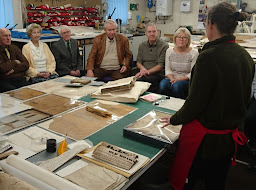
Rachel giving a talk in our studio    

Rachel had decided to set up her own makeshift studio in her new, but mostly undecorated house and would have access to the building to collect work and to monitor the environment in our strong rooms.

(You can read Rachel's fab blog here!)


But what was I going to do?

I had spent the odd day working from home, usually the result of a train strike. Living in Shrewsbury, and the archive being in Chester this means I can’t get into work. It’s a good opportunity to catch up with paperwork and plan events and training sessions. But this was going to be for much longer than a single day.

I was definitely at a disadvantage; I don’t drive, I live in a small flat, own a 13 year old laptop, my only broadband access is via an old limited data mobile device and my PC skills are definitely out of date.

But I didn’t have much choice. I would have to get with the programme and go digital!


Desktop working

Our What’s App group proved to be a godsend, especially at the start, as we were all having difficulties accessing our work accounts from home. As events had moved so fast, our IT help desk were overwhelmed with requests so it took time for all of our issues to be resolved, but eventually they were. And we all settled into what is now known as ‘the new norm’.


Initial steps

My introduction to home working came in the guise of ‘Trello’ our virtual staff information board. This would become the hub of our work activity, a place for us to keep track of and to reply to public enquiries, record project activity and generally act as a digital platform to exchange ideas and give feedback.

Now, I just had to jump in and assign myself a job.


Cheshire Image Bank

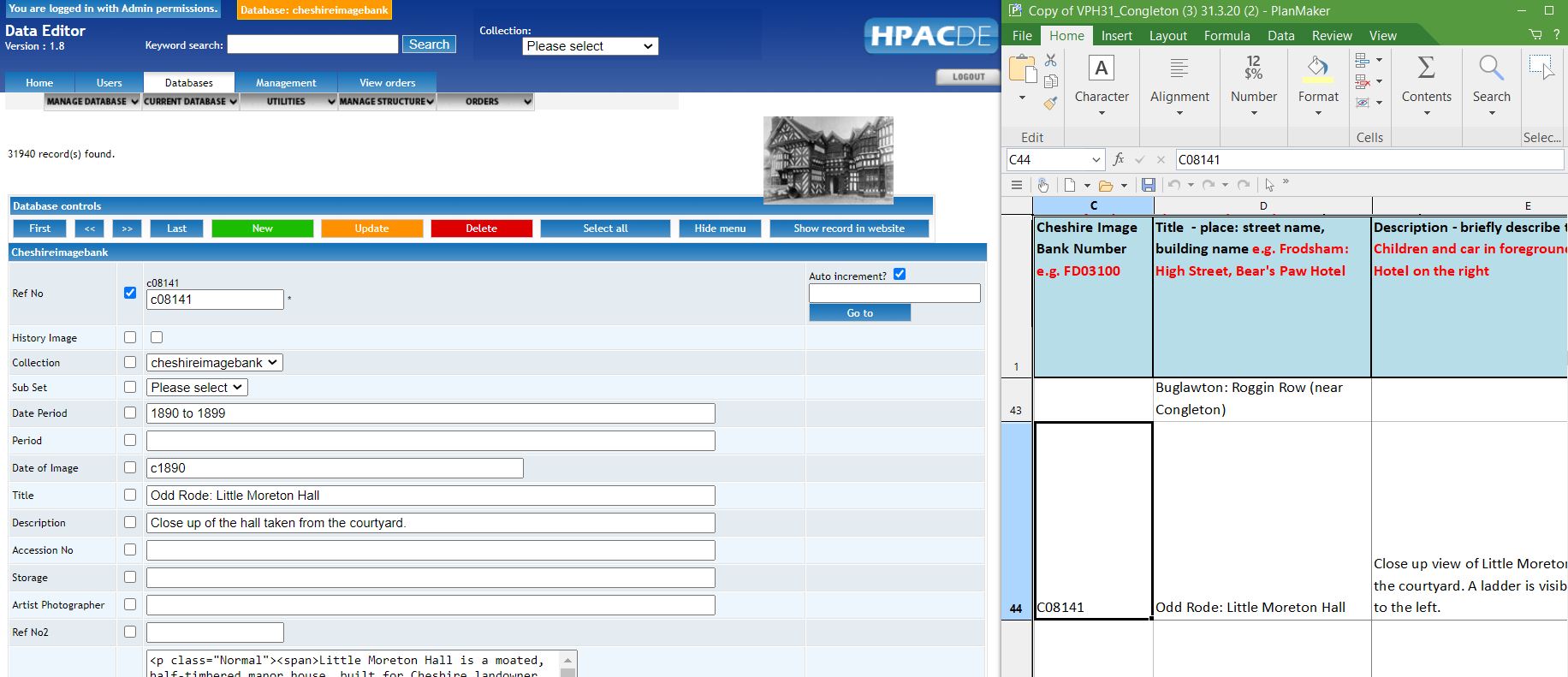
Katie, our Local Studies Adviser was looking for staff to help with their Image Bank Metadata Project; which involved adding and editing information collated by our volunteers onto the Cheshire Image Bank.

Who doesn’t love working with old photographs?

                                                             "What’s Zoom?”

To get us started, Katie ran a training session via Zoom. I had never even heard of Zoom, but it was easy and fun to use. I was put to work on a series of images of the Wolverhampton Corrugated Iron Works in Ellesmere Port from the early 1900s and later on some beautiful images of Congleton from c1890 through to the 1960s.


Little Moreton Hall c.1890

It was a great place to start.


Zooniverse - Parkside Asylum Project

Staff were also needed to test run an exciting new project using digitised copies of casebooks from the old County Lunatic Asylum in Macclesfield, also known as Parkside Asylum. Using the ‘people-powered research platform’ Zooniverse, volunteers will be able to work remotely from anywhere in the world to help make this vast resource of information more accessible for researchers.

                                                                “What’s Zooniverse?”

I found these records absolutely fascinating to work with and as a digital project newbie felt that I was able to contribute some really useful feedback. 


                                                            Working from home!

Online learning


Alongside getting involved in various digital projects, I participated in some online courses and webinars, which we were all encouraged to do. Once again, this was new to me and I was amazed by just how much was available and free to access.

I really enjoyed the Institute of Conservation (ICON) series of webinars: Together at home. These really made me feel connected to the conservation community, not just in the UK but internationally. Rita Udino’s talk from Barcelona on the ‘Conservation of oiled or impregnated tracing paper’ introduced me to a new treatment technique that I will definitely experiment with when I get back to the studio.

Herre de Vries webinar from Amsterdam on ‘The identification of ‘Shark Skin’ on bookbindings as Leather or Parchment’ will have me searching through our volumes to see if I can find any ‘Shagreen’ bindings in our collection.

I also participated in a couple of longer courses on Future Learn. The first was ‘The History of the Book’, a 4 week course run by Trinity College Dublin took me all the way from the origins of printing in the 1540s through to how the storming of the Bastille in 1789 was chronicled. 


 In light of anti-racist protests taking place here and across the world I decided to take Purdue University’s ‘Understanding Diversity and Inclusion’ course. I have just completed Week 2 of 3 and so far have found it very informative and thought provoking. There is a very strong element of reflection and participation in this course and I must say that sharing thoughts and feelings with an international group of students from such diverse backgrounds has been the most rewarding and powerful aspect of it.

Time for reflection


The Quarry Park in Shrewsbury

I think many of us have had more time to reflect during this lockdown and have perhaps reordered our priorities. If someone had asked me 3 months ago what I would miss doing most during this period, hill walking would have been at the very top of my list, closely followed by my regular Sunday visits to ‘Ginger & Co Coffee’ for tea and toast!

To be honest, I’ve not really missed either. I have been constantly amazed by just how much there has been to discover and enjoy on my own doorstep. My fear of falling apart, physically and mentally without hillwalking has proved unfounded. My love of walking and nature has been sustained by my daily perambulation along the River Severn and my fitness by a series of workouts for the over 50s and an old set of dumbbells!

A few of my regular companions


13 weeks into Lock-down

We have all come a long way since the start of the lock down back in March and have had to be flexible and adapt to new ways of working. I really don’t think any of us envisaged it going on for quite so long. Some hundred and odd days later and I have a fancy new PC, fibre broadband and quite a lot of new skills and knowledge in my toolkit.

Wednesday, 27 May 2020

A Conservator's Blog


Being a bit of a technophobe not having a PC or broadband was never really a problem; mobile phone reception was problematic and occasionally warranted running up the lane to the second oak tree on the right and waving my phone wildly about. But when lockdown was announced I did wonder if I’d made the right decision in being so unconnected with the outside world. How was I going to get any work done? All the other Record Office staff were able to work from home online.  Luckily I had a few days to think about it as I was on leave that week.

Being a conservator I decided that I’d conserve (if my manager agreed to it and luckily she did!), but what? I was limited to what materials and equipment I could take home, so it needed to be fairly simple. Also, what could I work on? Taking unique and valuable documents out of the safety of the Record Office would not be right. Second edition Ordnance Survey maps (25 inch) were the answer.  They are not unique and have no real financial value but they are often consulted in the searchroom and a very useful resource. The first and third editions have already been conserved as these were the most often looked at, but there were still a considerable number of second edition maps that were dirty, tatty, torn and creased with odd areas missing and in need of conservation. This I could do at home, although the encapsulation of the maps (custom made protective sleeves made of clear, inert polyester film) would have to wait till lockdown ended.

Close-up of a 2nd edition Ordnance Survey map.

Setting up a makeshift conservation studio was the next challenge. I’d decided upon the back sitting room which had plenty of light and space.  I’d moved house the previous summer and this room was still very much a work in progress. Bifolding doors had been put in, but there was still plenty of bare plaster and I’d been using the room as storage for boxes and furniture.  The remaining days of my leave were spent decorating, cleaning and tidying. The dining room table was utilised as my work table (for cleaning) and an old desk was used to do the repairs on.  I repainted on old cupboard which was to be used for storing materials and equipment. The O.S. maps are large objects (measuring approximately 1.05m x 0.72m) and I needed space to store the maps when I wasn’t working on them.  A redundant door (I’d just had a doorway bricked up) was employed as a makeshift table which was propped up by three dining room chairs – conservators are nothing if not resourceful!

My home conservation studio was soon up and running and working pretty well.

Faddiley annex of Cheshire Record Office.

As a conservator one of my duties at the Record Office was once a week to monitor and record the environmental conditions in each of the seven strongrooms, this still needed to be done. As I have a car I drive to the office once a week to check on the strongrooms, catch up on emails and check on the post. While I’m there I pick up a batch of O.S. maps to take home and bring back the ones I’ve conserved. I also cook up fresh paste once a fortnight as it soon starts going mouldy and needs to be kept in the fridge.

I love looking at maps, even O.S. maps from 1898. While I’m cleaning the maps my mind starts wandering and I wonder how the areas have changed over the past 120 years. I really wish I had the internet to look at our tithe map website, which not only shows all the tithe maps we hold, but all three editions of the 25 inch O.S. maps, aerial photographs and a current map. It’s a fantastic resource, you are able to zoom in and out of the maps and compare two different maps of the same areas. It also gives you such details as field names, owners/occupiers and land use. On thinking, it’s probably a good thing I don’t have the internet as I’d spend way too much time looking at the website each time I worked on a new map.  

Some of the names of buildings and places spark my interest, such as ‘Black Jane’s farm’ near Daresbury, who was Black Jane? And who ever lived at ‘Hades Nook’ (near Whitley)? I love the descriptive names such as ‘Thatched House Farm’, does the farm still exist and is it still thatched?  And the slightly surreal ‘Waterless Bridge’ (near Tabley) which goes over ‘Waterless Brook’, does it have any water in it? The tithe map website might just have the answer. 

Cleaning maps is a relatively simple technique and involves using a pure vinyl eraser which you rub over the surface of the map. Care, skill and experience is required in order not to leave any dirty streaks or create or worsen tears. Any pencil annotations have to be carefully cleaned around, a slip of the eraser and the pencil marks would soon be lost. Removal of surface dirt is necessary as dirt is not only visually distracting, but can be harmful to the map; it can be abrasive, acidic; act as food for insects and for mould to grow on.


Once cleaned the maps are repaired. Tears are repaired with a strong acid free lens on the back or, in professional speak, verso and a finer, transparent Japanese Kozo tissue (made from the fibres of the mulberry tree) on the front or recto. The tissue is cut out with a mattress needle and pasted down with a pure wheat starch paste; the tissue is smoothed down with a Teflon bone folder and pieces of paper maker’s felts and boards are place over the repair with a weight placed on top until the repair is dry.  Missing areas are filled in with a heavy weight, long fibred Japanese paper called Bunkoshi which has a similar colour, weight and texture as the original map paper. The repair paper is shaped to the missing area with a rotring pen filled with water. Once dry the repairs are trimmed to the size of the map.

Tools of the trade.

What am I enjoying working at home? Watching the garden birds, I can see the bird feeder from my work room and love watching the male pheasant strutting through the garden. My greenhouse – for a break I’ll take my mug of tea out there to see what has germinated and which bulbs are coming through; the plants are getting very well looked after at the moment. Getting to know my lovely neighbour, sometimes my morning break consists of talking to her over the garden fence mug in hand (and at a safe social distance).

Fezzy the tame pheasant on top of the hedge.

What am I missing? The staff, especially fellow conservator Angela, who, after over 10 years of working together is a good friend as well as colleague; not having the internet makes you feel more isolated from everyone. Cake, the staff tearoom is always well endowed with cake and biscuits kindly supplied by staff and searchers.

Excitement – it was silage week last week, the quiet lane was turned into a scene from wacky races with many tractors and trailers going up and down, and the fields change by the minute. Unfortunately it’s muck spreading week this week.

Thanks – to Radio 4 for keeping me entertained and sane.

Working from home has been an enjoyable challenge and brings back memories of doing work experience here 27 years ago, when cleaning O.S. maps was my first task. So far I have cleaned and repaired 54 O.S. maps.  I have cleaned an area of 82.04 metres squared, which is the equivalent of a fifteenth of an Olympic sized swimming pool.  I am less than halfway through the maps still to be repaired, so I should be able to be kept busy if lockdown continues.