Pages

Showing posts with label Frank Simpson. Show all posts

Wednesday, 15 March 2023

Behind the Scenes in Conservation: Drawings of the Heraldic Coats of Arms for Queens Park Suspension Bridge


There’s nothing that gets our hearts racing more than being presented with a box of dirty, torn, and tatty plans and being asked to Conserve them! In this instance, a map box containing ten rolled bundles of drawings of the Heraldic Coats of Arms for the ‘new’ Queens Park Suspension Bridge in Chester (ref. ZCR/715/1-10).


What are the drawings of?

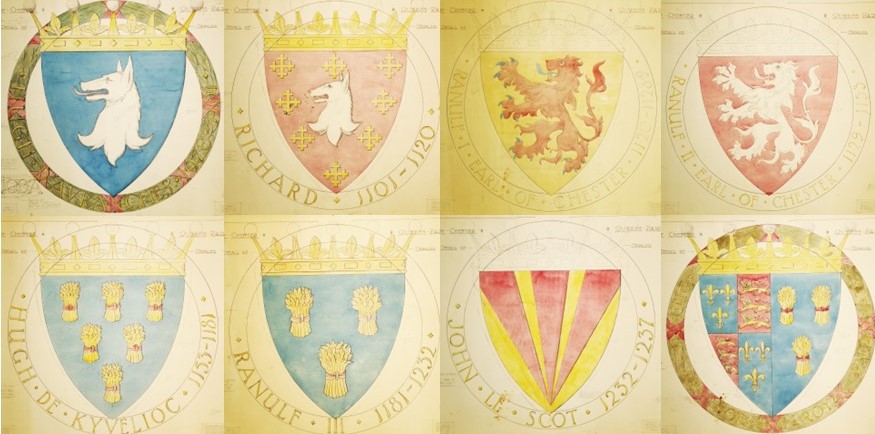
The first suspension bridge from the Groves to the new housing at Queens Park was built in 1852. This first bridge was replaced in 1923 by the Corporation at a cost of £7,000. These drawings are of the heraldic coats of arms of eight Norman Earls of Chester which decorate the arches above the bridge. The drawings are by architects F.A. Roberts and P.H. Lawson of 88 Foregate Street, Chester.

Why conserve these plans when we have so many others that need our care?

Events, activities and exhibitions are being organised to celebrate the one hundred year anniversary of Queens Park suspension bridge during May and June of this year. These plans, along with other related material, have been chosen by our Archivists’ to support this work.


How were the drawings made and what condition are they in?

An outline of the heraldic shield encircled by a wreath was printed onto paper and used as a template for the drawings. The designs have been hand drawn at full scale and coloured. There are eight completed designs with a set of additional pencil drafts of the designs on tracing paper. Media used for the drawings include pencil (for outline and shading), water colour paint and ink.


Once unrolled, we can assess the condition. Much of the damage has been caused historically by poor handling and storage. We find surface dirt, tears, missing areas (lacunae) and areas of paper degradation, especially along the top and bottom edges.

The conservation treatment consists of cleaning, flattening and repairing the plans so that they can be handled safely, without causing further damage, digitised and exhibited.


How do we remove the surface dirt?

The bread and butter of any Paper Conservators’ work is cleaning, and lots of it! It looks simple, but it takes years of experience (and sore fingers) to develop techniques that work effectively and that don’t cause damage to the original material.


These drawings were especially challenging to clean as the artist has used pencil for outlining and shading. We need to remove the general surface dirt whilst being careful not to remove the actual pencil. Using thin wedges of vinyl eraser we are able to carefully work around the pencil and remove the surface dirt.


How do we get them flat?

Next, we need to ‘flatten’ the rolled plans so that we can repair them. The drawings are placed in a large ‘damp-pack’ to introduce water vapour into the paper in a very controlled and gentle way. This in turn will ‘relax’ the individual paper fibres and make the paper more pliable. Once damp, they are placed under thick sheets of blotting paper and covered with sheets of Perspex, then weighted down to flatten them.


The humidification chamber (damp pack) we use is made up of a layer of clear polyester, a wet layer of capillary matting and a layer of Sympatex (a breathable waterproof membrane) on the top. The same three layers are then placed over that in reverse order, and the document placed in the middle to receive the water vapour and ‘relax’!

How do we mend the tears and fill in the lacunae?

Most of the drawings have some minor tears that need repairing, but a few of them, including ZCR/715/4 for Ranulf I, Earl of Chester, 1101–1120, have suffered more substantial damage. This long horizontal tear was likely to have been caused by someone attempting to unroll the plan. This sort of damage is commonly seen in large paper documents such as maps and plans that have been stored rolled.


The process begins with cooking some fresh wheat starch paste to use as an adhesive for the paper repairs, which we prepare in the Conservation studio. After cooking and cooling the paste, we sieve it three times to create a super smooth and sticky, but fully reversible paste.


It can be difficult realigning long tears so that the image area joins up accurately, even when the paper appears perfectly flat. Paper can be affected by levels of high humidity, so any exposure in the past, and during the humidification process can alter the placement of paper fibres making it difficult and sometimes impossible to join them perfectly.


We apply paste using a small brush to the edges of the tear, working on the image side (the recto) to check on alignment, and work along a small section at a time. This is sometimes called ‘Chasing the tear’! When the edges are joined, we turn the drawings over and adhere a section of Japanese repair paper to support this area from the back (the verso).

How do we consolidate these repairs?

Adding a support layer on the verso is essential when repairing tears as it adds strength to weak and degraded areas and allows the repaired paper to flex normally without any further damage being caused. We select a Japanese paper (Kozo Shi) of lighter weight but similar colour to the original document. The repaired areas need to be clearly visible but also be sympathetic to the original material.


Handmade Japanese papers are ideal as they have long fibres and keep their strength when wetted out. We use a mattress needle to score the repair paper to the shape and size we need, wet with a water brush and tear the support out. The resulting long fibred edges make for a strong and sympathetic support layer once pasted down.


What about the lacunae?

We add repair paper to infill and strengthen missing areas. This also includes replacing original material that has become detached. Using a heavier Japanese paper (Bunkoshi) that equals or is a bit lighter than the original and working on a light (illuminated) table; we score the exact area missing with a mattress needle.


We then soften the paper fibres using a Rotring pen filled with water and tear out the infill, add paste to the reverse and adhere in place to fill in the missing area. The repair to this plan is finally complete after the repairs have dried and trimmed with a sharp scalpel. As a final protective measure they are placed into transparent polyester sleeves.


We still have a bit of work to do until they are all conserved and accessible, but they will be ready in plenty of time for the upcoming events and activities. We wait, in eager anticipation, for the next box of tatty items to appear in our conservation studio!


To hear about future events subscribe to our newsletter at www.cheshirearchives.org.uk 


Wednesday, 6 October 2021

Chester's Delightful River Dee!

Have you tried our Talking Tour of Chester? It’s a self-guided walking tour of interesting parts of the city, made from oral histories recorded around 40 years ago. It features local people’s memories of events like the famous Chester Regatta, and the opening of the landmark Queen’s Park suspension bridge - but Cheshire Archives and Local Studies holds a huge amount of material on all aspects of the River Dee, going back centuries.

Lost trades

People have made their living on the river, not only from boat hire that still runs today, but in lost trades such as traditional salmon fishing. These photographs from c.1900 and 1969 show the nets that used to be seen along the banks, and fishermen hauling in their catch.


There also used to be mills along the banks of the Dee, with some only demolished within living memory. This image from 1905 shows ‘The Dee Bridge, Castle and Mills’ and is taken from a photo album by Frank Simpson. He was an authority on the history of Chester and an amateur photographer whose work is held at Cheshire Record Office (not just his photography but also sketches, manuscripts and diaries of local events).


Tragedy on the Dee

Going back even further, we know that people used to use the river for washing. This coroner’s inquest report from 1679 describes the sad death of Mary Alson, a spinster who was swept away and drowned whilst washing clothes in the Dee.

This is just one of countless tragedies from along the river, and the coroners’ reports we hold range from the recent past back to the Middle Ages.

A well-known tragedy was the Dee Bridge Disaster, an 1847 railway accident. Train carriages fell into the river through a new cast iron bridge, killing five people and injuring nine. Cheshire Record Office holds a collection of newspaper cuttings about the inquest, where renowned Victorian engineer Robert Stephenson, who designed the bridge, was accused of negligence.

Chester Regatta

On a happier note, the river has long been used for sport and entertainment, and Chester Regatta combines both. Established in 1733, it still takes place today, making it the oldest rowing regatta of its type in the world. We hold many images of the Regatta - some of which are featured on the searchable Cheshire Image Bank- and this print shows the Regatta in 1854. 


We also hold the archives of the Royal Chester Rowing Club, founded in 1838. A jewel in this collection is a scrapbook begun in 1933 (ZCR 419/3), full of club memorabilia like race programmes, results, press cuttings and photographs. This one is of rowers on the Dee during the Chester Regatta of 1938.


The Port of Chester

We may not give it much thought today, but Chester used to be a significant British port. We have some shipping and boat records covering several centuries, such as QDN 1/5, a register of vessels entering and leaving the port of Chester, 1740 – 1769. It shows information such as the vessel and masters’ names, the destinations, and nature of goods being transported. We can see from these pages that 15 tons of cheese were bound for Parkgate on The Friendship on 21st February 1743 (below left), and that The Duke William arrived from Lisbon with a cargo of wine on 4th May 1754 (below right).

River Management

For anyone interested in the river itself, we hold archives related to the management of the Dee, like those of The River Dee Committee. The Committee was established in 1837 and its main interest was in Acts of Parliament affecting the river and water supply. The collection includes letters, petitions, reports, a minute book, plans on the improvement of the river and volumes of soundings (measurements of the depth of water, which can be used to make maps of riverbeds and nautical charts). 


Bridges

No visit to Chester is complete without seeing the bridges over the River Dee, and hundreds of items about them are held at Cheshire Record Office: books, pamphlets, photographs, plans, prints and much more. These two images show the Queen’s Park Suspension Bridge that opened in 1923, and the old Queen’s Park Bridge, which it replaced.     


The big freeze!

Finally, did you know that the Dee has frozen over on occasion? This photograph of The Groves in Chester shows people ice skating and playing when the river froze during the winter of 1916-17. It happened again in 1963.


This is just a small snapshot of the wide range of material that Cheshire Archives and Local Studies holds about the River Dee. Why not try the Walking Tour, and if you’re inspired to come and see some original records, arrange your visit here!

The items listed above are available to view at Cheshire Record Office in Chester. Living Memory: A Talking Tour of Chester is available via the Echoes app – further details can be found here.


Thursday, 26 November 2015

Diary of a somebody - Frank Simpson's war diary part 9

Frank Simpson (1863-1942) was a prominent figure within his native city of Chester. During the First World War he was Quartermaster of the Chester Volunteers formed for home defence in 1914. One of our volunteers has begun to serialise his diaries. Our ninth installment recounts an incident that appears in the guard room diary.


Saturday, July 15, 1916
At 3.a.m Saturday, July 15th Private S. H. Bengon arrested 2 deserters from the South Lancashire Regt (T. F) and after reposting the matter to the Sergeant of the guard, he escorted them to the local hall and handed them over to the police. It appears that as a foods train was preceding along the line, furthest away from the sentry, on its way to Chester the sentry noticed two men in uniform running along just in rear of the train. He challenged them, and blew his whistle for the guard, who quickly arrived on the scene and took the men in custody, removing them to the guardroom. The men said they were looking for their camp, but shortly afterwards acknowledged they had deserted from the camp at Oswestry. They asked the guard if the rifles were loaded. The men seemed famished and some of the guard gave them food they had bought for refreshment during the night. While this was going on a Sergeant and constable of the police enquired from no 2 sentry (at the Curzon park end of the footbridge) what the whistle had been blown for and they were informed that no 4 sentry had arrested two men on the lines. They then asked if they might cross the bridge and visit the guard-room; they were allowed to do so. The Sergeant then questioned the prisoners and they acknowledged to having deserted from the military camp at Oswestry, had got to Wrexham from where they walked to Chester and to avoid passing through the city they proceeded through Curzon Park and got on to the Railway. The police then asked if the guard would hand them over so that they might be taken to the police office by doing so it would save time as they could phone Oswestry and get an escort to take them back to the camp to be dealt with by the O.C. this was agreed to. The (two) sentries which had been placed at the entrance to the guardroom with fixed bayonets were then withdrawn and the sentry who first challenged them accompanied the police and prisoners to the police office. They were young men, one having served in France where he was wounded. Strange to say these men belonged to the same regiment (Territorial) as the guard the Chester Volunteers had replaced on two days before. The men were brought before the magistrates at 11 am the same day.

Thursday, 8 October 2015

Diary of a somebody - Frank Simpson's war diary part 8

Frank Simpson (1863-1942) was a prominent figure within his native city of Chester. During the First World War he was Quartermaster of the Chester Volunteers formed for home defence in 1914. One of our volunteers has begun to serialise his diaries. Our eighth installment fast forwards to June 1916, at which point Simpson has become Quartermaster of the Chester Volunteers.


Thursday, June 22, 1916

The men on parade this evening were asked to undertake ‘guard duty’ to which there was a good response. Particulars of the duties to be performed will be settled in a few days time. Twenty-two men took the oath and enrolled as volunteers. Nine Youths, between the ages of 16 and 18, were enrolled as volunteers and received brassards and coat badges.


Tuesday, June 23, 1916

Met the Adjutant, the Hon: secretaries and platoon commander J. E. Bennett at Old Bank Buildings. It was agreed to find a permanent guard for the Railway Bridge (Roodee) as requested at Headquarters, Stockport; the party went to the bridge where they were met by Lieutenant C. Smith who explained the duties. The Headquarters ask for 18 men- that is for the three shifts of six men who with an N.C.O would each be on duty for eight hours, but this will be arranged during the next day or two.

The Adjutant (Major Wilberaham) at the request of the Quartermaster instructed him to procure fifteen pouches for ammunition, the same to be charged to the Battalion. He also requested the Quartermaster to have the Rifles examined by the gunsmith as to their safety with ball cartridge. Each man on duty to receive a pocket of ten cartridges but not to break the package unless strictly necessary.

The ammunition to be handed over to the successive guard.

Corporal Edgar Williams was appointed acting company Quartermaster Sergeant of the Chester Company.

It was also decided that the Quartermaster should make enquiries as to the insurance of volunteers.

Thursday, 9 July 2015

Diary of a somebody - Frank Simpson's war diary part 7

Frank Simpson (1863-1942) was a prominent figure within his native city of Chester. During the First World War he was Quartermaster of the Chester Volunteers formed for home defence in 1914. One of our volunteers has begun to serialise his diaries. Our seventh installment looks at the fall out from the recruitment incident we learnt about in part 6. 


September, Saturday 5, 1914

I met, during the day, inspector Wymme, and he informed me that he had made a report to the Chief-Constable (of what took place last night) and that the chief had informed the Major, who had communicated with General McKinnon, and had also forwarded a copy to Lord Kitchener. During the day arrangements had been made so that the recruits that night would have the use of the Northgate skating rink, which they did. This skating rink, not being used, should have been requisitioned earlier; this would have saved much unpleasantness. 

The City magistrates having passed an order that all public houses and hotels close at 9pm and not open before 9am. It was enforced for the first time this Saturday evening. The various clubs are included in this order as far as intoxicating drunks are concerned. Colonel Neville, now in charge at the castle, has issued an order that any publican supplying drink to a soldier in uniform before 12 noon, or after 9pm the house will be put out of bounds.

September, Monday  7, 1914

Today Monday 1300 men headed by two bands came by rail to Chester and marched through the streets to the castle where they all enlisted in Kitchener’s army. The men came from Port Sunlight, Wallasey, and Ellesmere Port. Sir William Lever, and Mr Gershom Stewart, M.P. for Wirral, led the contingent. General Mackinnon addressed the men upon their arrival in the castle square.
(Side note – “These men eventually became the 13th Battalion”).

Friday, 3 July 2015

Diary of a somebody - Frank Simpson's war diary part 6

Frank Simpson (1863-1942) was a prominent figure within his native city of Chester. During the First World War he was Quartermaster of the Chester Volunteers formed for home defence in 1914. One of our volunteers has begun to serialise his diaries. Our sixth installment looks at the huge number of men that turned out to sign up.


September, Friday 4, 1914

About 10:30 this evening, Grosvenor Street was crowded with recruits waiting for the clock to strike eleven when they fall in on the castle square so that they may be billeted at the various public houses in the city. From 11pm until 12:30am, Saturday morning, the crowd of recruits numbering about twelve hundred stood on the square singing various patriotic songs, during this time various detachments were sent to their respective billets. Upwards of 1000 were marched out to the various billets; the acting Sergeant Major then told the others they sleep on the square, this caused friction, some, as the castle gates were closed, climbed over the railing and jumped into the castle ditch on the south-west side of the castle, known to old Cestrians as “Peter Hughes’s field”. Others tried to argue with the Sergeant Major and his subordinates, without effect: they then sprang forward pushed aside the military men at the gates – opened them, and came out. About 1am, an officer came forward (I believe it was Captain Hussey) he spoke to the men and asked if they had come for feather beds or to fight for the King. One man replied “we have come to fight for the King, not to remain here; I left a good home, and a good place, I have left my wife and five children to fight for the King, I slept on this square last night; I have been here two days and had nothing”. A voice cried out “let’s mob them”. Then inspector Wymme of the police force stepped forward and said “who said that”, no one replied, I spoke to several, the man who said it was evidently ashamed, as the whole lot of them stood still, and there was no disorder – many saying come on lets go in, and a lot did so. It was unfortunate that this should happen, but as a matter of fact, everybody was tired out. The staff was not large enough to cope with the work, no-one dreamed that the recruits would come in such great numbers.