Pages

Showing posts with label Talking Tour. Show all posts

Tuesday, 18 April 2023

A Grand Day Out in Chester: celebrating 100 years of the new Queens Park Suspension Bridge

This year we celebrate 100 years of one of the most significant landmarks in Chester. We have looked back through newspaper reports and records held at Cheshire Archives and Local Studies to relive the local anticipation and excitement that surrounded the opening of the new Queens Park suspension bridge.

There had been an older bridge in existence since 1852 and it was used as a private bridge that provided a connection between the Queens Park Estate and the city and avoided a longer route round via Handbridge. The decision was made to replace the structure with a new bridge and demolition of the old bridge began in August 1922.

On 18th April 1923, the new Queens Park suspension bridge was officially opened by the Mayor of Chester, the Sheriff and aldermen of the city. Crowds gathered along both banks of the river and the steamers on the river were crowded with people too. One of the headline articles of the Chester Chronicle on 21st April 1923 was ‘great crowd witness unusual event’ and the paper reported that ‘the scene on the bridge was one that made a great impression on all who witnessed it’.

All the City officials were present with the Mayor of Chester, Councillor SR Arthur Hall, presiding over the event. The Sheriff, Chief Constable, City Surveyor and aldermen of the city processed to the bridge from St John School dressed in their formal robes along with the official sword and mace bearers.

The Mayor gave a speech in which he thanked all the people who had contributed to the construction of the bridge. He thanked the City Engineer, Charles Greenwood, who had developed the design for the bridge. At Cheshire Archives we hold a fascinating photograph album belonging to the City Engineer showing improvements and developments in the city. It includes a number of photographs of the early construction of the bridge.


The firm of W H Brockelsby of Birkenhead held the contract for masonry and the groundwork foundations and a separate contractor, David Rowell & Co of London, was appointed to create the steelwork. After the tower foundations had been laid, the sections of steelwork were transported to the site and constructed in situ.

The design of the bridge had been previously reported in the Chester Chronicle on 14th April 1923 - it described the bridge as a ‘wire rope stiffened suspension bridge’. It revealed further statistics on the bridge - a total length of 277 feet (beating the old bridge by twelve feet) and a width of 12 feet (twice the width of the old bridge) and finally a load capacity of 160 tons. Further points of interest in the design were copper ball finials on the towers that were designed to weather to a light green colour over time.


The Mayor stated that the bridge had to have certain conditions of use and they are listed in the minutes of the City Improvement Committee on 13th April 1923 and show how things have changed over the last one hundred years:
  • That no bicycles shall be ridden across the bridge
  • That no barrows, handcarts, or other vehicles other than perambulators and bathchairs, shall be allowed on the bridge
  • That no person shall run about, jump on the bridge, or use the bridge as a diving platform…. or use the bridge in such a manner as to cause unnecessary vibration.
  • That no horses or cattle be allowed on the bridge
The Mayor drew attention in his speech to the heraldic shields fixed to the towers which were symbols of the early history of the city. The coats of arms depict the first seven Norman Earls of Chester along with the arms of the Palatinate of Chester. Cheshire Archives hold the original design drawings of the shields (ref: ZCR 715/1-10) and you may have read a recent blog by our Conservator where she talks about the process of conserving these drawings for future generations to enjoy.


The Sheriff gave a vote of thanks too and said that ‘he hoped it would be appreciated as one of the beauty spots of their wonderful old city of Chester' and ‘would be a credit and source of pride to the citizens of Chester.’

When the speeches had concluded, the Mayor moved forward and ‘formally removed the rope obstruction which crossed the bridge and released the union jack which fluttered from the tower above the ancient heraldic symbols’ and announced, ‘it is my pleasure and honour, and I do hereby declare the bridge open.’

The Mayor and company then walked across the bridge and retraced their steps. Then it was the turn of the public and ‘there was a tremendous rush on to the bridge when the barriers were finally removed and there was great competition as to who should be the first across.’ 

Finally we can leave you with some contemporary sound recordings taken from our Chester Talking Tour which recount the opening of the bridge and the competition to be first across the bridge: Queen's Park Bridge in Living Memory: A Talking Tour of Chester and Stream Queen's Park Bridge - the Grand Opening by Cheshire Archives & Local Studies 


Tuesday, 21 June 2022

More Than a Shop - a Talking Tour of Chester

More Than a Shop: A Talking Tour of Chester is a historic walking tour by Cheshire Archives and Local Studies. 


In the early 1980s the Chester Archaeological Society recorded older residents’ recollections of life in the city throughout the twentieth century. These oral history recordings were recently digitised thanks to the British Library’s National Lottery Heritage Project Unlocking Our Sound Heritage and the expertise at the north west hub at Archives+ in Manchester.

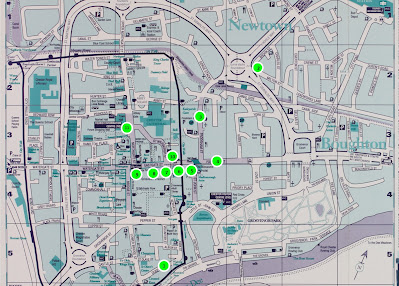
The tour is self-guided, so you can choose which sites you want to visit and in which order (our suggested route is mapped out below, or you can pick up a printed version from our Record Office). 

There is also the option of listening to the recordings on our brand new listening kiosk, just drop in to our searchroom between Tuesday 21 June and Thursday 23 June during our normal opening hours (9am-4pm). We are based at Cheshire Record Office, Duke Street, Chester. 

We hope you enjoy a bit of retail therapy on a talking tour full of memories of shops past - lets get started! 


1:    Welcome to Cheshire Archives & Local Studies where this converted warehouse holds miles of shelving full of records that document almost 1000 years of Cheshire life. Some of these records are oral histories recorded on cassettes, and tape cannot be trusted to survive for decades. Without the National Lottery Heritage Fund project run by British Library and the expertise at the north west hub at Archives+ in Manchester the voices on our talking tour would have been lost. 


2:    Setting the scene – Brook Street: A schoolgirl in the 1920s, whose route to school took her along Brook Street and Frodsham Street, with vivid memories of the sights and smells of shops at Christmas – but look out for the cows! She also remembers cows being driven from the cattle market where the bus station is now along Brook Street and Hoole Bridge to the railway sidings on Lightfoot Street. 


3:    Frodsham Street: ‘Two things couldn’t pass at the same time’ – much like today – chemists, shoe shops and bookshops – how much is that doggy in the window? 

4:    Foregate Street: Hear all about ‘Porky Pie Duttons’ where Marks and Spencers is now – with a sweet factory in the back!

5:    Eastgate Street and Eastgate Row: We now find ourselves in the heart of Chester’s shopping experience for over 200 years. Hear first how Browns, Bollands and Phillipson and Golder jostle for position – and then more details about what would have greeted you at each shop.

6:     Browns first...

7:    …and then Bollands...

8:    …and the curious figures from Venice that promoted the stationer and bookseller Phillipson and Golder. 

9.     Can you imagine taking a seat when you enter a shop and items being brought to you – or even brought to you sitting in your car outside. Welcome to the world of Minshull and Meeson.

10:    What would Browns customers or Mr Minshull and Mr Meeson have thought when F W Woolworth moved in across the street where Next is now? There is no ‘shopwalker’ and browsing is encouraged – and plastic goods arrive. And Woolworths expanded throughout the twentieth century filling the space between Eastgate Street and St Werbergh’s Street which leads us to the Old Market.


11:    Chester is about to open a new market replacing the new market mentioned here. But it is the old market that is brought to life – the china seller who smashes the items he doesn’t sell to the crowd entertain this young lad!

Wednesday, 6 October 2021

Chester's Delightful River Dee!

Have you tried our Talking Tour of Chester? It’s a self-guided walking tour of interesting parts of the city, made from oral histories recorded around 40 years ago. It features local people’s memories of events like the famous Chester Regatta, and the opening of the landmark Queen’s Park suspension bridge - but Cheshire Archives and Local Studies holds a huge amount of material on all aspects of the River Dee, going back centuries.

Lost trades

People have made their living on the river, not only from boat hire that still runs today, but in lost trades such as traditional salmon fishing. These photographs from c.1900 and 1969 show the nets that used to be seen along the banks, and fishermen hauling in their catch.


There also used to be mills along the banks of the Dee, with some only demolished within living memory. This image from 1905 shows ‘The Dee Bridge, Castle and Mills’ and is taken from a photo album by Frank Simpson. He was an authority on the history of Chester and an amateur photographer whose work is held at Cheshire Record Office (not just his photography but also sketches, manuscripts and diaries of local events).


Tragedy on the Dee

Going back even further, we know that people used to use the river for washing. This coroner’s inquest report from 1679 describes the sad death of Mary Alson, a spinster who was swept away and drowned whilst washing clothes in the Dee.

This is just one of countless tragedies from along the river, and the coroners’ reports we hold range from the recent past back to the Middle Ages.

A well-known tragedy was the Dee Bridge Disaster, an 1847 railway accident. Train carriages fell into the river through a new cast iron bridge, killing five people and injuring nine. Cheshire Record Office holds a collection of newspaper cuttings about the inquest, where renowned Victorian engineer Robert Stephenson, who designed the bridge, was accused of negligence.

Chester Regatta

On a happier note, the river has long been used for sport and entertainment, and Chester Regatta combines both. Established in 1733, it still takes place today, making it the oldest rowing regatta of its type in the world. We hold many images of the Regatta - some of which are featured on the searchable Cheshire Image Bank- and this print shows the Regatta in 1854. 


We also hold the archives of the Royal Chester Rowing Club, founded in 1838. A jewel in this collection is a scrapbook begun in 1933 (ZCR 419/3), full of club memorabilia like race programmes, results, press cuttings and photographs. This one is of rowers on the Dee during the Chester Regatta of 1938.


The Port of Chester

We may not give it much thought today, but Chester used to be a significant British port. We have some shipping and boat records covering several centuries, such as QDN 1/5, a register of vessels entering and leaving the port of Chester, 1740 – 1769. It shows information such as the vessel and masters’ names, the destinations, and nature of goods being transported. We can see from these pages that 15 tons of cheese were bound for Parkgate on The Friendship on 21st February 1743 (below left), and that The Duke William arrived from Lisbon with a cargo of wine on 4th May 1754 (below right).

River Management

For anyone interested in the river itself, we hold archives related to the management of the Dee, like those of The River Dee Committee. The Committee was established in 1837 and its main interest was in Acts of Parliament affecting the river and water supply. The collection includes letters, petitions, reports, a minute book, plans on the improvement of the river and volumes of soundings (measurements of the depth of water, which can be used to make maps of riverbeds and nautical charts). 


Bridges

No visit to Chester is complete without seeing the bridges over the River Dee, and hundreds of items about them are held at Cheshire Record Office: books, pamphlets, photographs, plans, prints and much more. These two images show the Queen’s Park Suspension Bridge that opened in 1923, and the old Queen’s Park Bridge, which it replaced.     


The big freeze!

Finally, did you know that the Dee has frozen over on occasion? This photograph of The Groves in Chester shows people ice skating and playing when the river froze during the winter of 1916-17. It happened again in 1963.


This is just a small snapshot of the wide range of material that Cheshire Archives and Local Studies holds about the River Dee. Why not try the Walking Tour, and if you’re inspired to come and see some original records, arrange your visit here!

The items listed above are available to view at Cheshire Record Office in Chester. Living Memory: A Talking Tour of Chester is available via the Echoes app – further details can be found here.