Pages

Showing posts with label Trains. Show all posts

Thursday, 17 November 2022

Cheshire Railways: Third Stop - Maps and Plans

"A map says to you. Read me carefully, follow me closely, doubt me not… I am the earth in the palm of your hand."
If this quote from aviator and adventurer Beryl Markham is to be true, then Cheshire Archives holds huge swathes of Cheshire’s earth, and beyond, in the hundreds of maps and plans in our railway collection. Plans of tracks, stations, bridges, tunnels, foot bridges, signalling, derailments, engine sheds, schools, goods yards, waiting rooms, lines that were built, lines that were never built - even the Station Master’s bathroom in Bebington. 

Over the last few years lots of work has been carried out to list, organise and repackage these plans to make them available for the public to view. So join us in this exploration of Cheshire’s railways and hold the earth, or at least some of it, in the palm of your hand.

First stop - understanding the plans

For some of the plans it is clear why they were made and what they are trying to show. The plans of Runcorn Bridge, for instance, are easy to understand. They show the bridge from various angles and different sections and elevations, and it doesn’t require knowledge of railway engineering to appreciate them. 

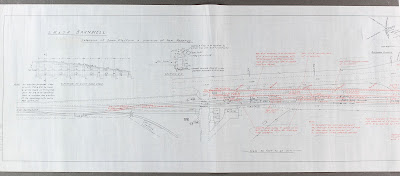
Other plans are more complex. The estate plans of lines with lots of handwritten annotations are difficult to understand. Was the line built, or not? What is the date? Sometimes a date is clearly stamped, but it is obvious that these were working plans and the annotations were added over years or even decades. But take from them what you can. The estate plans are full of wonderful details outlining ownership of parcels of land adjacent to the lines. They can include details that may not be found between census records, Ordnance Survey maps or other well-used family and local history records. 

The plans were made for many different reasons.  Some reasons are clear - such as to plan the construction of a bridge or the planning of a railway line - but for other plans it is less clear what the purpose is for. In listing and organising the collection, we have tried to make it clear on our catalogue what information can be taken from them - even when the purpose of the plan is less clear. As with all archives, the information contained within them can far exceed the purpose for which it was captured.

Second stop - understanding the types of plans

Firstly, there are plans that were created by the Engineering Department. These include buildings such as stations, waiting rooms, engineering sheds and goods yards. They show what the building would have looked like externally and internally - often in great detail. They show measurements and exist in various scales. Sometimes they show the area around the building and its location in relation to the wider station plan. 


There are plans of bridges, tunnels, culverts and viaducts. These are very similar in detail to the plans of the buildings, but often include mile points that indicate their position on the railway line. Engineering plans also include inspection sketches and signalling with details of alterations to tracks, signalling, sidings and junctions. There are also many more varied plans of engineering works such as drainage, line widening, and track plans.


The second series of records are those created by the Estate Department. These are more complex and can be difficult to understand. They largely consist of plans showing the full line or a section of a line. In their most basic sense, they show the routes and the land around them. They are full of details such who owned the land adjacent to the line. This is great if you are researching a nearby property or piece of land, especially if no other mapping exists for that point in time. 

The plans are drawn to various scales but the most common are the 2 chains to 1 inch surveys (1 chain=22 yards). They can be individual plans of a section of a line, or can be many plans bound together in large unwieldly volumes. They are often annotated with details that sometimes can be easy to understand or sometimes complex and technical. They are often stamped with details of different railway companies and have clearly been used over many years. They have been listed on our catalogue with the start and end point of the line, with details in the description of the stations in between which are featured.

Third stop - understanding the scope

The lines didn’t stop at county boundaries and neither do the railway plans. As such, it follows that a lot of the plans go beyond the scope of Cheshire. There are many plans for neighbouring counties but also many from much further afield including lines in Ireland and Wales. The plans are listed in good detail on our catalogue, so a search for the place of interest should be easily found.


Final destination - the catalogue

The plans on our online catalogue are arranged under three sections; engineering plans, estate plans, and deposited parliamentary plans. The deposited parliamentary plans are a shorter series and compliment those deposited plans in our Quarter Session records (see QDP). Within each section they are sub-divided into types of plans such as ‘stations and buildings’, ‘line sections’ etc. Within each series they are listed alphabetically by place. A further guide is in progress that will allow researchers to identify which line a station or structure sat on and if we hold plans. Watch this space for further details on this.

The railways covered a lot of earth and the plans cover a large portion of this. Search our catalogue to discover the full extent and arrange a visit to the Record Office to hold them in the palm of your hand.


All of these items are available to view at Cheshire Record Office in Chester.  Part 1 of this blog is First Stop - The History and Part 2 is Second Stop - Employee Records.  

Wednesday, 12 October 2022

Cheshire Railways: First Stop - The History

On 22nd August 1890, Richard Jones started work as a Wheelwright at Crewe Engineering Works. His name, date of birth and first day of employment were recorded in one of the works' large registers along with the names of thousands of others who were employed at the works over the years. Over 130 years later that register and piece of history still survives, along with many more railway records available to be viewed at the Record Office in Chester. Over the last couple of years, staff and volunteers have been working hard to catalogue this huge collection to make it fully accessible so the story of Richard Jones and many others like him can be discovered.


The history of the railway in Cheshire starts in the first half of the nineteenth century when Chester attracted the interest of various railway companies. The Chester and Birkenhead and Chester and Crewe Railways were the first to open their respective routes in 1840. This was followed by the construction of the Chester and Holyhead Railways which fully opened in 1850. Many more companies and lines followed. By the time Richard Jones started work several of these companies had merged and many became part of London and North Western Railway. 


In 1923, under the Railways Act 1921, the majority of railway companies were grouped into four main companies. It was the London Midland and Scottish Railway and the Great Western Railway who between them covered the Cheshire area. In 1948, with the nationalisation of the railways, these companies became part of British Railways under the London Midland Region and Western Region.

In 1986 it was decided by British Railways that the important archive records that told the story of history of railway in Britain would be put into the care of County Record Offices. Determining which Record Offices to house them in wasn’t a simple decision. Railways don’t stop at county boundaries. It was decided that they would be deposited in areas appropriate to the British Rail Regions and of the big four companies that came into being following the grouping of 1923. It was also decided that records of companies absorbed before 1921 would be offered to the County Record Office receiving the records of the absorbing company.


Cheshire Record Office received records of the following companies: London and North Western Railway Company, Great Central and North Western Railways Joint Committee, London Midland and Scottish Railway Company - Central Administration, Western Division (North), Western Division (South), London Midland and Scottish and Great Western Railways Joint Committee. It therefore follows that the area covered by these records often exceeds the boundaries of the County of Cheshire.


Over the course of future blogs we will explore two of the main series of records in the collection; employee records and railway plans. These have great research potential for local and family historians in Cheshire and beyond.

Look our for the Second Stop of this blog - Employee Records - coming soon!

These records and more are available to view at Cheshire Record Office in Chester.

Thursday, 5 May 2022

Making the Crossing: The Chester to Holyhead Railway

We continue the story of Cheshire’s railways with one of its most important lines. 175 years ago, this railway was the site of an early and tragic rail disaster.  Part 1, All Change at Crewe! is available here.

The early to mid-1840s saw Britain in the grip of ‘railway mania’. Low costs, speed and convenience made rail travel very popular - and lucrative. New railways for passenger and freight lines were quickly developed.

At that time the only communication links between London and Ireland were by horse-drawn coach or by sea. Both routes were made long and difficult by poor roads and harbour facilities. A railway that would take government mail dispatches more quickly to Ireland was well-supported in Parliament and the Chester and Holyhead railway was authorised in July 1844.

George Stephenson surveyed the route, which would extend the Chester to Crewe line along the North Wales coast. His son Robert Stephenson was the engineer, with Francis Thompson the architect and Thomas Brassey the contractor.


Building the railway was both challenging and extremely expensive. It required bridges over the River Dee, the River Conwy, and the Menai Strait at Anglesey. Progress on the railway was slow but the first section, between Chester and Saltney, opened in November 1846. It included a 250 ft long cast iron and stone bridge, designed by Robert Stephenson, that crossed the River Dee near to the Roodee. The bridge was opened with great ceremony. 

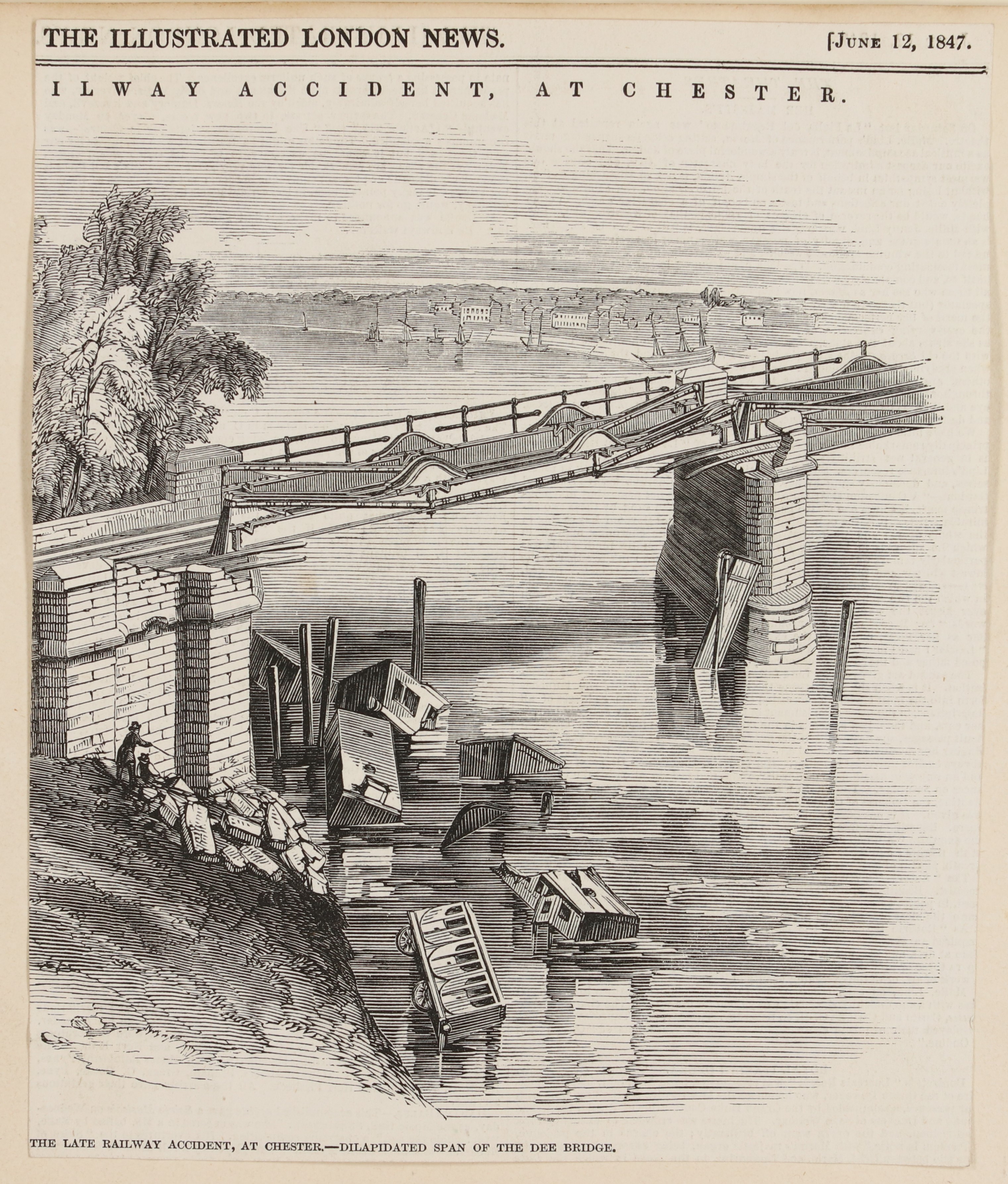
But just six months later, on 24th May 1847, disaster struck.  As a passenger train was crossing, the final span of the bridge collapsed. James Clayton, the driver, managed to get the 30-ton locomotive and its tender onto the far bank, but all four carriages and the guard’s van fell over 30 feet to the river below. Of the twenty-five people on board, five (the fireman and four passengers) were killed and fourteen were injured. Both local and national newspapers reported on the shocking and sensational incident.


Robert Stephenson was criticised for the bridge’s failure, threatening his reputation. An inquest was held in Chester and witnesses testified to seeing a fracture appear in the cast iron girders before the collapse.

Newspapers followed the case closely. After two weeks it was found that no one person was to blame, however the jury expressed concern about the use of ‘so brittle and treacherous a material as cast iron’.

Following the disaster, Robert Stephenson used only wrought iron on his railway bridges, including the Conwy Railway Bridge and the Britannia Bridge over the Menai Strait. Both were impressive engineering feats, particularly the Britannia Bridge at over 1500 feet long and standing over 100 feet above the water. On 5th March 1850, Stephenson himself laid the last rivet on the bridge and drove a test train across it, marking the completion of the Chester to Holyhead Railway.


The railway had a major impact on the city of Chester as a regional centre. The original Chester railway stations on Brook Street were little more than wooden shacks and converted houses. To cope with the growing traffic, the Chester and Holyhead and other rail companies agreed to build a new larger station. It was designed by Francis Thompson and built by Thomas Brassey. The station opened on 1st August 1848 to the acclaim of the local population.


The first Irish Mail train left the new station for Holyhead that same day. With the transportation of goods to Ireland, and an increase in trade from North Wales, Chester regained a good deal of the prosperity it had lost following the silting up of the River Dee. 


The line was fully opened to passengers on 18th March 1850 and was immediately popular. It enabled people to travel cheaply and quickly to holiday and tourism destinations in North Wales and Ireland. In 1858 a branch line to Llandudno, one of the early favourite holiday destinations, was opened. Throughout the late 19th and 20th centuries travel by rail to holiday destinations on the North Wales coast continued to grow.


Today the cause of the River Dee Railway Bridge collapse would be called metal fatigue. The bridge was rebuilt several times and eventually replaced with a completely wrought iron bridge in 1870. Robert Stephenson’s wrought iron Conwy Bridge still stands today, whilst the original Britannia Bridge was only replaced in 1980 after being severely damaged in an accidental fire. The railway line itself continues to be heavily used by passengers as part of the North Wales Coast Line.

175 years on from the tragic River Dee Bridge disaster, the greater story of the Chester to Holyhead railway is one of success.


These railway records and more are available to view at Cheshire Record Office in Chester. Transcriptions of several Crewe Works and railway companies’ staff registers can also be found at our web site here for Crewe, and here for four companies covering parts of Cheshire, Shropshire, Hereford and Wales.   

Keep a look out on our Instagram and Twitter pages for more from our railway collections soon!

Thursday, 21 April 2022

All Change at Crewe!

The world’s first inter-city railway was the Liverpool and Manchester, which opened in 1830. More railways soon followed. The first to enter Cheshire was the Grand Junction between Birmingham and Liverpool, which included the station we know today as Crewe.

On June 30th 1837, Parliament passed an Act authorising a railway between Chester and this new station. Its story is told through items in our Archives and Local Studies collections.


The railway might not have gone to Crewe at all. A line from Chester to Winsford was considered that would have been the shortest to link with the growing rail network.

The ‘father of railways’, George Stephenson, was chosen to engineer the line. He knew that railway building was already a difficult and expensive business and that this route would require tunnels and climbs through Delamere Forest.

He soon picked a longer, flatter route across 20 ½ miles of the Cheshire countryside. It would go directly through the township of Monks Coppenhall and meet the Grand Junction Railway at Crewe Station.


The man tasked with building the line was Thomas Brassey. Born near Chester in 1805, he has been called the world’s foremost railway builder of the 19th century. By the time of his death in 1870 ‘Cheshire’s Brunel’ had built an impressive 1/3 of the railways in Britain, 1/20 of the railways worldwide, and numerous engineering works such as Runcorn Bridge and Chester Railway Station.


Work on the railway began with optimism, but heavy rains in Autumn 1839 slowed construction down. Costs also rose as landowners began to realise the value of their land to rail companies. The railway’s investors soon couldn’t commit the capital needed to complete the line and work came to a standstill. In October 1839 the Chester and Crewe directors voted to sell the unfinished railway.

Rescue came when the Grand Junction Company absorbed the line and in May 1840 construction resumed. Local newspapers were finally able to announce that the grand opening would take place and publish the first passenger timetables.

The railway opened on October 1st, 1840. It had an immediate impact on everyday life. Travelling between Chester and Monks Coppenhall by coach took 2 1/2 hours and cost 8 shillings, whereas the same journey by rail would now take just 1 hour and cost 4 shillings. Cheaper and quicker travel across Cheshire and to places like Birmingham, Liverpool, Manchester and eventually London was now accessible for the people of Cheshire. Passenger numbers grew quickly in the 1840s.


With the railway now a reality, Crewe was no longer just one of the stations on a single line and greater changes occurred that left an indelible mark on the history of Cheshire.

Early on, the Grand Junction Company saw Crewe station’s potential as a hub to link to Britain’s growing rail network. There was also the promise of linking with Ireland through an extension of the Chester and Crewe line to Holyhead. In 1840 they made plans to move their workshops and locomotive works from Edge Hill to Monks Coppenhall, just across the township boundary from Crewe station.

The company built 200 cottages ready for its workers and the rapidly developing settlement soon adopted the name of the station, marking the beginning of the town of Crewe as we know it today.


By 1842 Crewe station was the focus of 3 major railways. As more lines were opened it became a busy junction and in 1861 it was rebuilt to cope with the traffic. Over the last 185 years it has grown further and today has 12 platforms.


The Locomotive Works opened in 1843, marking the start of a great tradition of industry and engineering in Crewe. By 1848, it had over 1000 workers and built one locomotive per week. Production grew steadily in the 19th and 20th centuries and at its height the Works employed 20,000 people. The last locomotive ran off the line in 1991 and the site is now occupied by the Crewe Heritage Centre museum.

Today, passengers continue to use the Chester and Crewe railway to cross Cheshire and reach the rest of Great Britain and Ireland. The journey from Chester to Crewe takes around 20 minutes whilst Crewe to London takes around 2 ½ hours, something which would have been unthinkable in 1837.

Crewe is seeing major development and is currently bidding to become the home of Great British Railways (GBR), the new national rail operator from 2023. The railway station could also play an important role as a hub in the planned HS2 network.

185 years since it was first approved, the Chester to Crewe railway is still changing life for the people of Cheshire and connecting them with each other and the world beyond.


These railway records and more are available to view at Cheshire Record Office in Chester. Transcriptions of several Crewe Works and railway companies’ staff registers can also be found at our web site here for Crewe and here for four companies covering parts of Cheshire, Shropshire, Hereford and Wales.   

And look out for our next blog, which continues the story of railways with the Chester to Holyhead line and the 175th anniversary of one of Cheshire's most famous rail disasters. (This was published on 5th May 2022, read it here.

Tuesday, 14 December 2021

Planes, Trains and Automobiles!

We’ve had lots of interest in photographs of old vehicles in some of our recent exhibitions and blogs, so we’re dedicating this blog to early vehicles and transport in Cheshire. Read on for images of planes, trains and automobiles – and more! 

Planes

This striking photograph is from 1911 and shows an aeroplane flying over the Widnes Transporter Bridge. It was taken during the Round Britain Air Race and the pilot was a James Valentine, who landed briefly in Widnes. He was one of only four pilots to finish the race, and later served in the Royal Flying Corps during the First World War. 

Cheshire Image Bank also contains a postcard of the first arrival of an aeroplane in Northwich, in 1912 (above right). The pilot, pioneering British aviator Gustav Hamel, can be seen standing next to his plane. Demonstration flights were apparently given on nearby Leftwich Green!  

We hold archive images from Hooton Park Airfield, including this one from 1944 of an early helicopter, the Sikorsky ‘Hoverfly’, designed by helicopter pioneer Igor Sikorsky. Also photographed at Hooton is the iconic Spitfire aeroplane. 


Trains

Our Local Studies collection contains many dozens of books, pamphlets and articles about trains and railways of Cheshire, as well as the images on the Cheshire Image Bank. This photograph of an unusual-looking locomotive was deposited at Cheshire Record Office with the information "Silver Jubilee, taken at Wrenbury Station, 1936" inscribed on it.  The Silver Jubilee was a streamlined train designed to travel at exceptionally high speeds - although we have since been informed that this locomotive may in fact be a Coronation Scot, introduced in 1937. 

Railway records also feature in our Archives, including the Basil Jeuda photographic collection (ref: D 7386) - an extensive railway-related collection of photographs from the 1860s to the 1980s. Many trains have been captured, such as this one at Prestbury Station in the 1880s below left, and the image of the ‘Ludwig Mond’ engine taken at Brunner Mond works in Winnington in 1912. 


Automobiles

We hold vehicle licensing records for Cheshire and Warrington going back to 1903, and regularly fulfil requests for copies from vehicle enthusiasts wishing to re-license restored cars. We have some images of very early cars, such as this one of motorised vehicles on the High Street at Winsford, taken in the early 1900s. 


The image below left shows the Mayor of Winsford pictured in his first official car – it also dates from the first decade of the 20th century. And from the 1910s, we have an image of Tom Booth’s Cycle and Motor Depot on Main Street, Frodsham (below right). Pictured in the car is a Mr Philbin, who was apparently the chauffeur to the local bank manager. 


This early advert for car hire is taken from the Nantwich Almanack and Directory of 1916.  And from our Archive collections, one of our favourite images is from a 1930s scrapbook of the Royal Chester Rowing Club: an early roof rack! Captioned ‘Henley 1937’, sadly we don’t know if the car was photographed at the Henley Regatta, or driven there like this from Chester.  


Another popular search and copying request at Cheshire Record Office is of the records of Fodens commercial vehicle manufacturers of Elworth, Sandbach. They started producing agricultural engines in the 1870s and became a leading manufacturer of steam engines and later of diesel trucks - we hold production records, technical drawings, photographs and more covering over 100 years (collection ref: DFO). Though made in Cheshire, the vehicles went far and wide – the one below to a famous company from Nottingham! 


Whilst they haven’t been seen on the roads for the past hundred years, we do have some images of charabancs, an early type of open-topped motor coach. The name comes from the French char à bancs ('carriage with benches') and was popular for sightseeing or ‘works outings’. These images relate to just that: the first (below left) is of a Helsby Ladies charabanc outing circa 1920 and the second is a 1919 outing from Lynch’s Garage in Northwich. 


This is an image of a Daimler charabanc, taken in Northwich during the 1910s – with the young boy stood next to it, we wonder whether this could have been an early school bus?


There are plenty of images and information about buses in both our Archives and Local Studies collections. The photograph below left is captioned ‘first bus in Widnes’ and was taken between 1900 and 1909. And on the right is a Nantwich and Crewe motor bus, photographed around 1910.  

Boats

With Cheshire having a significant canal network, we hold many items related to the canals and barges of the county – as well as rivers and boats. The image below left is of a barge stranded in a semi-dry canal after the famous canal burst at Kerridge near Macclesfield in February 1912. And below right is a picture of salt being loaded onto a canal barge for transport, taken at Middlewich in the early 1900s. 


Bicycles

Do you consider bicycles to be vehicles? If so, we have some lovely early examples, such as these two, including a penny farthing, photographed in Alderley Edge in the 1880s.  And on the right, these enthusiasts are members of the West Cheshire Bicycle Club, photographed in 1884. 


Motorbikes

Moving on to motorcycles, this image is from the 1910s, and shows an early motorcycle outside the shop of Fred Wakefield, a cycle agent in Sandbach. 


Also from the 1910s is this image of plumber Frank Turner and storekeeper Fred Basnett, pictured at Castle Park in Frodsham with a motorcycle and side car – and, on the subject of side cars, this Bollington butcher has a novel way of transporting livestock! 


With all these vehicles, we will end on a note of safety. This image is undated, but comes from Simms Cross School in Widnes, and shows children taking part in a Road Safety campaign. We wish them happy driving! 


All these images and more are available to view at Cheshire Record Office in Chester. For images of early fire engines and ambulances, see our recent blog on Cheshire’s Emergency Services here.