Pages

Showing posts with label Thomas Brassey. Show all posts

Thursday, 5 May 2022

Making the Crossing: The Chester to Holyhead Railway

We continue the story of Cheshire’s railways with one of its most important lines. 175 years ago, this railway was the site of an early and tragic rail disaster.  Part 1, All Change at Crewe! is available here.

The early to mid-1840s saw Britain in the grip of ‘railway mania’. Low costs, speed and convenience made rail travel very popular - and lucrative. New railways for passenger and freight lines were quickly developed.

At that time the only communication links between London and Ireland were by horse-drawn coach or by sea. Both routes were made long and difficult by poor roads and harbour facilities. A railway that would take government mail dispatches more quickly to Ireland was well-supported in Parliament and the Chester and Holyhead railway was authorised in July 1844.

George Stephenson surveyed the route, which would extend the Chester to Crewe line along the North Wales coast. His son Robert Stephenson was the engineer, with Francis Thompson the architect and Thomas Brassey the contractor.


Building the railway was both challenging and extremely expensive. It required bridges over the River Dee, the River Conwy, and the Menai Strait at Anglesey. Progress on the railway was slow but the first section, between Chester and Saltney, opened in November 1846. It included a 250 ft long cast iron and stone bridge, designed by Robert Stephenson, that crossed the River Dee near to the Roodee. The bridge was opened with great ceremony. 

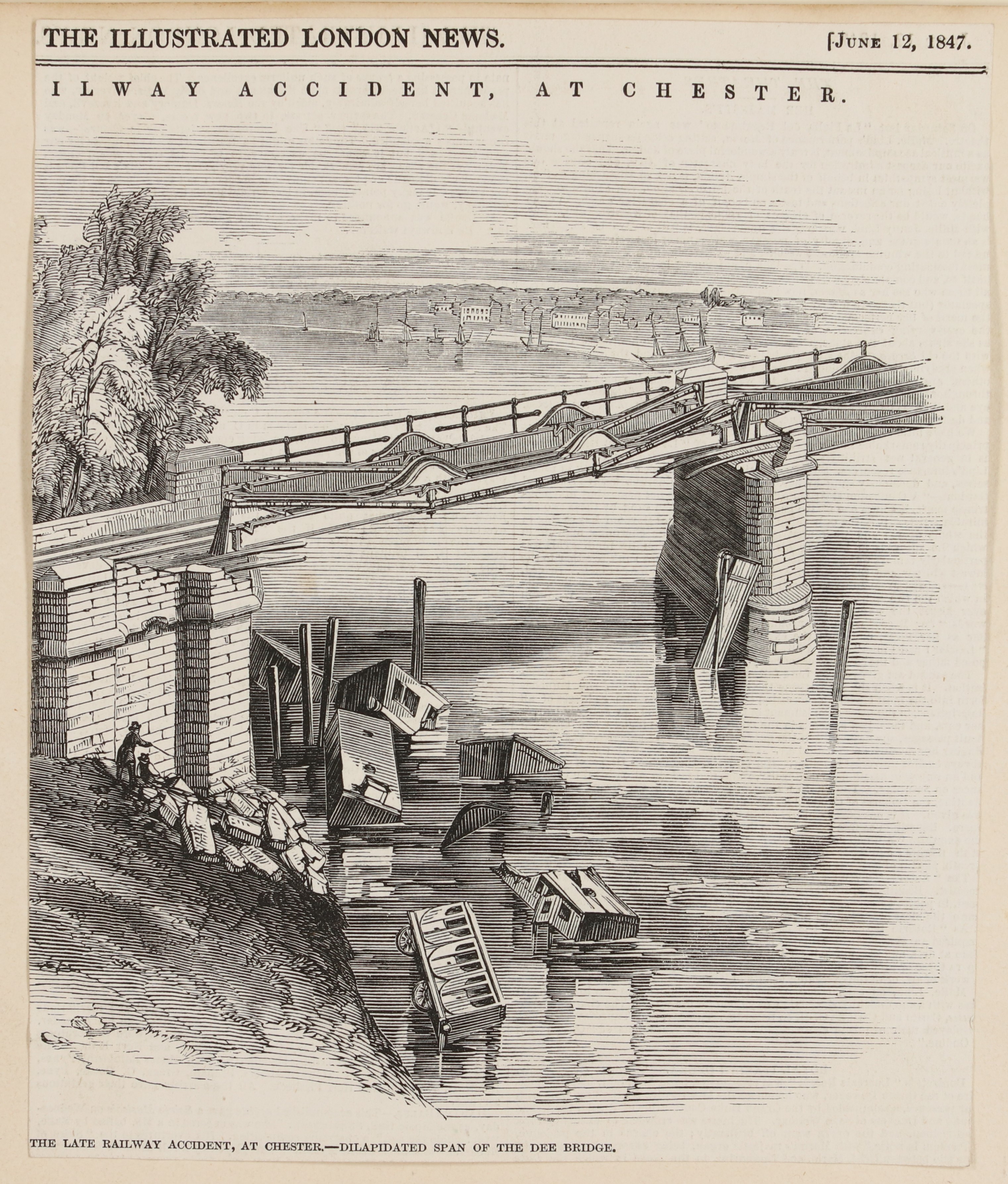
But just six months later, on 24th May 1847, disaster struck.  As a passenger train was crossing, the final span of the bridge collapsed. James Clayton, the driver, managed to get the 30-ton locomotive and its tender onto the far bank, but all four carriages and the guard’s van fell over 30 feet to the river below. Of the twenty-five people on board, five (the fireman and four passengers) were killed and fourteen were injured. Both local and national newspapers reported on the shocking and sensational incident.


Robert Stephenson was criticised for the bridge’s failure, threatening his reputation. An inquest was held in Chester and witnesses testified to seeing a fracture appear in the cast iron girders before the collapse.

Newspapers followed the case closely. After two weeks it was found that no one person was to blame, however the jury expressed concern about the use of ‘so brittle and treacherous a material as cast iron’.

Following the disaster, Robert Stephenson used only wrought iron on his railway bridges, including the Conwy Railway Bridge and the Britannia Bridge over the Menai Strait. Both were impressive engineering feats, particularly the Britannia Bridge at over 1500 feet long and standing over 100 feet above the water. On 5th March 1850, Stephenson himself laid the last rivet on the bridge and drove a test train across it, marking the completion of the Chester to Holyhead Railway.


The railway had a major impact on the city of Chester as a regional centre. The original Chester railway stations on Brook Street were little more than wooden shacks and converted houses. To cope with the growing traffic, the Chester and Holyhead and other rail companies agreed to build a new larger station. It was designed by Francis Thompson and built by Thomas Brassey. The station opened on 1st August 1848 to the acclaim of the local population.


The first Irish Mail train left the new station for Holyhead that same day. With the transportation of goods to Ireland, and an increase in trade from North Wales, Chester regained a good deal of the prosperity it had lost following the silting up of the River Dee. 


The line was fully opened to passengers on 18th March 1850 and was immediately popular. It enabled people to travel cheaply and quickly to holiday and tourism destinations in North Wales and Ireland. In 1858 a branch line to Llandudno, one of the early favourite holiday destinations, was opened. Throughout the late 19th and 20th centuries travel by rail to holiday destinations on the North Wales coast continued to grow.


Today the cause of the River Dee Railway Bridge collapse would be called metal fatigue. The bridge was rebuilt several times and eventually replaced with a completely wrought iron bridge in 1870. Robert Stephenson’s wrought iron Conwy Bridge still stands today, whilst the original Britannia Bridge was only replaced in 1980 after being severely damaged in an accidental fire. The railway line itself continues to be heavily used by passengers as part of the North Wales Coast Line.

175 years on from the tragic River Dee Bridge disaster, the greater story of the Chester to Holyhead railway is one of success.


These railway records and more are available to view at Cheshire Record Office in Chester. Transcriptions of several Crewe Works and railway companies’ staff registers can also be found at our web site here for Crewe, and here for four companies covering parts of Cheshire, Shropshire, Hereford and Wales.   

Keep a look out on our Instagram and Twitter pages for more from our railway collections soon!

Thursday, 21 April 2022

All Change at Crewe!

The world’s first inter-city railway was the Liverpool and Manchester, which opened in 1830. More railways soon followed. The first to enter Cheshire was the Grand Junction between Birmingham and Liverpool, which included the station we know today as Crewe.

On June 30th 1837, Parliament passed an Act authorising a railway between Chester and this new station. Its story is told through items in our Archives and Local Studies collections.


The railway might not have gone to Crewe at all. A line from Chester to Winsford was considered that would have been the shortest to link with the growing rail network.

The ‘father of railways’, George Stephenson, was chosen to engineer the line. He knew that railway building was already a difficult and expensive business and that this route would require tunnels and climbs through Delamere Forest.

He soon picked a longer, flatter route across 20 ½ miles of the Cheshire countryside. It would go directly through the township of Monks Coppenhall and meet the Grand Junction Railway at Crewe Station.


The man tasked with building the line was Thomas Brassey. Born near Chester in 1805, he has been called the world’s foremost railway builder of the 19th century. By the time of his death in 1870 ‘Cheshire’s Brunel’ had built an impressive 1/3 of the railways in Britain, 1/20 of the railways worldwide, and numerous engineering works such as Runcorn Bridge and Chester Railway Station.


Work on the railway began with optimism, but heavy rains in Autumn 1839 slowed construction down. Costs also rose as landowners began to realise the value of their land to rail companies. The railway’s investors soon couldn’t commit the capital needed to complete the line and work came to a standstill. In October 1839 the Chester and Crewe directors voted to sell the unfinished railway.

Rescue came when the Grand Junction Company absorbed the line and in May 1840 construction resumed. Local newspapers were finally able to announce that the grand opening would take place and publish the first passenger timetables.

The railway opened on October 1st, 1840. It had an immediate impact on everyday life. Travelling between Chester and Monks Coppenhall by coach took 2 1/2 hours and cost 8 shillings, whereas the same journey by rail would now take just 1 hour and cost 4 shillings. Cheaper and quicker travel across Cheshire and to places like Birmingham, Liverpool, Manchester and eventually London was now accessible for the people of Cheshire. Passenger numbers grew quickly in the 1840s.


With the railway now a reality, Crewe was no longer just one of the stations on a single line and greater changes occurred that left an indelible mark on the history of Cheshire.

Early on, the Grand Junction Company saw Crewe station’s potential as a hub to link to Britain’s growing rail network. There was also the promise of linking with Ireland through an extension of the Chester and Crewe line to Holyhead. In 1840 they made plans to move their workshops and locomotive works from Edge Hill to Monks Coppenhall, just across the township boundary from Crewe station.

The company built 200 cottages ready for its workers and the rapidly developing settlement soon adopted the name of the station, marking the beginning of the town of Crewe as we know it today.


By 1842 Crewe station was the focus of 3 major railways. As more lines were opened it became a busy junction and in 1861 it was rebuilt to cope with the traffic. Over the last 185 years it has grown further and today has 12 platforms.


The Locomotive Works opened in 1843, marking the start of a great tradition of industry and engineering in Crewe. By 1848, it had over 1000 workers and built one locomotive per week. Production grew steadily in the 19th and 20th centuries and at its height the Works employed 20,000 people. The last locomotive ran off the line in 1991 and the site is now occupied by the Crewe Heritage Centre museum.

Today, passengers continue to use the Chester and Crewe railway to cross Cheshire and reach the rest of Great Britain and Ireland. The journey from Chester to Crewe takes around 20 minutes whilst Crewe to London takes around 2 ½ hours, something which would have been unthinkable in 1837.

Crewe is seeing major development and is currently bidding to become the home of Great British Railways (GBR), the new national rail operator from 2023. The railway station could also play an important role as a hub in the planned HS2 network.

185 years since it was first approved, the Chester to Crewe railway is still changing life for the people of Cheshire and connecting them with each other and the world beyond.


These railway records and more are available to view at Cheshire Record Office in Chester. Transcriptions of several Crewe Works and railway companies’ staff registers can also be found at our web site here for Crewe and here for four companies covering parts of Cheshire, Shropshire, Hereford and Wales.   

And look out for our next blog, which continues the story of railways with the Chester to Holyhead line and the 175th anniversary of one of Cheshire's most famous rail disasters. (This was published on 5th May 2022, read it here.