Pages

Showing posts with label tourism. Show all posts

Thursday, 5 May 2022

Making the Crossing: The Chester to Holyhead Railway

We continue the story of Cheshire’s railways with one of its most important lines. 175 years ago, this railway was the site of an early and tragic rail disaster.  Part 1, All Change at Crewe! is available here.

The early to mid-1840s saw Britain in the grip of ‘railway mania’. Low costs, speed and convenience made rail travel very popular - and lucrative. New railways for passenger and freight lines were quickly developed.

At that time the only communication links between London and Ireland were by horse-drawn coach or by sea. Both routes were made long and difficult by poor roads and harbour facilities. A railway that would take government mail dispatches more quickly to Ireland was well-supported in Parliament and the Chester and Holyhead railway was authorised in July 1844.

George Stephenson surveyed the route, which would extend the Chester to Crewe line along the North Wales coast. His son Robert Stephenson was the engineer, with Francis Thompson the architect and Thomas Brassey the contractor.


Building the railway was both challenging and extremely expensive. It required bridges over the River Dee, the River Conwy, and the Menai Strait at Anglesey. Progress on the railway was slow but the first section, between Chester and Saltney, opened in November 1846. It included a 250 ft long cast iron and stone bridge, designed by Robert Stephenson, that crossed the River Dee near to the Roodee. The bridge was opened with great ceremony. 

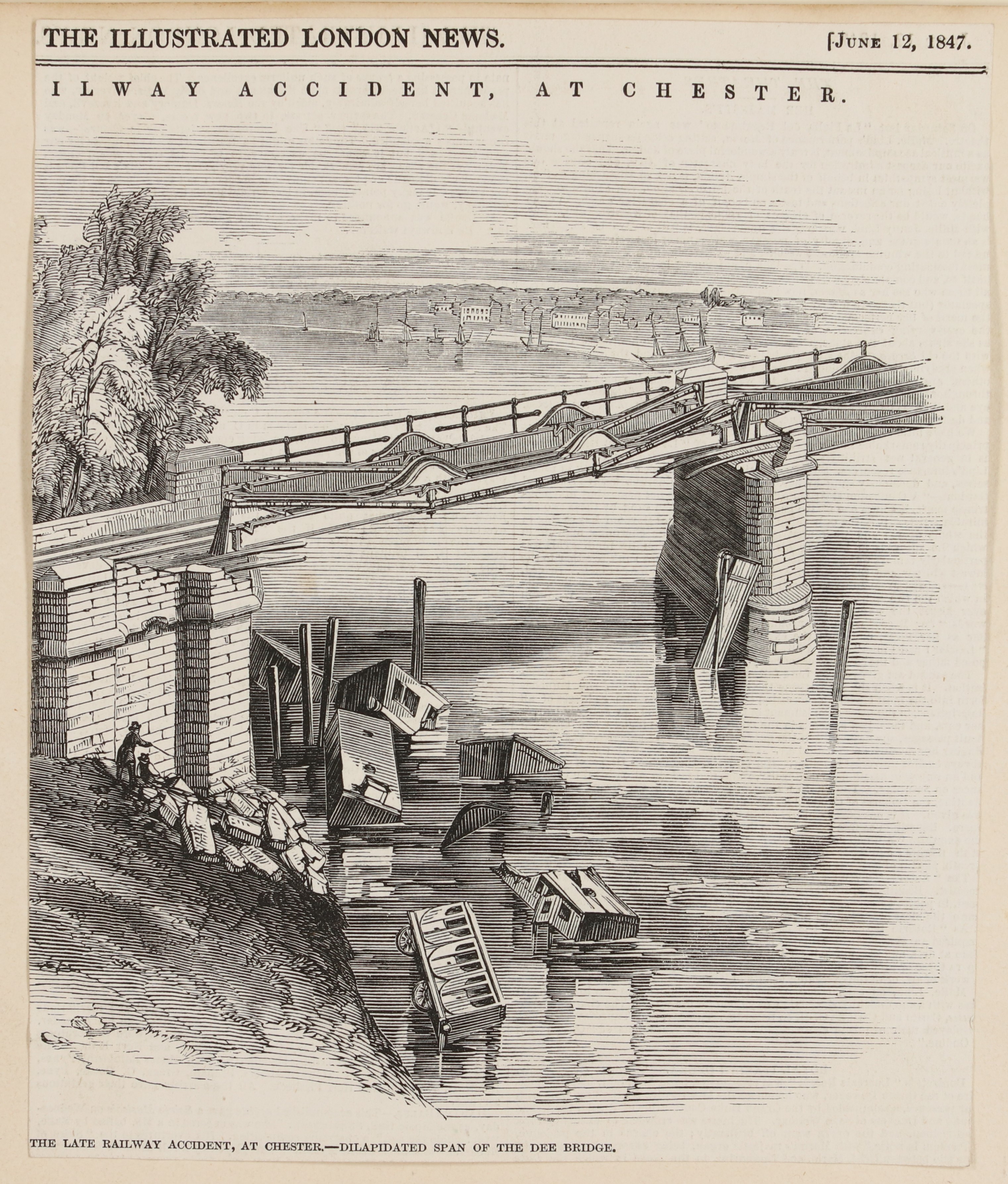
But just six months later, on 24th May 1847, disaster struck.  As a passenger train was crossing, the final span of the bridge collapsed. James Clayton, the driver, managed to get the 30-ton locomotive and its tender onto the far bank, but all four carriages and the guard’s van fell over 30 feet to the river below. Of the twenty-five people on board, five (the fireman and four passengers) were killed and fourteen were injured. Both local and national newspapers reported on the shocking and sensational incident.


Robert Stephenson was criticised for the bridge’s failure, threatening his reputation. An inquest was held in Chester and witnesses testified to seeing a fracture appear in the cast iron girders before the collapse.

Newspapers followed the case closely. After two weeks it was found that no one person was to blame, however the jury expressed concern about the use of ‘so brittle and treacherous a material as cast iron’.

Following the disaster, Robert Stephenson used only wrought iron on his railway bridges, including the Conwy Railway Bridge and the Britannia Bridge over the Menai Strait. Both were impressive engineering feats, particularly the Britannia Bridge at over 1500 feet long and standing over 100 feet above the water. On 5th March 1850, Stephenson himself laid the last rivet on the bridge and drove a test train across it, marking the completion of the Chester to Holyhead Railway.


The railway had a major impact on the city of Chester as a regional centre. The original Chester railway stations on Brook Street were little more than wooden shacks and converted houses. To cope with the growing traffic, the Chester and Holyhead and other rail companies agreed to build a new larger station. It was designed by Francis Thompson and built by Thomas Brassey. The station opened on 1st August 1848 to the acclaim of the local population.


The first Irish Mail train left the new station for Holyhead that same day. With the transportation of goods to Ireland, and an increase in trade from North Wales, Chester regained a good deal of the prosperity it had lost following the silting up of the River Dee. 


The line was fully opened to passengers on 18th March 1850 and was immediately popular. It enabled people to travel cheaply and quickly to holiday and tourism destinations in North Wales and Ireland. In 1858 a branch line to Llandudno, one of the early favourite holiday destinations, was opened. Throughout the late 19th and 20th centuries travel by rail to holiday destinations on the North Wales coast continued to grow.


Today the cause of the River Dee Railway Bridge collapse would be called metal fatigue. The bridge was rebuilt several times and eventually replaced with a completely wrought iron bridge in 1870. Robert Stephenson’s wrought iron Conwy Bridge still stands today, whilst the original Britannia Bridge was only replaced in 1980 after being severely damaged in an accidental fire. The railway line itself continues to be heavily used by passengers as part of the North Wales Coast Line.

175 years on from the tragic River Dee Bridge disaster, the greater story of the Chester to Holyhead railway is one of success.


These railway records and more are available to view at Cheshire Record Office in Chester. Transcriptions of several Crewe Works and railway companies’ staff registers can also be found at our web site here for Crewe, and here for four companies covering parts of Cheshire, Shropshire, Hereford and Wales.   

Keep a look out on our Instagram and Twitter pages for more from our railway collections soon!

Friday, 9 June 2017

A honeymoon tour to remember!

Who has kept a diary? I have – with a birthday at Christmas time and growing up in the seventies there was every chance I would receive at least one diary, usually with matching pen, every year – but even the most attractive of them (purple velvet) still didn’t inspire me much beyond February. Then there were the teenage years  ... And the last diary I kept? Recording a trip to Japan in my early twenties I supposed I wouldn’t make again.

The wonderful thing about diaries in Cheshire's archive collections is that we can recognise all of this and ourselves in them. For International Archives Day 2017 and #archivestourism here are extracts from a young woman's honeymoon diary.

Wednesday July 13th 1892

We were to travel by a train which left Alderley Edge soon after half past three in the afternoon – Leo and I. The express which Leo had decided on to take us up to London would not stop for us at Alderley, though most politely requested to do so; but brides and bridegrooms were things it was very accustomed to, and its iron heart was not to be moved. The express left Manchester at a quarter past four, so we had a good half hour to wait at Crewe. Leo put me in the waiting room to rest before the journey. He came to summon me presently, and took me to the express which had come in, and finding his name on the window of a coupe, he opened the door. We reached Euston about half past eight. Leo got a cab and we packed in with our luggage, my box and Leo’s portmanteau and he had a hat box, and I a handbag, and set off for the Victoria Hotel in Northumberland Avenue.  We were expected, and our room was waiting for us. It is a very fine hotel, the largest I have yet been in.
Of course we were much too late for dinner, and we were too tired to care for a private one, so Leo ordered cutlets and tea, as the most refreshing things he could think of, to be ready immediately. Leo, who knew the hotel, made his way to the coffee room, where our tea was to be laid, a handsome room, but oh so hot and close! Our tea came soon, cutlets, chip potatoes, tea and toast, and very good and refreshing it was, but I was not sorry to leave the hot room as soon as possible, and as we were both very tired, we went straight away to bed. I do not seem to have much to say about today, but it is not a day one would choose to write about.

Thursday July 14th

I am ashamed to say what time it was when we got up, but Leo had slept badly, having had toothache, which was very unromantic, but true nevertheless. 

We went down to breakfast (I might say at last), and Leo ordered coffee, and fried soles, and toast, which was very nice, but the room was as close as ever, and my new morning frock pinched so dreadfully round the neck, that I unhooked it, and furtively fastened the brooch in again over a good gap of collar. (Otherwise, it is a very nice blue serge, and in my heart I rather admire it, with collar and cuffs.) 

Our newly weds have the best part of a day to kill before their train to the coast and the boat for Rotterdam.  They would both have liked Kew (Frances will become an expert gardener) but it’s too far out and museums or galleries seem like hard work …

So Leo proposed that we should go and see ‘Venice’ at Olympia, as a good lazy way of passing the time, for as we know that there were canals and gondolas, we naturally thought that they must be in gardens. In other respects, we knew nothing at all about it.

The gardens were creations of our own wild imagination … the glass-making was in progress at certain hours, but we did not see it …. We went to see the – I know not what to call it – say, spectacle. Presently the play began, a hash-up of all sorts of things, the whole thing was sung; and we were too far away to hear anything of words. 

And on to the boat at Harwich, and perhaps the reasons for Frances’ growing dissatisfaction becomes clear … Leo predicts a calm night …

We did not want any supper, after the long dinner we had had, but I was very anxious to be allowed to pass the night on the saloon couches; the cabins looked so full and close, and I don’t care to be sick before strangers, in a box. At first we were told that I could and Leo went away cheerfully to look after his own berth. But by and by came the stewardess to me, and said that it could only be allowed if all the berths were taken up. When Leo came back he had found a berth, and an old lacrosse acquaintance. I waited awhile, but I was doomed to disappointment; the stewardess came and bore me off to a berth, in a cabin containing four. The whole place was about as big as a very small dining table and it already contained three Americans. I climbed into my top berth, half undressed and lay down. Presently came the stewardess and dealt out basins. ‘Prevention is better than cure’ she said with a pleasing smile. My heart sank right to the bottom end of my berth. The abominable Adelaide began to roll almost immediately after leaving Harwich, and one of the Americans succumbed early, and kept it up all night. If this were any consolation to me I had the pleasure of lying and listening to it, until the small hours, when I too succumbed. 

Friday July 15th

Not to have slept till morning, and not much then, does not conduce to general briskness, to say nothing of the horrors of seasickness and a close cabin. Soon after six I roused up altogether, for the stewardess came in and said that we were later than usual, for we had had a very rough passage. And that was Leo’s calm night.


Frances Crompton was born near Prestbury in 1866, and lived in Wilmslow, where she met and married bank manager John Leopold Walsh. They later lived in Holmes Chapel and Chelford. She published 29 children’s stories, was a skilled painter and kept her Gardening Diary begun in 1915. She died in 1952 and her daughter deposited her diaries in the archives. The collection reference is D 5453.

With thanks to volunteer Hilary Morris for transcribing diary extracts.