Pages

Showing posts with label Parkside Asylum. Show all posts

Friday, 27 January 2023

Parkside Asylum Case Books - Not just names on a page…

The history of Parkside Asylum can be found on-line today (Parkside - County Asylums) but what do we know about the patients who were admitted there? Who were they? Where did they live? Why were they admitted? How long did they stay? Where can we find their stories?

At Cheshire Archives, we are just beginning to explore the wealth of incredible material found within Parkside’s case books. Technology is supporting the information shift from these original leather-bound books into a searchable, accessible on-line research goldmine. With that transformation, our insight into the lives of those living within its walls magnifies and we start to gather information beyond the medical…These patients were real people, with real lives, in a time when we were just learning about mental health.

Where did they come from? 

Parkside Asylum was in Macclesfield; however, its patients came from all over the United Kingdom. The case books are an incredible source of address and place information, which helps us delve even further and join the dots with sources already available to us – censuses, births, marriages and deaths indexes, electoral registers.

What did they do before they came to Parkside? 

The occupations of the Parkside patients are incredibly diverse – from actresses to accountants, cloggers to cooks, shepherds to schoolmasters, paupers, and private patients alike. Parkside treated patients from every walk of life.


Could these be the only images of your ancestors? 

The casebooks contain small passport-sized images of many of the patients. Putting a face to a name and their story. An interesting observation is although there are a few from the 1870’s, these photographs are generally much more common during the 1880’s onwards.

Happenstance or hereditary…

The detailed case notes, medical terms and diagnoses of Parkside’s patients will help us to better understand mental illness and its treatment in the 19th century. Why were patients admitted? How were they treated? What was their diagnosis? Some patients were admitted many, many times. Can we find out why? Although some died at the Asylum, others were discharged, some were transferred to other asylums or hospitals. With the right connections, perhaps one day we can build a timeline of what happened to them. After all, wouldn’t you want to know what happened to your great Aunt or great-great Grandmother?

The use of different sources, like the census, comes in handy as interpreting the copperplate writing from the original books is sometimes a challenge! Were they a Boden, Bowden, or Bodan? Is that a T, a J, or an S – occupation Tailor, Jailor, or a Sailor?



Prepare to be shocked…there was no holding back with how medics described their patients in the 1870’s. Some of the terminology used then, we certainly wouldn’t use now. Medical terms and names of diseases are vast and varied. Do you know what Mania a potu is, for example?

We have 40 years of detailed case books and - with the help of our amazing volunteers – we will continue to build and develop this incredibly valuable information source for us all.
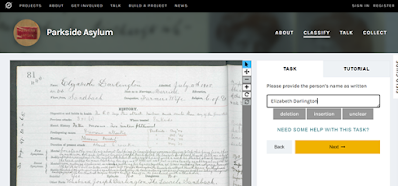

So, you see, the patients of Parkside Lunatic Asylum are not just names on a page, and we’re starting to tell their stories…


Our team of remote volunteers are helping Cheshire Archives index the Parkside case notes. This means the data can easily be searched and analysed by the public and researchers alike.

Want to be a part of it? You can! Email us for more information or join up straight away on the Zooniverse website


Thursday, 29 September 2022

Joel's Record Office Resumé

This blog was written by one of our work experience students, Joel, who spent a week with us over the summer.  Thank you for your work Joel! 

Being at the Record Office for four days, I learnt a lot of different things, from research skills to conservation, as well as what goes on behind the scenes. The tour of the building right at the start of my time there really gave a good insight into the various jobs that happen in the archives, as well as allowing me to enter one of the strong rooms where all the records are kept. I also attended two Microsoft Teams meetings in which the new archive buildings were discussed and upcoming events were planned out. In total I worked on three big projects for the archives.

The first main project I worked on was looking at a scrapbook made by the various mayors of Chester between 1936 to 1979. Continuing where Archie left off, [Archie's Archives Experience blog can be found here] I looked at the entries made between 1947 to 1957. One of the most interesting things I found was that there was a great difference in the entries, including a letter relating to the death of King George VI, menus and table plans for luncheon at the Grosvenor Hotel, Christmas Cards, an invite to a Turner exhibition in the Town Hall, a programme for the presentation of new colours to the Cheshire Regiment and (perhaps most strangely) an invite to the 51st Annual Conference of the Llay Angling Society on Northgate Street. 


The randomness of these events is fascinating to me, and they give a really good indication of the duties undertaken by the mayor of Chester. The work on the scrapbook also gave me the opportunity to have a go at the conservation process and learn how the Record Office preserve their archived materials.

As well as the scrapbook, I was also given the chance to work with the Local Studies team. My work for them involved looking at photographs of Chester and seeing whether or not they were on the online image bank. For those that were not, I was given the task of creating online descriptions and catalogues for them. Some of these included photos of The Church of St. John the Baptist in Guilden Sutton, The Suspension Bridge by the Groves from the 1920’s, The Blue Bell on Northgate Street, King Charles Tower and Children in Fancy Dress from the 1910’s. Seeing how the city has changed over time (and how things have stayed the same) was really interesting to me.


The third and final of my projects was related to the Parkside Asylum, which was located in Macclesfield. The first part of it involved using Zooniverse, which gives you a case note to answer questions on. Though it was tricky to begin with (due to handwriting being difficult to read) I soon got the hang of it. After finishing the Zooniverse tasks, I began to look at Parkside case notes on the online catalogue in order to log the diagnosis of individuals (death, transfer, recovery etc) and to see if the case notes came with a photograph of the individual. Seeing photographs of real patients brought a greater connection between me and the work.

One of the highlights of the four days was the people working and volunteering at the records office, all of whom were passionate about what they do. They were also extremely helpful and happy to answer any questions I had or to talk to me about what they were all doing.

In the future, I wish to be a historical researcher for television, films, and video games, and I believe the skills that I have acquired at the Record Office will help me with this aim.


The documents and photographs Joel worked with are available to view at Cheshire Record Office in Chester. 

Wednesday, 6 July 2022

Archie's Archives Experience!

This blog post was written by one of our work experience students, Archie, who spent a week with us in June. Thanks for all of your work Archie!

During my work experience at Cheshire Record Office, I discovered plenty of new and genuinely interesting things I didn’t know existed.

On my first day I was able to sit in on a staff meeting and learn about how Cheshire Archives and Local Studies were partnering with local communities, finding them photos, documents and anything else they wanted so that they could hold their own events about themselves. 

I spent some time reading, cleaning and documenting the Mayors Scrapbook from 1936-1979. Not only did I learn about how to properly take care of precious archives and how to keep them in the best condition so other people can view them later on, but I was able to read these small snippets of history, whether they were simple invites to tea from the Mayor and Mayoress in 1941, or a New Year’s card with a quote hoping for peace and an end to the war. It felt like I was there, experiencing it myself. Even just small things told a story, like a letter from the Royal household explaining that the Mayor and his wife wouldn’t be able to get a congratulations letter for their Golden Jubilee for their marriage, which was received on December 25th.


I also helped to check photographs and see if they were on the Cheshire Image Bank or not. If they weren't on the site then I indexed them onto a spreadsheet, and did some research around the people, places and events photographed. Looking at a photograph of a local blacksmith taken in the 19th century, it can only make you wonder who those people were, what they’d experienced themselves and what they did after the photo was taken. These small bits of history, which in the greater scale of things didn’t mean much, represented normal people who lived, grew up and died well before I was born, like a window into the past.


I also used Zooniverse, a website where you can transcribe articles and documents from hundreds of subjects. I was moving information over from patient records from the Parkside Asylum. Stuff like this can be used for studies relating to anything, and could help countless people in research. (You can get involved in the Parkside Asylum project here!)

The people who work at the Record Office are genuinely some of the most dedicated people I’ve met, you can see that they have a huge interest in what they do, and that they want others to be able to know about what they do and use the records they hold.