Pages

Wednesday, 15 March 2023

Behind the Scenes in Conservation: Drawings of the Heraldic Coats of Arms for Queens Park Suspension Bridge


There’s nothing that gets our hearts racing more than being presented with a box of dirty, torn, and tatty plans and being asked to Conserve them! In this instance, a map box containing ten rolled bundles of drawings of the Heraldic Coats of Arms for the ‘new’ Queens Park Suspension Bridge in Chester (ref. ZCR/715/1-10).


What are the drawings of?

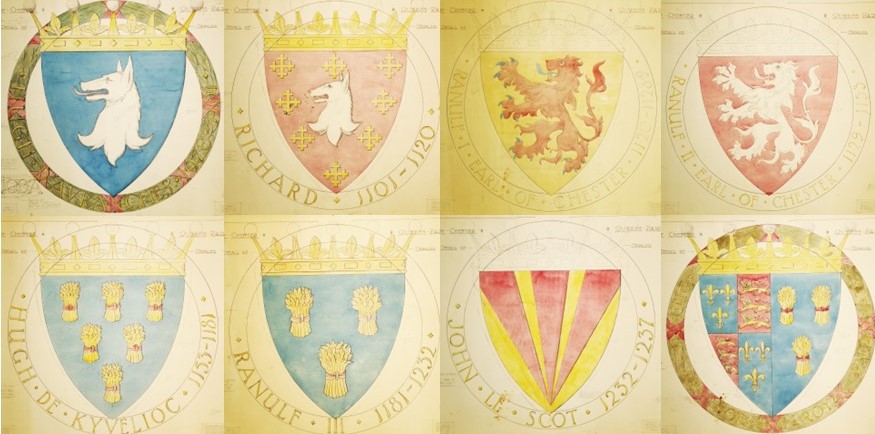
The first suspension bridge from the Groves to the new housing at Queens Park was built in 1852. This first bridge was replaced in 1923 by the Corporation at a cost of £7,000. These drawings are of the heraldic coats of arms of eight Norman Earls of Chester which decorate the arches above the bridge. The drawings are by architects F.A. Roberts and P.H. Lawson of 88 Foregate Street, Chester.

Why conserve these plans when we have so many others that need our care?

Events, activities and exhibitions are being organised to celebrate the one hundred year anniversary of Queens Park suspension bridge during May and June of this year. These plans, along with other related material, have been chosen by our Archivists’ to support this work.


How were the drawings made and what condition are they in?

An outline of the heraldic shield encircled by a wreath was printed onto paper and used as a template for the drawings. The designs have been hand drawn at full scale and coloured. There are eight completed designs with a set of additional pencil drafts of the designs on tracing paper. Media used for the drawings include pencil (for outline and shading), water colour paint and ink.


Once unrolled, we can assess the condition. Much of the damage has been caused historically by poor handling and storage. We find surface dirt, tears, missing areas (lacunae) and areas of paper degradation, especially along the top and bottom edges.

The conservation treatment consists of cleaning, flattening and repairing the plans so that they can be handled safely, without causing further damage, digitised and exhibited.


How do we remove the surface dirt?

The bread and butter of any Paper Conservators’ work is cleaning, and lots of it! It looks simple, but it takes years of experience (and sore fingers) to develop techniques that work effectively and that don’t cause damage to the original material.


These drawings were especially challenging to clean as the artist has used pencil for outlining and shading. We need to remove the general surface dirt whilst being careful not to remove the actual pencil. Using thin wedges of vinyl eraser we are able to carefully work around the pencil and remove the surface dirt.


How do we get them flat?

Next, we need to ‘flatten’ the rolled plans so that we can repair them. The drawings are placed in a large ‘damp-pack’ to introduce water vapour into the paper in a very controlled and gentle way. This in turn will ‘relax’ the individual paper fibres and make the paper more pliable. Once damp, they are placed under thick sheets of blotting paper and covered with sheets of Perspex, then weighted down to flatten them.


The humidification chamber (damp pack) we use is made up of a layer of clear polyester, a wet layer of capillary matting and a layer of Sympatex (a breathable waterproof membrane) on the top. The same three layers are then placed over that in reverse order, and the document placed in the middle to receive the water vapour and ‘relax’!

How do we mend the tears and fill in the lacunae?

Most of the drawings have some minor tears that need repairing, but a few of them, including ZCR/715/4 for Ranulf I, Earl of Chester, 1101–1120, have suffered more substantial damage. This long horizontal tear was likely to have been caused by someone attempting to unroll the plan. This sort of damage is commonly seen in large paper documents such as maps and plans that have been stored rolled.


The process begins with cooking some fresh wheat starch paste to use as an adhesive for the paper repairs, which we prepare in the Conservation studio. After cooking and cooling the paste, we sieve it three times to create a super smooth and sticky, but fully reversible paste.


It can be difficult realigning long tears so that the image area joins up accurately, even when the paper appears perfectly flat. Paper can be affected by levels of high humidity, so any exposure in the past, and during the humidification process can alter the placement of paper fibres making it difficult and sometimes impossible to join them perfectly.


We apply paste using a small brush to the edges of the tear, working on the image side (the recto) to check on alignment, and work along a small section at a time. This is sometimes called ‘Chasing the tear’! When the edges are joined, we turn the drawings over and adhere a section of Japanese repair paper to support this area from the back (the verso).

How do we consolidate these repairs?

Adding a support layer on the verso is essential when repairing tears as it adds strength to weak and degraded areas and allows the repaired paper to flex normally without any further damage being caused. We select a Japanese paper (Kozo Shi) of lighter weight but similar colour to the original document. The repaired areas need to be clearly visible but also be sympathetic to the original material.


Handmade Japanese papers are ideal as they have long fibres and keep their strength when wetted out. We use a mattress needle to score the repair paper to the shape and size we need, wet with a water brush and tear the support out. The resulting long fibred edges make for a strong and sympathetic support layer once pasted down.


What about the lacunae?

We add repair paper to infill and strengthen missing areas. This also includes replacing original material that has become detached. Using a heavier Japanese paper (Bunkoshi) that equals or is a bit lighter than the original and working on a light (illuminated) table; we score the exact area missing with a mattress needle.


We then soften the paper fibres using a Rotring pen filled with water and tear out the infill, add paste to the reverse and adhere in place to fill in the missing area. The repair to this plan is finally complete after the repairs have dried and trimmed with a sharp scalpel. As a final protective measure they are placed into transparent polyester sleeves.


We still have a bit of work to do until they are all conserved and accessible, but they will be ready in plenty of time for the upcoming events and activities. We wait, in eager anticipation, for the next box of tatty items to appear in our conservation studio!


To hear about future events subscribe to our newsletter at www.cheshirearchives.org.uk 


Tuesday, 28 February 2023

Historical thinking: using the census in primary teacher education

This blog is from a guest contributor. It is based on an article written by Tony Pickford, Visiting Lecturer in the School of Education at the University of Chester, about using the Census in primary education.


Local History is a required area of study on the primary school curriculum. When educating would-be teachers, I have always encouraged them to empathise with historical characters and to try and think like them as well. A key resource in promoting this ‘historical thinking’ is the census. Site visits, images and written documents such as diaries all have potential for prompting ‘historical thinking’ - in teachers and older primary pupils alike - but census extracts provide a unique window into real lives and life experiences in the 19th and 20th centuries.

A census has been conducted in this country every ten years since 1801 (except 1941). The first only gathered population figures for villages or towns, but details of the members of each household were collected and recorded from 1841 onwards. In every census year, heads of households were instructed to complete forms giving details of everyone who slept in that dwelling on census night, which was usually a Sunday in March or April. The forms were collected a few days later by an enumerator, who entered the information into enumeration books.

For the period up to 1901, enumeration books recorded people’s place of birth, their age, occupations and relationships. In 1911, because of rising standards of literacy, forms completed by householders were retained for the first time. Accessing the pre-1911 records is now a relatively straightforward task: transcribed and digitised versions of the schedules are available via the online subscription services Ancestry and Findmypast, which are provided for free at Cheshire Record Office in Chester. Some transcripts of census records are also available free of charge on www.freeCEN.org.uk.

Younger primary children can find it difficult to read 19th century handwriting, and this is easily addressed via transcriptions mentioned above. But older children often enjoy the challenge of deciphering original documents. The authenticity provides a tangible link to the past and helps to foster ‘historical thinking’. To promote this principle further, I developed some census-based activities for students.


The first activity aimed to combine history and information technology. Students had to imagine a time machine bringing back an enumerator from the past to do a final check of the census. They had to ‘become’ the residents of a street and use census information held on a database to find information about ‘themselves’, such as their address, relationship in the household, occupation or place of birth. When the enumerator appeared (myself or a colleague wearing a Victorian top hat!) we would discuss what they had learned. It became clear that while this task and role-play was useful at demonstrating how to use a database, it was less useful at immersing students in the period and getting them to relate to the people in the census.

As a result, I changed the activity to include more immersive role-play to try and achieve the goal of ‘historical thinking’. We visited the streets listed in a chosen census and students had to identify buildings through photographs of features on buildings. Finding a suitable street was not a difficult prospect being based in Chester, with an abundance of streets built in the 18th and 19th centuries, and Cheshire Record Office has a searchable online database of local images (Cheshire Image Bank). This, with supplementary work like sketching buildings, or listing key words to describe the people who lived and worked there in the past, had a more positive outcome.


Back in the classroom, students were given copies of the census, and were surprised by the range of different households in the locality, and their inhabitants, that the census revealed. Alongside wealthy middle-class families with servants, there were boarding houses, public houses, small hotels and even a bank. Students were then given a key task that I hoped would lead to ‘historical thinking’: working in small groups to create a short conversation between the residents of ‘their’ property – a conversation that might be overheard by a passer-by and give some information about who lived there. We would discuss the type of language that would be used - words and expressions that would and would not have existed in 1901, for example - and strict instructions to avoid slang and expressions such as ‘okay’ and ‘yeah’!


We recorded these conversations and, after sharing them with the wider group, students were asked how they had approached the task. Had ‘historical thinking’ been used to underpin the conversations? The answer to this question was not simple.


Some conversations produced a great deal of information. Others conveyed individual characteristics with some humour (such as using an accent or imagined personality traits linked to a person’s profession) but gave little detail about relationships in the households. A few conversations suggested students had genuinely explored the views that characters might express – differing opinions about issues of the time that might arise in the households, for example. There were glimpses of ‘historical thinking’ - not enough to claim that the role-play had achieved its aim in full, but the conversations showed more engagement and immersion in the census material than the previous database activity. To that extent, this second activity was successful.

The session concluded with students translating the activity into a series of lessons for a chosen age-range of primary school pupils, and the audio files were shared on the University intranet. Overall, the second activity showed that census extracts, when supplemented with other sources like a visit to the houses and streets documented in that census, can provide the cognitive scaffolding that might support student teachers – and the children they are intending to teach – in ‘getting inside the head’ of people in the past.


Thank you to Tony Pickford for offering us his article.

Cheshire Archives and Local Studies published another blog about the census in 2022. ‘A “New” Census’ can be found here.


Tuesday, 14 February 2023

What Is Cheshire?

Cheshire Archives and Local Studies is one of hundreds of public record offices throughout the country, which carefully preserve and allow access to the historical archives of their local communities. These are often called “County Record Offices”, although in practice the areas they serve can be far smaller (or occasionally even bigger) than a county. Which raises the question… what is the county of Cheshire? Well, the answer depends on the date and the type of records you’re looking for. 

The “Cestrescire” recorded in the Domesday Book of 1086 was one of 34 ‘shires’ that the Saxons established in England and Wales well before the Norman Conquest. Its boundaries then appear to have extended into what later became south Lancashire and most of Flintshire. However, the boundaries of the shires remained fluid and continued to evolve over the next few centuries. 

From 1254 to 1545 the County Palatine of Chester had its own parliament, consisting of nobles from the county serving under the Earl of Chester. This was abolished by the Chester and Cheshire (Constituencies) Act 1542, and thereafter the county was represented at Westminster by two Knights of the Shire, while the city of Chester was separately represented by two burgesses. 

Speaking of the city of Chester, in 1238 this had been granted the status of a “county corporate”, effectively making it independent from the rest of Cheshire, with its own completely separate system of local government. This was officially styled as the City and County of Chester, to distinguish it from the County of Chester (referring to the rest of Cheshire). These potentially confusing descriptions could still be found in some official sources until as late as 1974. 


By the mid-16th century, Cheshire had assumed its familiar ‘teapot’ shape, with the Rivers Mersey and Tame marking its northern extent, and the River Dee delimiting most of its western boundary with Wales. This area is often referred to as the Ancient County of Cheshire, and it remained largely unchanged until the Victorian period, when new systems of local government were required to cope with the demands of an increasingly large and industrialised population. 

The Registration County of Cheshire was formed from groups of poor law unions set up in 1835, under which groups of parishes would combine to care for their poor and infirm residents. When a new civil registration system for births, marriages and deaths was established in July 1837, most of the poor law unions doubled as “registration districts”, with the poor-law overseers becoming local registrars. However, unions and registration districts didn’t always respect county boundaries, with the parishes of Hawarden (Flintshire), Biddulph (Staffordshire), and Heaton Norris and Reddish (both Lancashire) being included in Cheshire districts, while the Cheshire parishes of Disley, Mottram in Longdendale and Malpas were originally placed with districts in Derbyshire, Lancashire and Denbighshire respectively. When searching the national indexes for our ancestors’ births, marriage or death certificates, this can mislead us into disregarding entries which seem to be in the ‘wrong’ county. These boundary anomalies persisted until 1937. 

The Victorian period also saw the introduction of local boards of health, to improve conditions in the towns and cities. From 1872 these became “urban sanitary districts”, with the remaining parts of each poor law union becoming “rural sanitary districts”, and they gradually took on more and more responsibility for local affairs (the “sanitary” part of the name was dropped in 1894). Several of these districts inconveniently extended into two or more counties: for example, Stockport, Stalybridge, Warrington, Ashton under Lyne and Mossley, each of which comprised parts of Cheshire and Lancashire (with Mossley including parts of Yorkshire for good measure). To remedy this problem the Local Government Act 1888 created a system of Administrative Counties, by placing each district in the county where it had the largest population. Although the administrative county of Cheshire was a little smaller than the ancient county, it contained a larger population. 


Although the 1888 Act made it clear that administrative counties were intended to exist alongside (rather than replace) the ancient counties, the latter became increasingly redundant for purposes of local government, especially after a new system of county councils and county boroughs was established in 1889 by the same legislation. This meant that certain large towns and cities functioned as counties in their own right: in Cheshire these were Chester, Birkenhead and Stockport (joined later by Wallasey in 1913). 

This system of local government was swept away when the Non-Metropolitan County of Cheshire was created in April 1974. The urban areas on the Wirral peninsula, and to the south and west of Manchester were transferred to the new metropolitan counties of Merseyside and Greater Manchester respectively, while Cheshire gained the towns of Warrington and Widnes from Lancashire in compensation. All the county boroughs were abolished, with the city of Chester at the centre of one of eight new districts making up the county, all overseen by a reformed Cheshire County Council. 

In 1998, two of these districts, Halton and Warrington, became “Unitary Authorities”, granting them the powers of a county council. In 2009, the remaining parts of the county were divided into two more unitary authorities – Cheshire West and Chester, and Cheshire East – with the result that Cheshire County Council ceased to exist. However, Cheshire itself lives on as a Ceremonial County, established under the Lieutenancies Act 1997, now comprising the boroughs of Cheshire East, Cheshire West and Chester, Halton, and Warrington. 


We should also mention the Diocese of Chester, which at its foundation in 1541 extended as far north as Cumberland and Westmorland, taking in almost the whole of Lancashire, and parts of north east Wales. During the nineteenth century the area of the diocese was steadily reduced to roughly correspond to the ancient county of Cheshire, as it still remains to this day. 

Cheshire Archives holds records relating to all the Diocese of Chester and the former county authorities, although some collections for places outside present-day Cheshire have been transferred to neighbouring record offices – for examples, wills for Lancashire residents proved in the Diocese of Chester before 1858 are now at Lancashire Archives. So if you aren’t sure whether we have the records you need then please ask us before you visit, or consult our online catalogue and guides.

Friday, 27 January 2023

Parkside Asylum Case Books - Not just names on a page…

The history of Parkside Asylum can be found on-line today (Parkside - County Asylums) but what do we know about the patients who were admitted there? Who were they? Where did they live? Why were they admitted? How long did they stay? Where can we find their stories?

At Cheshire Archives, we are just beginning to explore the wealth of incredible material found within Parkside’s case books. Technology is supporting the information shift from these original leather-bound books into a searchable, accessible on-line research goldmine. With that transformation, our insight into the lives of those living within its walls magnifies and we start to gather information beyond the medical…These patients were real people, with real lives, in a time when we were just learning about mental health.

Where did they come from? 

Parkside Asylum was in Macclesfield; however, its patients came from all over the United Kingdom. The case books are an incredible source of address and place information, which helps us delve even further and join the dots with sources already available to us – censuses, births, marriages and deaths indexes, electoral registers.

What did they do before they came to Parkside? 

The occupations of the Parkside patients are incredibly diverse – from actresses to accountants, cloggers to cooks, shepherds to schoolmasters, paupers, and private patients alike. Parkside treated patients from every walk of life.


Could these be the only images of your ancestors? 

The casebooks contain small passport-sized images of many of the patients. Putting a face to a name and their story. An interesting observation is although there are a few from the 1870’s, these photographs are generally much more common during the 1880’s onwards.

Happenstance or hereditary…

The detailed case notes, medical terms and diagnoses of Parkside’s patients will help us to better understand mental illness and its treatment in the 19th century. Why were patients admitted? How were they treated? What was their diagnosis? Some patients were admitted many, many times. Can we find out why? Although some died at the Asylum, others were discharged, some were transferred to other asylums or hospitals. With the right connections, perhaps one day we can build a timeline of what happened to them. After all, wouldn’t you want to know what happened to your great Aunt or great-great Grandmother?

The use of different sources, like the census, comes in handy as interpreting the copperplate writing from the original books is sometimes a challenge! Were they a Boden, Bowden, or Bodan? Is that a T, a J, or an S – occupation Tailor, Jailor, or a Sailor?


Prepare to be shocked…there was no holding back with how medics described their patients in the 1870’s. Some of the terminology used then, we certainly wouldn’t use now. Medical terms and names of diseases are vast and varied. Do you know what Mania a potu is, for example?

We have 40 years of detailed case books and - with the help of our amazing volunteers – we will continue to build and develop this incredibly valuable information source for us all.


So, you see, the patients of Parkside Lunatic Asylum are not just names on a page, and we’re starting to tell their stories…


Our team of remote volunteers are helping Cheshire Archives index the Parkside case notes. This means the data can easily be searched and analysed by the public and researchers alike.

Want to be a part of it? You can! Email us for more information or join up straight away on the Zooniverse website


Tuesday, 17 January 2023

Behind the Scenes in Repro!

Everybody is welcome to visit Cheshire Record Office to discover our Archives and Local Studies collections. But did you know we have a copying service for people who can’t make it to the search room in Chester? This is a glimpse behind the scenes of our Reprographics Department. 

‘Repro’, as it’s known, is run by the four Archives Assistants (‘AAs’) who work at Cheshire Record Office, and we do our best to provide copies of almost anything that people ask for, within copyright rules of course. We use a combination of photocopying, digital photography, microfilms, scanning and printing to fulfil orders placed via our online shop or the search room, and there is a huge range of items that can be reproduced: from wills to parish records, maps to newspapers, vehicle registrations and many, many other documents. 


We had over 400 reprographics orders last year, not just from Cheshire but from all four nations of the UK, and around 10% of the orders are from overseas. Nearly one in 20 are sent to the USA and, over the past 12 months, they also went as far afield as Jersey, Spain, Norway, Sweden, Israel, Canada, Australia and New Zealand. 

Some of our most popular requests are for wills, which can help with family history research. We hold thousands of Cheshire wills dating back to the 16th century, and these can usually be photocopied and sent by post. They are charged at a flat rate whether they cover just one or two pages or dozens, so you might get a bargain! We never know until they’re retrieved from storage how long they are, what they include or how beautifully written they might be. Occasionally people decide to order them in large format for display, such as this one from 1806.


Family history enthusiasts can also order copies of parish register entries, where we print and post out the handwritten notes from a church’s baptism, marriage or burial registers from over 100 years ago. These documents also stretch back hundreds of years, and some have been digitised, appearing on family history web site Find My Past as part of The Cheshire Collection.

We get numerous requests for copies from our extensive collection of Cheshire newspapers, and usually use microfilm to produce these. Orders include anything from someone’s own appearance in the local paper; to reports of significant events like the late Queen’s Coronation (these were particularly popular during last year’s Platinum Jubilee celebrations); or back further still to articles from the 19th and even 18th centuries, to help with family or local history research.


Maps and large format prints are a substantial part of our repro work. We can produce copies up to A1 in size (that’s 594 x 841 millimetres!) and copy items up to 72 x 110 cm, but sometimes even this isn’t sufficient to reproduce our extra-large archive documents. In those cases, the AAs try to weave some digital magic to provide you with the best image possible. For instance, one order was for a map so big that it that had to be captured in 9 separate photographs, but we used computer software to stitch them together to send the customer one overall image by e-mail. And copies of old Ordnance Survey or Tithe maps are not just for people to hang on their walls for decoration – we’ve recently done an order for someone using our maps to replant and restore trees in their original locations! 


Vehicle licensing documents are also popular repro requests – they are needed to re-issue original number plates for vintage cars, but we are asked to copy other transport-related records as well. The order below was for an image of an early wagon built by Foden’s of Sandbach. The image in question was an old glass plate negative, but we were able to use digital technology to provide a more realistic image to go with it. 


In addition to regular repro orders, we also deal with bulk orders – these are for large numbers of images which often come from academics needing copies of documents for their research. They can be on any subject but, as an example, we have recently photographed hundreds of pages of 17th and 18th century court documents for a national academic project about the English Civil Wars. 

These are just a snapshot of the many different types of documents that come through the reprographics department. And we don’t just deal with customer orders – we produce material for in-house and partnership events as well. Recent work includes printing photographs for a project celebrating the lives of older people at Storyhouse in Chester; making displays for a Chester Town Hall event celebrating the long friendship between the City of Chester and Poland; and digitising memorabilia from Browns of Chester department store for a series of events in partnership with the University of Chester and West Cheshire Museums. 


Working on repro can bring to light some unexpected items from our collections, and we’ll end with a couple of our favourites. When reproducing some images from an album of photographs of Spanish mines belonging to the United Alkali Company, we found this one showing three men on the night of 7th May 1910 – they were watching out for the passing of Halley’s Comet! And when copying some archives of the village of Bollington, we thought the description ‘photograph of Sunday School’ would be an image of a building, but instead found a lovely photo capturing hundreds of people at a Sunday School event in 1908. 


If you’d like to have a copy of something from the Archives or our Local Studies collections, first head to our online catalogue then click on our online shop – and our Repro team will do the rest! 

All of these items and more can be viewed at Cheshire Record Office in Chester – or ordered from our Reprographics Department!

Wednesday, 14 December 2022

The Journey of a Local Studies Donation

Earlier this year we received a fantastic collection of photographs of Crewe in the 1890s, kindly donated to us by one of our volunteers, Susan. We thought this blog would be a great opportunity to showcase the collection, as well as thank Susan for her donation, and to highlight all the staff and volunteers involved with the donation and cataloguing process.

First a bit more about the photographs, and why Susan decided to donate it to us. Richard Baxter Booth was a Crewe dental surgeon, and this photograph collection was compiled by him in the 1890s.

Susan says “I found the album for sale on eBay, and Baxter Booth’s granddaughter has been shown the images; her father, Walter (Baxter Booth’s son) was also a dentist and keen photographer. This is album number two; number one is lost unfortunately. Baxter Booth’s dental surgery was in the row of buildings on Crewe Market Square that was replaced by Marks & Spencer, it was the last one on the left on the corner of what is now Queensway. After his marriage he lived at Oaklands in Haslington; he was an active member of the Crewe Cycling Club, the Crewe Alexandra Cricket Club, and Crewe Golf Club. All the images are 'Kodak no. 2' prints”. Baxter Booth had previously lived at Fields Farm, Haslington, rented from the Crewe Estate.

Once we had received the collection and Susan had completed our donation form, the photographs were passed to one of our conservators, Angela.

Angela says, “The original binding had completely failed, so the loose album pages were cleaned with a plastic eraser and placed into custom made polyester sleeves and then put into an acid free folder. These preservation measures will protect the album pages and photographs when they are being handled and also protect them from dust and any fluctuating environmental conditions they may encounter.”


Next, the collection was looked at in more detail by our Local Studies Librarian, Heather. She tells us, “The collection was added to CALM, our collections management system, so that it could be found by staff, researchers, and members of the public online. CALM generated a unique 6-digit reference code for the item, 231804. It was also given a class number of VPH96, which helps to locate the item in our visual collection. Here I am storing the collection away in one of our strongrooms, in an archive box, and where temperature and humidity levels are monitored.”


Another of our volunteers, Helen, was tasked with looking at each individual photograph and indexing it onto a spreadsheet.

Helen says “I am currently a volunteer working on the photographic archives at Duke Street, finding out any extra information about the subjects of the photographs and then entering all the information onto a spreadsheet. These spreadsheets, such as the one I worked on for the Richard Baxter Booth collection, will allow the public to access the information online, widening public access to the contents of the archives.”

This should help any researcher interested in the collection to find the exact photograph most useful to them. Helped by Susan’s knowledge of the area at the time, and of the photographer Richard Baxter Booth, this task is now complete. Please speak to a member of staff if viewing this spreadsheet would be helpful to your research.


We have not yet digitised the whole collection, but a selection of our favourites are featured below. The album contains scenes and events in Crewe, such as the Crewe Flower Show and a football match, as well as buildings (the Mechanics Institute, Town Hall, pubs, churches), and also features the residences of other doctors/medical men in Crewe such as Dr Atkinson’s residence “Mirion House” on Earle Street. The photographer also used his friends, family, and pets as his subjects.


The next step will be to have more of this fantastic album digitised and available on the Cheshire Image Bank website. 

If this blog has inspired you to consider donating an item or collection to us, then we would love to hear from you. Please do contact us first, as we can then check that the item fits with our collection policy and is not something we already have. You can get in touch with us via our website, telephone 01244 972574 or email recordoffice@cheshiresharedservices.gov.uk.  

All of these photographs and more are available to view at Cheshire Record Office in Chester.