Pages

Wednesday, 28 September 2016

Final Remarks as a Trainee

Trainees just starting out at DCDC15. Image courtesy of Emma Stagg.
I have been working at Cheshire Archives and Local Studies for the past year as a Transforming Archives Trainee and have learnt a huge amount about archives and digitisation. Unfortunately, my time here is coming to a close.

A number of Transforming Archives Trainees have begun their traineeships this year (Cohort 2 of 3); with a smaller amount in Scotland as part of Opening up Scotland’s Archives. With two official trainee meetups throughout the year and a lot more impromptu ones, we have all supported one another while early on in our careers.
Transport used inside The National Archives' building to transport documents.

Everyone undertaking the traineeship is enrolled onto a module at the University of Dundee. This module was undertaken via distance learning and I studied an Introduction to Digitisation and Digital Preservation. In fact, Transforming Archives/Opening Up Scotland’s Archives have been so successful in ensuring the new workforce is up to speed with digital preservation, that they have been shortlisted for the Award for Teaching and Communications in the Digital Preservation Awards 2016!

With a training fund available to me throughout the year, I have been able to go to a large number of conferences and courses of my choice. Naturally, the Digital Preservation Coalition’s Student Conference, was one of my first choices as it supported my distance learning course. Other courses completed include the Care of Paper and Photographic Collections and Photographing Museum Objects: both of which otherwise I would be unable to afford.
Possible hazards to consider at the Archives as part of the Care of Paper and Photographic Collections course.

The funding has also allowed me to purchase books relating to digital preservation and preventive conservation of photographs, to improve my knowledge in these areas and support my archival career.

I have become a member of the Archives and Records Association and Institute of Conservation over the course of my traineeship post; attending both of their conferences. Additionally, I am now a member of the Association for Historical and Fine Art Photography with plans to go to their conference in November after my traineeship has concluded. A number of the trainees from all three years will also be attending DCDC16 in Salford from 10th-12th October 2016. 

Back at Cheshire Archives, I have catalogued and re-packaged over 15,000 Local Studies items. These range from 35mm slides, to prints, glass plate negatives and original illustrations. A selection of those catalogued were digitised and uploaded onto the Cheshire image bank and I have spoken about a series of these in a previous blog post.
Selection of Local Studies slides from the 80s, showing views of Cheshire and North Wales.

After working with Local Studies, Medieval Deeds was my next project. Over 350 Medieval Deeds were digitised and are all accessible remotely for our volunteers to transcribe them from their original Latin. The goal is ultimately to add both image and transcription to our cataloguing system. This will make the whole series searchable and increase the value and knowledge which can be gained from these manuscripts. This project has just been released to volunteers and will continue under the management of the new trainee.

To tie in with the Medieval Deed transcription, I organised two days of Horrible Handwriting courses to assist the public in deciphering and making sense of the English writing on old documents. This was a successful event and also helped me to improve my palaeographical skills alongside assisting those attending.

In between these main projects, smaller ad-hoc duties have cropped up. Early in the year, I produced a blog post promoting The National Archives' Explore your Archives week which runs again this year, 19-27th November. At Christmas I photographed Chester’s Christmas Markets, which was the perfect time to capture that area of Chester. Town Hall Square will soon look a lot different with the progression of the new Northgate shopping development.

More recently, I have scanned glass negatives for Twitter and even produced a variety of visuals to be displayed at Cheshire’s Tour of Britain. The sheer range of work I have undertaken here has made it a very informative year for me!
Eastgate Clock, Chester. Glowing pink just after its refurbishment. 

You can follow the work of next year’s trainees (and take a look back at this year) via the following Twitter accounts:
And you can read a bit more about my work, and how I got here on the National Archive’s blog.

For now, I hand over to my successor Miranda Lennon and wish her and the rest of the new cohort the best of luck with the year ahead. 

Thursday, 25 August 2016

The Folk-Speech of South Cheshire

Following on from an earlier blog (http://cheshirero.blogspot.co.uk/2016/04/dialect.html) I wrote about books and articles relating to local dialect in the Local Studies Collection here at the Record Office in Chester, I stumbled upon Thomas Darlington’s The Folk-Speech of South Cheshire (Ref: 200293) which was published for the English Dialect Society (EDS) in 1887 just two years after Robert Holland’s 'A Glossary of Words' used in the County of Chester was issued, also by the EDS.  Darlington is rather apologetic about this, but because Holland specifically stated in his preface that he had little opportunity to become acquainted with the dialect in the Southern part of the county, an area he defines as ‘that part of Cheshire lying South of a line drawn from west to east across the county, and passing through Handley (six miles S.E. of Chester) and Crewe), it was felt by Darlington, and the EDS, that this new work was warranted.  And at 450 pages in length it clearly was.

The book contains a fascinating introduction talking about the influence of neighbouring dialects and language on that of South Cheshire.  Not all though – the “paucity of Welsh words in the folk-speech can only be explained as the result of the singular antipathy which the men of Cheshire have always shown towards their Welsh neighbours.”

What follows is a detailed Pronunciation and Grammar guide (of the kind that used to terrify me when studying languages in Secondary School), and then a rather interesting dialect version of the Book of Ruth (see image below)


The main bulk of the book (nearly 350pp) is a glossary of words as collected by Darlington and used in the defined geographical area.  It is a fascinating collection, and arguably his descriptions are a little more readable than Holland’s. Here’s a small selection of entries that caught my eye:

Apperntle, s. an apronful: from appern, an apron.  “A apperntle o’ ‘tatoe-pillin’s for th’ pigs”
Chommer, v.a. to masticate, chew. “Whey, if that young foxhaind hanna chommered my slipper aw to bits”
Cuckoo-wuts, s.pl. oats sown after the cuckoo has come.  Oats sown so late are not expected to turn out well.
Fecks, or Good Fecks!, interj. an exclamation of surprise.
Goblin, s. a gooseberry.
Hoozy-poozy, adj. wasting time. “Has Dick gone after that missin’ heifer?  Whey, one o’ the little lads mit ha’ fatcht her.  It is so hoozy-poozy to be doin’ a-that-ns, when hey mit ha’ bin getting on wi’ the milkin’ “
Johnny Raw, s. an ignorant, uncouth person.  “Yo bin a pratty Johnny Raw, to be turnt ait by yursel, an’ dunna know a B from a bull’s foot”
Kindle, v.a. to bring forth, bear.  Used of all small animals except cats, which are said to kittle.
Lithermon’s Looad, s. a lazy man’s load; a load piled up to save the trouble of a double journey.  “An’ nai, ye can go an’ fatch the rest o’ th’ hee; there’ll be rather moor t’n a jag left; bu’ dunna bring lithermon’s looad, else ye’n meebe have a waut “
Smellers, s.pl. a cat’s whiskers.  “If I know’d hooa’d cut that cat’s smellers off, I’d tickle their toby”
Three-cornered, adj. irritable.  “Yo mun mind what you sen to th’ mester; he’s in a very three-corned wee this mornin’, he welly snapped my yed off when I spoke to him just nai”
As someone born in Sheffield, I also rather enjoyed Yorkshire, s. cajolery, blarney, attempt to hoodwink or deceive.  “Let’s ha’ none o’ yur Yorkshire”
And finally (actually that honour falls to Zowkers – an exclamation of surprise)…the letter Z itself: “Elderly people have told me this letter used to be called uzzard; and persons now hardly past their prime were taught in their school days to call it zod.”

Wednesday, 10 August 2016

From Audlem to New York


Photographs can give amazing insight into the lives of the people of the past. At Cheshire Archives and Local Studies, cataloguing part of the glass plate negative collection unearthed a number of such images. These images are glass plate negatives depicting American life in the early 1880s. The only question was, why had we accepted items relating to an area so outside our collection policy? A theory arose that perhaps these people had links to Cheshire but had left to discover a new life in America. 


New York Garden- c11607 on Cheshire Image Bank

Upon inspection of the various boxes, it was found that some in fact were of areas around Audlem in Cheshire. The same hand had written the captions for both New York and Audlem; creating a link between the images and reinforcing the glass plates’ original grouping as a set.

We decided to research some of the names shown in the captions. Our Local Studies manager started on the trail of Brettel Gullen. She found out that his place of birth was listed as Brooklyn, America in October of 1884.


Marriage
After some further research, we came up with a discovery. Brettel’s parents had married in the Parish of Audlem the year before his birth (1883), and the newly married couple travelled to Brooklyn, USA where they began their lives together. Later records show that by 1894 three daughters had been added to the family- Margaret Emily; Agnes May and Edith Fernley Gullen.

1883 Marriage certificate of William Gullen and Emily Fernley from Find My Past


Jesse Fernley

Jesse Fernley is Brettel’s maternal grandfather and is listed on his daughter’s marriage certificate. In 1883 he is a school master, and Brettel’s mother (Emily Willoughby) plus two of her sisters followed in Jesse’s footsteps, becoming school mistresses.

“At this time,[1870-80s] Jessie Fearnley [sic] was the interesting headmaster of the C. of E. School, who lived at Moss Villa...” Marjorie Burton, Nineteenth Century Audlem.

Jesse stayed at Moss Villa until his death in 1924.


Moss Hall- copy from original by Jesse Fernley- c11618 on Cheshire Image Bank


The images we hold of Audlem in this collection are attributed to J.F (presumably Jesse Fernley) in 1875, copied onto glass plates by his son-in-law 17 years later.


Death
William Frederich Gullen (Brettel’s father) had copied these plates of Audlem, possibly to help him and his wife stave off homesickness. However, a mere two years afterwards she would be making her way back to the UK with her four children. The ship passenger list states that she is now a ‘widow’. Her husband had died close to his 40th birthday. Brettel was now the head of the family, aged 9.

1894 Passenger List Montreal to Liverpool from Ancestry


Later Life


Regardless of this setback, the remaining family’s fortune seemed to remain good over the next few years.

As Brettel grew up, he studied in both Leeds and London as a railway carriage draftsman and continued in his work with the railway throughout his life. Multiple passenger lists show him going between Southampton and Buenos Aires repeatedly. A lot of British companies were buying up Argentinian rail networks around this time which could explain Brettel’s presence there.

1933 Passenger list Buenos Aires to Southampton from Ancestry


All the family except Brettel show up in the 1911 Wales census, with an address in Cardiff. It shows us that the daughters have all followed in their mother’s and grandfather’s footsteps and become teachers. The address here and the address found 22 years later on Brettel’s passenger list (above) are under a 45 minute walk from each other. We don’t know if Brettel moved away or they all moved and continued to live together not far down the road.

1911 Wales Census from Ancestry


Despite Brettel and his siblings losing their father at a young age, they got to meet their Cheshire Grandfather for the first time and had the chance to experience two different ways of life and we have some amazing photographs to show for it.


The whole Gullen family (inc. a 5th child who died in infancy) with pet bird- c11613 on Cheshire Image Bank


If you want to see more about this family and their life in America, the whole set of images have been digitised and are available on Cheshire Image Bank now.

N.B Previously we had said Mr Gullen was from America but he was in fact from Walsall, later moving to Liverpool and then to America before his marriage.


Tuesday, 31 May 2016

100 years of remembering HMS Chester at the Battle of Jutland

Chester has not forgotten its link with HMS Chester and the men who served on her at the Battle of Jutland on 31 May 1916. If you visit Chester Town Hall this week you will find a small and touching exhibition relating to John Travers Cornwell VC prepared by Chester History and Heritage.

Correspondence between Albert E Horne of Cheltenham, who served on HMS Chester, and the Mayor of Chester indicates that he made regular visits to civic events from the 1950s onwards. In June 1970 he presented the city with a photograph of the 'Boy Cornwell' that is still held in our collections.

In November he writes again to the Mayor enclosing photographs taken at the opening of the 'Victoria Cross' pub on Jack Cornwell Street in his home borough of Newham on 15 September 1970. They appear here with Mr Horne's captions as a tribute to the shipmates and 100 years of remembering.


The six shipmates with two Ind Coope directors, Mr Green, Librarian and Chef


A chat over old times


Six Chester shipmates with Mrs Alice Payne, 80, Cornwell's sister

Thursday, 26 May 2016

Thinking Local - Toot Hill and Forest Chapel

This blog began with a visit to some friends who have recently moved to the delightful (and tiny – literally a handful of houses and a small church) hamlet of Forest Chapel near Macclesfield.  I’ve had family living in Buxton and have previously walked around Wildboarsclough and up Shutlingsloe (arguably more correctly, Shutlingslowe) – ‘the Matterhorn of Cheshire’, but this hamlet was entirely new to me.  It’s an immediately interesting and very picturesque hamlet, and, despite being only 5 minutes away from the main Macclesfield to Buxton ‘Cat and Fiddle’ Road it feels pleasingly away from the hustle and bustle of the modern world.  As I went out for a nice walk in the chilly March sunshine I was also shown the Toot Hill (or Toothill, depending on your source) earthworks up above the hamlet.  I wondered aloud about the naming of this ‘Roman fort’, and indeed what material we might hold with regards to Forest Chapel as a whole?  When I returned to work in the week I endeavoured to have look, and now (a couple of months on) I have finally done just that.
View from Forest Chapel 2016
I started by picking up Dodgson’s The Place-Names of Cheshire (published in 5 parts, but actually 7 volumes – and available on the open shelves in the Record Office search room - Ref 500189).  This explains the origin of the ‘Toot Hill’ name:

[Incidentally, and relating to an earlier blog on Cheshire Dialect, locally at the dawn of the 20th Century, corn just shooting above the ground, was said to ‘toot’.]


It is not entirely clear exactly how these earthworks became ‘Roman’.   J.P Earwaker in his Roman Remains in the Eastern Part of Cheshire (Ref 213934) does some careful measurements of the area, and talks about them being a ‘small camp’ and with a slightly raised ridge nearby that ‘may have been a Roman road’ but he provides not the slightest genuine evidence of such a connection.
A more extensive archaeological excavation is undertaken by F.A. Bruton and A.C.B. Brown in 1906 and published in a Classical Association of England and Wales publication Excavations at Toothill and Melandra published in 1909 (Ref 200763).  This contains some interesting plates and very detailed measurings and yet, sadly, “The result of the excavations may be summarised in a few words.  They yielded nothing in the way of finds – as regards traces of human occupation they are negative – and except in so far as a careful examination and measurement of the earthwork may assist, they throw no light on the date of the structure.”


F. Thomas undertook A Fresh Survey of the Earthwork on Toothill in 1960 (Ref 207875) and concludes that “Toothill was never a fort in any period..” and “the site as a whole appeared typical of medieval park and forest sites”.  He also adds, perhaps a little pointedly,  that “Excavation of the ditch and rampart might, with the aid of pollen analysis, possibly combined with radio-carbon dating, give some idea as to date, but unfortunately, the central rectangle was almost completely excavated in 1906, and any evidence, which more scientific methods might have found useful, may have been destroyed.”

In addition to these items, there are some good maps - the early Ordnance Survey 25-inch scale maps (We hold the 1st and 3rd Edition sheets for this area), the Tithe Map from 1849 (Ref EDT 255/2 - also available online) as well as Registers from the church itself (St Stephen, Forest Chapel - Ref P88) which is particularly well known for its annual rushbearing ceremony, and several either items


In total, typing ‘Forest Chapel Macclesfield’ into the catalogue produces nearly 50 responses, the majority of them from our excellent local studies collection. 
The point, if indeed this blog is trying to make one, however is not meant to be specific, but general.  Literally nowhere is too small (or indeed, too large) to have some records of some description be held by us.  Why not take a look at what we hold on your town, village, hamlet, street, even your house?  You will never know unless you look.

Wednesday, 30 March 2016

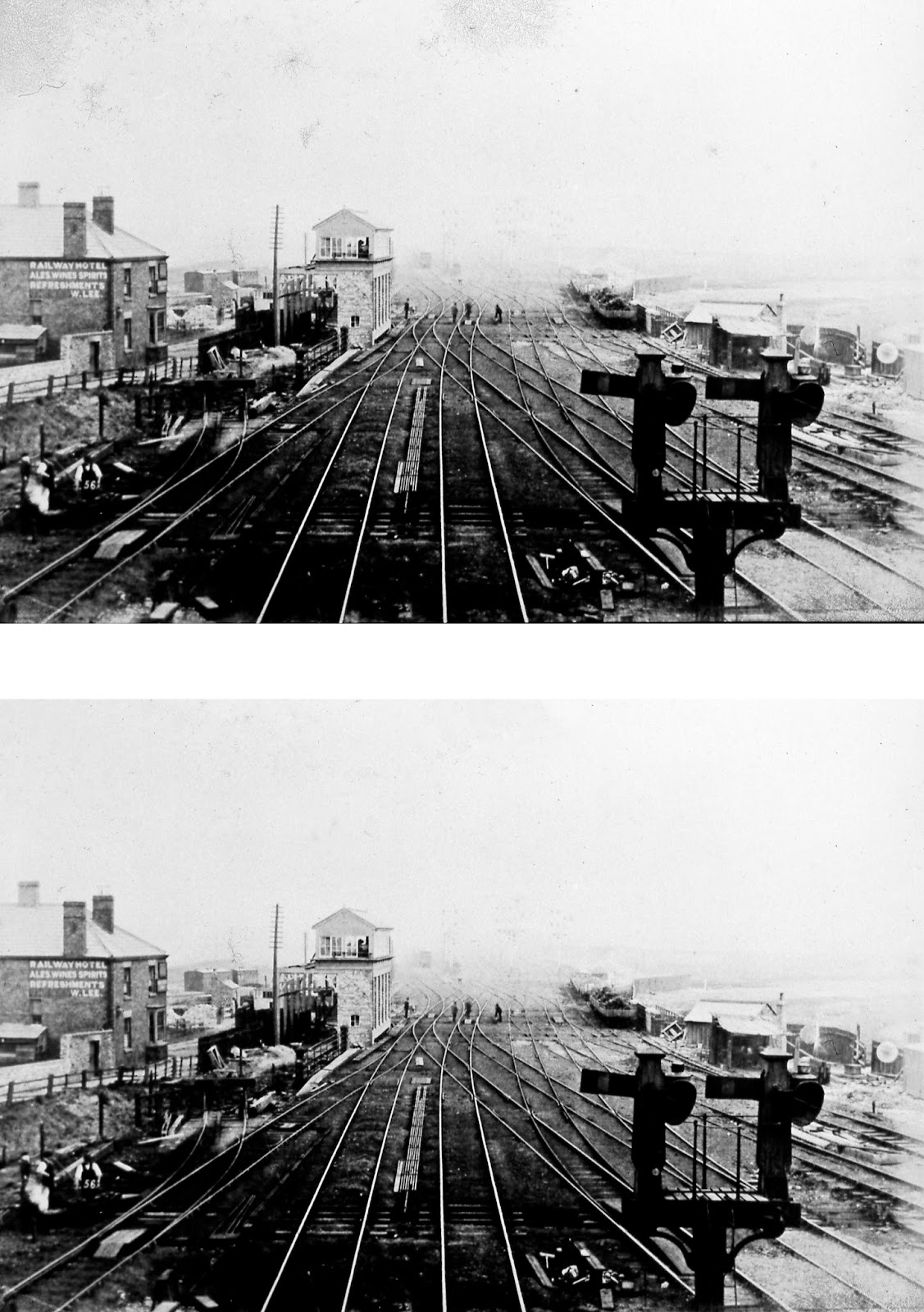
Digital Restoration


It is said that at interview, would-be Kodak employees had to put their hands onto a small piece of metal. The oils in some people’s hands would dramatically eat through the metal, whilst others wouldn’t. People with especially acidic hands would not get the job. I am unsure if this is true but it goes without saying- if your hands can dissolve metal, they shouldn’t be touching valuable photographs! 

Railway Junction Before and After
Railway Junction
Even without handling, photographs can become brittle, dog-eared and damaged over the course of their lives. Often, such items make their way into our archives where our conservators can try to repair and extend the life of the object.

Below are 35mm slides with a range of damages to them. The most prominent damage on these small images is fingerprints. Due to the small size, a single fingerprint can effectively obscure the whole image, and can be even more noticeable when enlarged.
Train Crash
Train Crash

Touching photographic materials with your hands transfers oils to the photograph, which will effectively etch onto the image over time. Digitising the image allows the use of image manipulation software such as Adobe Photoshop, and for most of the damage to be digitally removed. This is a relatively quick process- the longest time I spent editing one of these images was 15 minutes, the shortest only about 5 minutes! 
Crewe Station Before and After
Crewe Station

Photoshop can also enable fixes to take place after conservation has been completed. The image below is from a conserved glass plate negative which had been broken into a number of pieces and fixed back together. Upon digitising, black lines can be seen where the plate had previously been broken. Removing these is a quick job in Photoshop. This is a less invasive task than removing the large scale fingerprints and requires adding in fewer ‘new’ pixels to the affected area.
Glass Plate Before and After Photoshop
Glass Plate Image
Close up of repair
Close up of repair


It would be interesting to know people’s thoughts on this subject. Should we digitally restore our digitised images or keep them true to their current state?


Tuesday, 1 March 2016

Putting the record straight ...

From time to time we are asked to confirm or deny a rumour about the safety of the Welsh in Chester - in honour of St David's Day we publish below the text of our longstanding stock reply ...

"Anyone who has lived in Chester for more than a couple of years will have heard the story that there is a law which allows anyone to use a bow and arrow to kill any Welshman found within the City after dark. As with all such tales, it is largely myth, but equally typically, there is a kernel of truth lurking at its heart.

At the beginning of the 15th century Cheshire and the Welsh borders were in ferment. In the year following Henry IV’s seizure of the throne in 1399, the Welsh rose in a rebellion which continued for several years. The situation was made much worse in the summer of 1403 when Henry Percy, up until then a loyal servant of the new king, joined the revolt and advanced south from Yorkshire, reaching Chester on 9 July. The rebels’ ranks were swollen by those loyal to the deposed King Richard II – rumours were rife that he was still alive – and an army of probably at least 14,000 men advanced towards Shrewsbury. Just north of the town they met the royal army on 21 July. The battle was long and savage but the royal army ultimately triumphed; Percy was among the dead. The work of pacification was not so easily achieved ...

On 4 September, just six weeks later, Henry Prince of Wales and Earl of Chester issued an order for the Mayor, Sheriffs and Alderman of the City to reduce the risk of trouble from dissident Welshman in Chester. Its provisions included the expulsion of all Welsh people – or people of Welsh extraction or sympathies – from within the walls and a ban on their entry before sunrise or their staying after sunset, “under pain of decapitation”, a ban on the carrying of arms by any Welshman, “apart from a knife to cut his dinner”, no Welsh person was to enter a tavern, and any gathering of three or more Welshmen was illegal.

So there was a ban on Welshmen staying in Chester, and severe restrictions on what they could do while in the City. But there is no suggestion of carte blanche for any citizen to take the law into their own hands, and certainly no reference to bows and arrows. As to the idea that the order is still in force, it is probably not the sort of edict which was formally repealed; more likely it was simply left to fall into disuse. Certainly, at the time of Perkin Warbeck’s rebellion in 1489 a similar order was issued to expel Welshmen and there was no suggestion that the earlier order was still “on the books”.

Whatever the case, the order as issued was part of the Palatinate jurisdiction of the Earldom of Chester, the last vestiges of which were abolished in 1830. So for at least the last 185 years, Welsh people have been able to sleep easy in their beds within the City!"