Pages

Showing posts with label photograph. Show all posts

Wednesday, 22 November 2017

Volunteer Stories: Connecting with a collection

In 2016, Sandbach High School student Zia Duncan first began examining our collection relating to the Knutsford Ordination Test School (collection reference D 3917). She had this very personal and emotional response to the material ...

It has been just over a century since the beginning of World War One in 1914, a war that lasted four years but took millions of lives away from families across the world. But for the ones that survived, they came back to a home that was very different. Boys who were pulled out of having an education at fifteen or sixteen came back as men who lacked the knowledge and training for future careers as the years that were supposed to be spent in school had been replaced by living in a trench. Their prospects seemed dim, especially for the poorer classes who could not afford the cost of re-learning all their missed years.

Using newspaper articles, photographs and written histories related to the school I was able to research the incredible story of the men who had had the courage and bravery to fight but now wanted to build a future for themselves. The building chosen to house this school was originally Knutsford Gaol, which had been occupied by German prisoners during the war. Due to the housing shortage it was one of the few remaining buildings left that could house the number of men, although it was grim, dirty and out-dated. After enduring the trenches, there were initially some doubts as to how the men would take the news, but fortunately they rose to the occasion. The students arrived at their new school on the 26th March 1919. The advance party, which was aided by a few local well-wishers, had worked very hard to get it ready in time (which meant cleaning up the mess of the German prisoners). Men would now enter their first term at Knutsford with “gallant and high-hearted happiness”.


Despite the obstacles that the residents of the Test School had to face, many of them completed their education in the subjects of History, Natural Science, English Literature and Greek (or Latin) to Test Examination standard and set themselves on the road for higher ambitions. For example, by the end of the Summer term in 1920, 155 men left for further education, 111 for universities and 44 for theological colleges. Through the dedication of the local people and the well-wishers who helped transform the dirty Gaol into a school, the former soldiers of a dreadful world war had managed to set themselves up for a bright, well-deserved future.


Volunteer Katherine Treacher has continued working on the collection as we anticipate there may well be interest in this remarkable institution in its centenary year in 2019. The collection has inspired her to visit sites connected with the School, including St John's in Knutsford where the men went to church. She continues the story ...

The primary aim of the Knutsford Ordination Test School was to educate young men from all backgrounds returning from the First World War having missed out on higher education, with a view to them following their vocation to become priests. The school spent two years equipping the men with an education that would give them access to theological college or university to progress on to ordination. The ‘test’ part of the school’s ethos referred to the testing of each student’s commitment and suitability for clerical life. One well-known figure involved in the teaching at the School was the Reverend Philip ‘Tubby’ Clayton of the Toc H movement.

By 1922 the Church of England had stopped funding the school and it became a voluntary organisation. With this came the necessity for the School to raise all its own funds and provide student bursaries with limited outside support. From then on the School’s existence seems to have been dogged by struggles to raise enough money to stay open.

The archive contains many interesting documents including Annual Reports that chart the progress of the School from its early beginnings until the early 1940s when funding became extremely challenging. They record the progress of the school from Knutsford Gaol, now the site of Booths supermarket, to the Hawarden Old Rectory, now the Flintshire Record Office. The School had moved briefly in the early 1920s to a large house near Knutsford Common but struggled to operate in cramped conditions. In 1925, the Gladstone family gifted the Old Rectory at Hawarden (new) Castle and £3000 for building works to enable the creation of a new, spacious school in grounds of nearly eight acres.

The Annual Reports also record the wide variety of activities, giving an impression of a lively and vibrant community involving sporting events, fĂȘtes, festivals, musical concerts, plays, lectures, lantern shows and Quiet Days led by local bishops and other religious visitors. As the number of ordained old boys from the school grew, so subscriptions and donations from their parishes grew, helping to make the heyday of the school the late 1920s. The archive also includes copies of the School magazine Ducdame and magazines of the Knutsford Fellowship dating until the early 1970s.

There is also a card index which contains what appear to be the records of all the students who attended the School and notes about their nature, attendance and later careers. Comments such as ‘fond of girls…sacked!’ and ‘chief interest cars and films,’ are amongst the more colourful. This information might be of particular interest to researchers interested in tracing an ancestor who attended the School. Amongst other items that might be of interest are playbills, copies of exams, minutes, letters, Knutsford Fellowship directories and numerous photographs of the men. A number of photographs have names on the back or are early, signed studio portraits, but many more of these are not named. However, the spirit of School is apparent in the numerous group shots which emit happiness and pride.


Thursday, 5 October 2017

Medieval Deeds Project


Searching the word ‘deed’ on our online catalogue brings up over 1500 results. Each of these results could relate to a single item or to an entire collection of numerous boxes.


Due to the vast amount of deeds we have, we decided to make them more readily accessible to researchers. The plan was to digitise the deeds and improve the description of them, with the resulting output then added to our catalogue. Catalogue searches would be more effective and show up more detailed results. The catalogue could direct users to exactly the right deed and also provide a digital image of it- perfect for people who can’t make it into the search room. Having the deeds digitised also reduces the need to produce the original, and reduces the handling of these items when in a number of cases a digital surrogate is enough.

The plan was to digitise the deeds and improve the description of them.

The decision was taken to start the process with our Medieval Deeds. These are mostly written in Latin, so extracting key pieces of information from them would be of most benefit to the average user with little to no knowledge of the language. 


DCH_J75_2 one of our first completed deeds.

Due to the specialist knowledge needed to read and understand Latin and the writing style (palaeography) we decided to seek out people with this skill. To enable as broad an array of people as possible to help us with this, we decided to use a digital platform, from which we created a digital collaboration project. A fully digital project allows people to volunteer from their own home and in their own time.

After some research, we chose Trello to build our project on. Trello is a free online tool designed to assist collaborative working; assigning members of the team different tasks which can be seen by all. It allows multiple people to log in simultaneously from wherever they are. The layout is similar to a Kanban board, where you move items to the right as they progress through the workflow (far left is items pending, far right is items completed). This fit in well with our plan for the project.

Current screenshot from the project.

If you want to see this platform in action please watch our YouTube video. We are still relatively early on in this process and looking for more volunteers to help to push it forward.

The particular deeds in this project are characterised by the fact that they are made of parchment (stretched and scraped animal skins) and display a variety of seals and seal attaching techniques. They are primarily written in iron gall ink. The longevity of parchment documents means that they survive today in remarkable condition however extra care needs to be taken with the sometimes brittle and fragmented wax seals.


Close-up of one of the seals from the DCH Collection.


The Medieval Deeds digitised for this project are taken from our DCH collection, “Title deeds and leases, Cheshire and elsewhere, 12th century - c1900”, specifically DCH/J- Deeds relating to various Townships. 


Before digitising, any folded deeds were flattened and restored where necessary by our in-house conservation department. We have now digitised around 500 of the Medieval Deeds in our collection.

Currently, all these deed images are uploaded to Trello and our volunteers can choose from them and allocate one to themselves. The volunteer then translates the key sections of the deed and moves it onto the next stage. We don’t ask for a full transcription- just for essential information to be extracted and translated into English. This mainly consists of names, dates and locations but also costs involved and relationships between named people.

At this point, a different volunteer takes over and quality checks the description and adds their comments if required. The information is then checked a further time before being passed over to our in-house Latin specialist for final verification. When a batch of deeds has been completed, we will upload the images and results of the project onto our catalogue. This will be done intermittently until all deeds are finalised.

If you have a thorough understanding of Latin and feel that you could help us, please get in touch for more information at recordoffice@cheshiresharedservices.gov.uk

All you require is an email address; computer and internet access to get started. Some of our volunteers even visit their local library to get internet access and assist us! All work is undertaken at a time and place convenient to you. There is no minimum number of hours required to help out.

In time, this will make the whole of DCH/J easier to search and increase the value and knowledge which can be gained from these manuscripts.

Want to know more about this project? See more:


On our blog:
Deeds Indeed


Friday, 16 June 2017

Protecting Cityscapes

This year we celebrate 50 years of the Civic Amenities Act 1967, and what it means for our historic places across England, Wales and Scotland. President of The Civic Trust and MP, Lord Duncan Sandys helped to bring this legislation into being. The Act was passed in 1967 but a number of events leading up to it pushed conservation to the forefront.


1945
After the war there was a need to rebuild war damaged areas across the country. Chester had been largely unaffected by the architectural damages of war but was in need of an overhaul to rectify some of its problems. A Plan for Redevelopment was written up by Charles Greenwood in 1945. It focused on controlling the city centre traffic and dealing with old housing with undesirable living conditions. About 2500 houses over 100 years old were condemned.
Chester, Francis Street. Image Courtesy of Chester History & Heritage. Image Bank ch5860


Many recommendations in the report were used as the basis for future changes, but lack of funding meant that redevelopment was slow and ineffective in reaching the goals over the short term. But it was the beginning.

1960s
In the 1950-60s there was concern that the historical face of Chester was being slowly obliterated which sparked the creation of Chester Civic Trust in January 1960. After their formation, the Chester Civic Trust immediately had to step in regarding The Blue Bell. The Blue Bell in Northgate Street was in danger of being demolished, but the Chester Civic Trust put forward their case that it should be kept and restored. The council agreed to keep the building and to fund the restoration project themselves. This was one of the first major wins for the Trust.
Northgate Street, Chester : neglected and in danger of demolition (LHS)
Northgate Street, Chester : Restored and repaired with the adjoining Blue Bell. (RHS)
Taken from the Insall Collection at Cheshire Archives and Local Studies.
In 1964 a Central Area Plan was developed for the city by Grenfell Baines. The plan focused on traffic flow- using one-way streets to discourage traffic in inner city areas. It also suggested the pedestrianisation of Town Hall Square (which was undertaken) and St Werburgh Street.
Around this time, lots of new development projects were being proposed. This included small and larger tower blocks. Chester Civic Trust tried to fight to stop these going ahead. Those approved with only minor consideration for the views of the public included Commerce House (now demolished to make way for Storyhouse); The Police Headquarters (now demolished to make way for the ABode hotel and Chester West and Chester council HQ) and the replacement for Clemences restaurant on Northgate Street.
Chester Civic Trust did however make some headway and advised the council not to demolish a number of historically important houses on Queen Street and to acquire and renovate the Nine houses on Park Street, which still stand today. The idea of preserving and conserving buildings had been brought to the forefront of people’s minds.
Chester: Park Street View of the Nine Houses. Image Bank c10324 
1967
1967 brought the Civic Amenities Act. The Act required local authorities to start to recognise groups of buildings with historical value and designate them as conservation areas. Most of the centre of the city was designated. Previously, historical buildings were at risk of becoming derelict and demolished with little money or support to stop this. The aim of the Act was to conserve groups of buildings which made a town, city or village unique and ensure their value was not overshadowed by new developments.

In the new conservation areas, additions to properties such as extensions were regulated and trees within the areas were occasionally granted historical importance and not allowed to be felled. Also, any “proposed developments must preserve or enhance the special architectural or historic character of the conservation area. This does not specifically exclude innovative proposals but they must be sympathetic to their context.”
Out of this Act came four Historic Town Reports (one each for Bath, Chester, Chichester and York). Chester commissioned their Historic Town Report to be undertaken by Donald Insall Associates entitled ‘Chester, A study in Conservation’.

  Cover of Donald Insall’s report “Chester: A Study in Conservation.” Taken from the Insall Collection at Cheshire Archives and Local Studies.


Sir Donald Insall and his team identified key streets and areas in need of conservation efforts. Photographs were taken, voice recordings of initial impressions made and rough conservation costs drawn up of properties at risk. The photographs produced for this work are now held on-site at Cheshire Archives and Local Studies.
The report considered the most problematic area to be Bridgegate. A base of operations was set up in the area, and the need for swift restoration was highlighted when the office’s roof collapsed!
Gamul House and Gamul Place were some of the first chosen to be preserved and extensive work was carried out in this area and the rest of Bridgegate. A short film ‘The Conservation Game’ was produced and shown on television to highlight the considerations over this period and to follow the renovations of the buildings.
Gamul House, Lower Bridge Street, Chester : following restoration


Houses in Shipgate Street, Chester before restoration
Houses in Shipgate Street, Chester following restoration. Taken from the Insall Collection at Cheshire Archives and Local Studies.

More recently, conservation work was undertaken on the City Walls in 2013 and on Eastgate and Eastgate Clock in 2014. Modernisation and conservation of buildings around Chester Station has also been undertaken after some had fallen into disrepair. The Civic Amenities Act 1967 has made a difference to the cityscape of current Chester with the spirit of conservation continuing on.
More photographs from the Insall Collection will be shown on our Twitter page @CheshireRO for #civicday 17th June 2017. The whole collection of images taken for Chester’s Historic Town Report are held by Cheshire Archives and Local Studies and we are working to make them accessible to the public as soon as possible.

Wednesday, 28 September 2016

Final Remarks as a Trainee

Trainees just starting out at DCDC15. Image courtesy of Emma Stagg.
I have been working at Cheshire Archives and Local Studies for the past year as a Transforming Archives Trainee and have learnt a huge amount about archives and digitisation. Unfortunately, my time here is coming to a close.

A number of Transforming Archives Trainees have begun their traineeships this year (Cohort 2 of 3); with a smaller amount in Scotland as part of Opening up Scotland’s Archives. With two official trainee meetups throughout the year and a lot more impromptu ones, we have all supported one another while early on in our careers.
Transport used inside The National Archives' building to transport documents.

Everyone undertaking the traineeship is enrolled onto a module at the University of Dundee. This module was undertaken via distance learning and I studied an Introduction to Digitisation and Digital Preservation. In fact, Transforming Archives/Opening Up Scotland’s Archives have been so successful in ensuring the new workforce is up to speed with digital preservation, that they have been shortlisted for the Award for Teaching and Communications in the Digital Preservation Awards 2016!

With a training fund available to me throughout the year, I have been able to go to a large number of conferences and courses of my choice. Naturally, the Digital Preservation Coalition’s Student Conference, was one of my first choices as it supported my distance learning course. Other courses completed include the Care of Paper and Photographic Collections and Photographing Museum Objects: both of which otherwise I would be unable to afford.
Possible hazards to consider at the Archives as part of the Care of Paper and Photographic Collections course.

The funding has also allowed me to purchase books relating to digital preservation and preventive conservation of photographs, to improve my knowledge in these areas and support my archival career.

I have become a member of the Archives and Records Association and Institute of Conservation over the course of my traineeship post; attending both of their conferences. Additionally, I am now a member of the Association for Historical and Fine Art Photography with plans to go to their conference in November after my traineeship has concluded. A number of the trainees from all three years will also be attending DCDC16 in Salford from 10th-12th October 2016. 

Back at Cheshire Archives, I have catalogued and re-packaged over 15,000 Local Studies items. These range from 35mm slides, to prints, glass plate negatives and original illustrations. A selection of those catalogued were digitised and uploaded onto the Cheshire image bank and I have spoken about a series of these in a previous blog post.
Selection of Local Studies slides from the 80s, showing views of Cheshire and North Wales.

After working with Local Studies, Medieval Deeds was my next project. Over 350 Medieval Deeds were digitised and are all accessible remotely for our volunteers to transcribe them from their original Latin. The goal is ultimately to add both image and transcription to our cataloguing system. This will make the whole series searchable and increase the value and knowledge which can be gained from these manuscripts. This project has just been released to volunteers and will continue under the management of the new trainee.

To tie in with the Medieval Deed transcription, I organised two days of Horrible Handwriting courses to assist the public in deciphering and making sense of the English writing on old documents. This was a successful event and also helped me to improve my palaeographical skills alongside assisting those attending.

In between these main projects, smaller ad-hoc duties have cropped up. Early in the year, I produced a blog post promoting The National Archives' Explore your Archives week which runs again this year, 19-27th November. At Christmas I photographed Chester’s Christmas Markets, which was the perfect time to capture that area of Chester. Town Hall Square will soon look a lot different with the progression of the new Northgate shopping development.

More recently, I have scanned glass negatives for Twitter and even produced a variety of visuals to be displayed at Cheshire’s Tour of Britain. The sheer range of work I have undertaken here has made it a very informative year for me!
Eastgate Clock, Chester. Glowing pink just after its refurbishment. 

You can follow the work of next year’s trainees (and take a look back at this year) via the following Twitter accounts:
And you can read a bit more about my work, and how I got here on the National Archive’s blog.

For now, I hand over to my successor Miranda Lennon and wish her and the rest of the new cohort the best of luck with the year ahead. 

Wednesday, 30 March 2016

Digital Restoration


It is said that at interview, would-be Kodak employees had to put their hands onto a small piece of metal. The oils in some people’s hands would dramatically eat through the metal, whilst others wouldn’t. People with especially acidic hands would not get the job. I am unsure if this is true but it goes without saying- if your hands can dissolve metal, they shouldn’t be touching valuable photographs! 

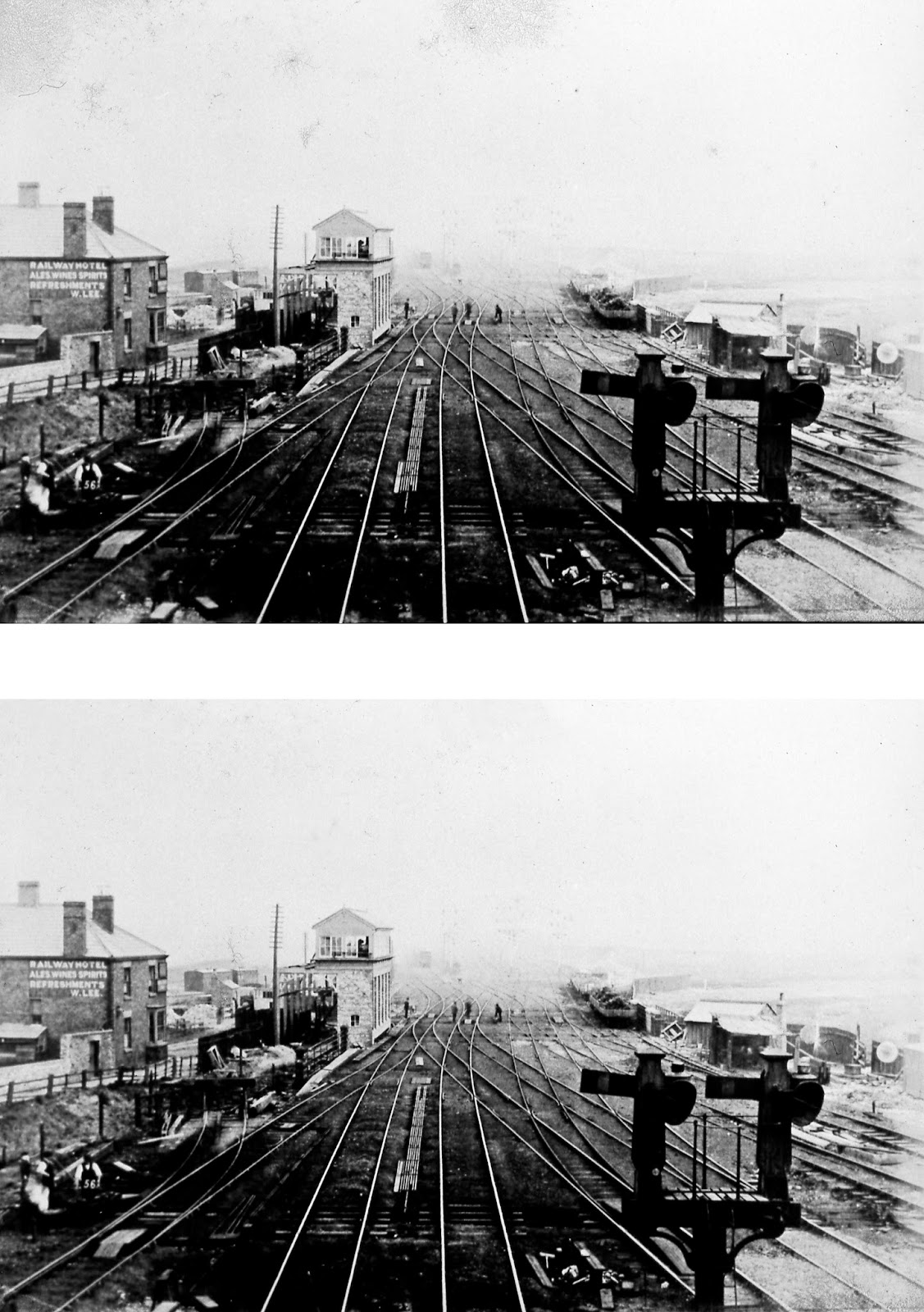
Railway Junction Before and After
Railway Junction
Even without handling, photographs can become brittle, dog-eared and damaged over the course of their lives. Often, such items make their way into our archives where our conservators can try to repair and extend the life of the object.

Below are 35mm slides with a range of damages to them. The most prominent damage on these small images is fingerprints. Due to the small size, a single fingerprint can effectively obscure the whole image, and can be even more noticeable when enlarged.
Train Crash
Train Crash

Touching photographic materials with your hands transfers oils to the photograph, which will effectively etch onto the image over time. Digitising the image allows the use of image manipulation software such as Adobe Photoshop, and for most of the damage to be digitally removed. This is a relatively quick process- the longest time I spent editing one of these images was 15 minutes, the shortest only about 5 minutes! 
Crewe Station Before and After
Crewe Station

Photoshop can also enable fixes to take place after conservation has been completed. The image below is from a conserved glass plate negative which had been broken into a number of pieces and fixed back together. Upon digitising, black lines can be seen where the plate had previously been broken. Removing these is a quick job in Photoshop. This is a less invasive task than removing the large scale fingerprints and requires adding in fewer ‘new’ pixels to the affected area.
Glass Plate Before and After Photoshop
Glass Plate Image
Close up of repair
Close up of repair


It would be interesting to know people’s thoughts on this subject. Should we digitally restore our digitised images or keep them true to their current state?