Earlier this year at Cheshire Archives and Local Studies we examined some images of Queen Victoria's Golden Jubilee celebrations in Macclesfield, in 1887. These images are now available on the Cheshire Image Bank and can be viewed here. Amy, one of our work placement students, enthusiastically researched the images and put together this blog post to tell us more...
Queen Victoria's Golden Jubilee was celebrated on June 20th and 21st, 1887. For the Queen herself, the celebrations included a royal banquet and, escorted by the Indian Cavalry, a celebratory procession in London, before returning to Buckingham Palace for a final appearance on the balcony, receiving huge cheers from the crowds below.
In Macclesfield, Sunday School children gathered on Park Green and sang the National Anthem in celebration. Photographs from the day show crowds of people assembled in a procession, arriving at Park Green. The photographs show mill buildings such as Frost Mill, which was destroyed in a fire in 2011, and the Methodist Free Church, also known as Chapel Mill, which became the head office of Gradus Ltd.
Banners were held by those taking part in the procession, including one which can be seen depicting Queen Victoria. Crowds also gathered in windows and on rooftops to watch; clearly health and safety laws were less stringent in those days!
Mill Street, Chestergate and Market Place were decorated with flags and bunting. Local businesses such as P & Wood Printers can be seen on Mill Street. The public house known as the Wheatsheaf can be seen in Market Place, as well as Macclesfield Town Hall. Instead of cars, horse-drawn carts can be seen in these photographs. Queen Victoria herself rode in her gilded state landau drawn by six cream-coloured horses during her jubilee celebrations, as part of the procession through London.


The people of Macclesfield showed strong loyalty and adoration to their Queen. An example of this can be seen in a silk counterpane presented to Queen Victoria by the women of Macclesfield as a gift to celebrate her Golden Jubilee. The counterpane reads "Victoria by the Grace of God Queen" surrounding the letters VIR. This is surrounded by four Cheshire crests and a border of leaves and butterflies. A note at the bottom of the counterpane reads "Presented to Her Majesty Queen Victoria in her Jubilee Year MDCCCLXXXVII by the women of Macclesfield in the County of Chester". This counterpane was presented to Queen Victoria at Osbourne House, on the Isle of Wight, on August 19th, 1887. The counterpane was made of silk to represent Macclesfield, which at the time had the largest silk industry in the United Kingdom. An illuminated address accompanying the counterpane reads:
Victoria, by the Grace of God, Queen. To the Queen's most excellent Majesty, may it please your Majesty. The Women of Macclesfield desire to approach your Majesty with feelings of most Dutiful and Loyal Affection, and to offer you their Sincere Congratulations that a kind Providence has preserved your Majesty for so many years to reign over a prosperous people. The happy event of your Majesty's jubilee - the occasion of a World's Rejoicing - affords them the opportunity of presenting for your most gracious acceptance, the accompanying embroidered silk counterpane, which is entirely of Macclesfield Manufacture, and which represents the Industry of Macclesfield, The Largest Silk Manufacturing District in the United Kingdom. That God may continue to guide and bless your Majesty for many years to come, is the Sincere and Earnest prayer of your Majesty's faithful and devoted subjects. Signed on behalf of the Women of Macclesfield.

On June 22nd, 1887, Macclesfield residents gathered in West Park to plant an oak sapling to celebrate the Queen's Golden Jubilee. Men, women and children can be seen gathered on, in front of, and even under a platform in the park to be part of a photograph of the event. West Park was originally known as Macclesfield Public Park, and was opened in 1854 to give working people access to the countryside after the closure of the commons in 1804. Within three weeks of Councillor John May's proposal that a public park be opened in Macclesfield, £300 had been collected in small amounts from 17,000 working people in the town, which became known as "The Pennies of the Poor". This was one of the most successful fundraisers in the town at that time, showing the strong public desire to have access to a space for leisure and to be around nature.
Have you ever noticed the plethora of chimney sizes and shapes in the city of Chester? You might think this is a niche subject, but once you start looking up it can be quite addictive! One of the most famous architects associated with chimneys in Chester is John Douglas, and this blog post will introduce you to him and his beautiful work. Why not make it into a tour of the city?
John Douglas was born in Sandiway in 1830 and worked prodigiously in Cheshire as an architect. He became articled (bound to a firm to undertake training in order to qualify in a profession) to the prominent Lancaster architect E.G. Paley during the 1840s. Here he gained grounding in ecclesiastical commissions which would influence some of his later work. He worked on grand houses including Eaton Hall (his principal patron being the Grosvenor family), Oakmere Hall, Shotwick Park and Broxton Hall, as well as lodges in parks, and churches, even entire rows of shops! His style was very broad, as you will see from the examples below, borrowing from European architecture with a romantic, fairy-tale flair influenced by Germanic castles. His work is characterised by half-timber, brick and terracotta, a mix of Gothic and Renaissance elements, and barley sugar twist chimneys.

From 1860 he lived and worked at No.6 Abbey Square, before moving with his family to Dee Banks and retaining No.6 as his office. Douglas went on to partner with Daniel Porter Fordham, and later Charles Howard Minshull. Douglas produced the Abbey Square Sketch Book, in three volumes dating from 1872 to 1889, consisting of sketches and architectural drawings by many contributors [ref: 220399].
Sadly Douglas’s wife and four of his five children died during his lifetime. Douglas then spent the last years of his life in Walmoor Hill, Dee Banks, a building he designed, and passed away in 1911. Douglas was a member of the Chester Archaeological Society for half a century, joining in 1861, and his obituary can be found in the 1911 edition of the society’s journal [ref: 011059];
“…his reproductions of the Cheshire style in both City and Country are a pleasing monument to this memory.”
So in memory of Douglas, here is a whistle-stop tour of several buildings associated with him which you can still see today in Chester:
- 1-11 and 13 Bath Street – built on land owned by Douglas in 1903. Incorporating sandstone, the houses are detailed, with conical-roofed turrets. No.13 was to have formed part of a projected street which would have linked up with Grosvenor Park Road, though this did not come to fruition.
- Grosvenor Park Lodge – a Grade II Listed building, originally the park-keeper’s lodge, built 1865-7 for the second Marquess of Westminster. The external walls bear ornamental carvings representing William the Conqueror and the seven Norman Earls of Chester. The lodge is a picturesque little building, with a stone ground storey and half-timbered above, evoking older Tudor buildings.
- Grosvenor Club and North & South Wales Bank, Eastgate Street – Douglas made additions to this building in 1908. This is now the HSBC, next to the Eastgate Clock.
- East Side of St Werburgh Street, St Oswald’s Chambers - again built on land owned by Douglas, for S.J.R. Dickson in 1898. The buildings feature ornamental carved woodwork and are gable-fronted. Douglas purchased the street to maintain a uniformity of architecture, rather than a mix of styles being produced from different owners.
- 29-31 Northgate Street – Douglas worked on part of the rebuilding of Shoemakers’ Row in 1902.
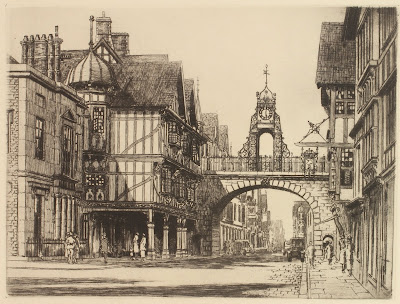
- Diamond Jubilee Memorial Clock – towering above the crowds on the streets below, you can get a fantastic view from the Eastgate Clock of the chimneys and rooftops associated with Douglas. Possibly his most famous work, the clock commemorates Queen Victoria’s diamond jubilee, although it was actually completed two years later in 1899.
- 6-11 Grosvenor Park Road – high steep roofs and several gables, slender octagonal turrets, moulded red bricks and tiles, all characteristic Douglas touches. Built in 1879-80, the buildings lead to the main entrance of Grosvenor Park and its lodge also by Douglas. Built at the same time, today we can still see the Grosvenor Park Baptist Church, again featuring octagonal turrets and dramatic skylines.
- Parker’s Buildings, Foregate Street – plus the two buildings flanking it, were designed by Douglas in 1888 and built by George Parker as model tenement buildings. The buildings were later modernised and re-opened in 1982 by the Northern Counties Housing Association Limited.
Although many designs by Douglas are still visible today, others have been demolished, such as his work on the Little Nag’s Head Cocoa House in Foregate Street, a half-timbered, ornately carved building. Many of his other designs and schemes remain unexecuted.
We have books, pamphlets, visual materials, correspondence, sketches, and plans at Cheshire Archives and Local Studies, so if this has inspired you to research an old Cheshire building near you, or you are interested to see which other works Douglas contributed to in the county and beyond, why not get in touch? You can also visit www.cheshireimagebank.org.uk to explore our visual collection online.


