Pages

Showing posts with label nature. Show all posts

Tuesday, 17 May 2022

Spring has Sprung with Tunnicliffe

The staff here at Cheshire Archives and Local Studies are enjoying the change in seasons and have been getting out in their gardens, parks and green spaces to connect with nature.  To celebrate Spring we’ve turned to Cheshire’s most famous wildlife artist, Charles Frederick Tunnicliffe, for inspiration.

“Nature is lavish with her riches for those who have eyes to see” 

Charles Tunnicliffe, “My Country Book” (ref 112947).


Born in Langley near Macclesfield in 1901, Charles grew up in nearby Sutton where he sketched animals on the walls of the family farm buildings as a child.  A local teacher spotted his natural talent for drawing, and he attended the Macclesfield School of Art before winning a scholarship to train at the Royal College of Art, London.  
Here is a selection of his work.

Tarka The Otter

Tunnicliffe’s work was sought after commercially but he became a household name after illustrating the popular book Tarka the Otter by Henry Williamson in 1932. He went on to illustrate over 300 books during his lifetime and we are delighted to have many of them in the Local Studies collection at Macclesfield Library.


Birds and the RSPB

Tunnicliffe was captivated by wild birds and he developed a scientific approach to sketching them, drawing from life where possible. The RSPB commissioned Tunnicliffe to paint many illustrations for their magazine and books, and in 1975 they awarded him a gold medal for his services to bird protection.


Alison Uttley

The author Alison Uttley began writing tales for children while living in Bowdon, Cheshire, during the 1930s. She commissioned Tunnicliffe to illustrate 19 of her books, amazed at his “imaginative way of entering my stories”.


Brooke Bond Tea

From 1954 until 1999, packets of Brooke Bond tea included small coloured ‘picture cards’ which were collected and traded by thousands of children and adults. Tunnicliffe provided the illustrations for 7 sets of tea cards between 1957 and 1965 and they remain a favourite amongst collectors to this day.


Ladybird Books

Tunnicliffe was asked to provide illustrations for the publisher Ladybird in a series called ’What to Look For In…’ about the seasons. They were “so instructive and educational that grown-ups read them with as much delight as their children”. He also illustrated a ‘Ladybird Learning to Read Book’ that was heavily used in British primary schools.


Nomad

Norman F Ellison started radio broadcasting in the BBC’s Northern Children’s Hour in 1945 with a programme called ’Wandering with Nomad’. It was a hugely popular show and ran for seventeen years. He wrote six adventure stories as ‘Nomad’, for which Tunnicliffe provided the illustrations.


Although Tunnicliffe made Anglesey his home until his death in 1979, his artistic output was inextricably linked to the Cheshire landscape and wildlife of his childhood and early career. These places may have changed over time, but for all the outdoor and nature enthusiasts amongst us, our local environment continues to inspire and create wonder.

Tuesday, 3 November 2020

Fauna and flora of Cheshire

In 1900, Thomas Coward described the county of Cheshire in his book Birds of Cheshire (Ref: 011889) as consisting of three distinct areas; The Central Plain, The Hill Country of the East, and the Wirral Peninsula and Marshes of the Dee, all varying greatly in character, and providing maritime habitats for wildlife as well as a farmed landscape. The county has changed much in the century since Coward wrote his work. This blog uses items from our collections to explore the fauna and flora of Cheshire, both past and present.

Like many other areas of the United Kingdom, local names for wildlife developed in Cheshire, including an “urchin” (hedgehog), a “mouldywarp” (mole), “spadgers” (house sparrows) and a “gil-hooter” (owl). What animals do you think the below are local words for?! Answers can be found at the bottom of the blog post! Many more local names for wildlife can be found in Vertebrate fauna of Cheshire and Reptiles and amphibians, both by T. Coward (Ref: 011896).

1. Snig

2. Rabbidge

3. Tummuz

4. Windhover

5. Dabchick


Cheshire is linked with several renowned naturalists. Charles Tunnicliffe (1901-1979) was an artist of natural history, born in Macclesfield. He illustrated Henry Williamson’s Tarka the Otter (see Ref: 112994), as well as Ladybird books and Brooke Bond tea cards, specialising in British birds and wildlife. A collection of his work can be found at Macclesfield Library. He also illustrated books by his friend “Nomad the Naturalist”, the alias of another local naturalist, Norman Ellison.

Ellison was born in Liverpool in 1893, and worked as a radio presenter and author, making programmes about nature and the countryside. His uncle, George Ellison, was also a local naturalist. “Nomad” wrote A Naturalist’s Notebook column for Cheshire Life magazine between the 1940s and 1970s.

 
In The Wirral Peninsula (Ref: 010568), originally published in 1955, Ellison embarks upon walks in the area, from Parkgate to Neston, describing the marshy grassland on the other side of the sea wall, looking out towards Wales. He describes the marsh as treacherous, with deep gullies and clinging mud. He also records wildlife he sees on a walk around the gardens at Ness; willow warblers, a great spotted woodpecker, martins and swallows, and a badger sett.


Ness Gardens was established by the Liverpool Cotton Broker and keen naturalist Arthur Kilpin Bulley in 1898. Bulley was interested in the “acclimatisation” of plants from abroad and opened his gardens to the public. A. K. Bulley died in 1942, and in 1948 his daughter presented the whole estate to the University of Liverpool, to be kept as a botanic garden, with the condition that public openings of the grounds continued.

Our next local naturalist to introduce to you is George Bramwell Evens (1884-1943), also known as “Romany”, who lived for a time in Wilmslow. He was a radio broadcaster and naturalist, writing on nature and the countryside, producing many Out with Romany programmes. His first book A Romany in the Fields was published in 1929 (see Ref: 401720, held at Willmslow Library along with several other items of his work).


And finally, we also hold the records of Arnold Whitworth Boyd (1885-1959) at Cheshire Record Office (Ref: D 5154), an ornithologist and naturalist born in Altrincham. Like Ellison, A. W. Boyd also wrote wildlife columns, including for the Manchester Guardian. A reprint of Boyd’s weekly nature notes from this newspaper can be found in The Country Diary of a Cheshire Man (Ref: 200208), published in 1946.

If you feel inspired by our Cheshire naturalists and some of the wildlife mentioned here, Cheshire is a fantastic county to explore, with many popular walking trails, including the Sandstone Trail and the North Cheshire Way.

The Sandstone Trail


The Sandstone Trail explores 55km (34 miles) of Cheshire’s central sandstone ridge from Frodsham to Whitchurch. The highest point is Rawhead, near Bickerton in central Cheshire, rising 227m (746 feet) above sea level. It is one of the earliest middle-distance ways in Britain and was conceived by the Cheshire County Council in the 1970s, officially opening in 1974. Along the way you may see peregrines, which have returned to nesting in Cheshire. Look out for mature deciduous woodland across the Peckforton and Bulkeley Hills. The marshland around Frodsham provides habitats for wildfowl such as teals, shelducks, redshanks and dunlins. The woodland paths of the trail are lined with wildflowers such as celandines, wood anemones and bluebells in spring and early summer. Delamere Forest is an ideal place for fungal forays during the autumn. The steep, wooded Peckforton Hills are home to a range of mammals and birds, with buzzards, ravens and sparrowhawks 
nesting in the woods, and an increasing number of polecats.


See
Walking Cheshire’s Sandstone Trail by Tony Bowerman (Ref: 222267) to learn more about this route and the wildlife which can be found along it.

The North Cheshire Way

The North Cheshire Way is Cheshire’s longest long-distance footpath, running for 114km (71 miles) from Hooton Station to Disley Station, crossing the county from west to east. On the way you might see “herb Peters” (cowslips) or “paigles” (primroses).


For further information, see The North Cheshire Way, a slice of Cheshire (Ref: 219999), published by the Mid-Cheshire Footpath Society.

Whilst walking, keep an eye out for the following fauna and flora common to Cheshire: 

  • Butterflies, such as the holly blue, red admiral and orange tips.
  • Mammals, including common pipistrelle bats, hedgehogs and red foxes.
  • Trees, including English oaks and holly.
  • Wildflowers, such as bluebells in spring, wild garlic, and the common poppy.
  • Reptiles and amphibians. Look out for adders, common toads and common frogs. Locally tadpoles of the common frog have been known as “bull-heads”.
  • Birds such as robins and tiny wrens. We love this quote from Coward in Birds of Cheshire (Ref: 011889): “Mr. F. S. Graves saw a [wren’s] nest at Capesthorne in the spring of 1899, built in the head of a Brussels-sprout”! Coward also reports on a swallow, one of our migratory birds, seen flying in Delamere, completely white in colour.


ANSWERS: 1. Eel, 2. Rabbit, 3. Toad, 4. Kestrel, 5. Moorhen

View more images of Cheshire’s landscape online at www.cheshireimagebank.org.uk

Thursday, 9 March 2017

T.A. Coward and the origins of ‘jizz’?

You know that moment when you bump into something which you thought only you had the vaguest interest in, and suddenly it all makes just a little bit more sense?  Well, that moment…

I was looking through some of our Local Studies collection relating to Birding and Ornithology when I fell upon a book by the Cheshire Naturalist T.A. Coward entitled Bird Haunts and Nature Memories (Reference 200289) from 1922. This is a handsome volume published by Frederick Warne, a collection of sometimes revised articles, many of which we are told originally appeared in the Manchester Guardian, Scotsman, Daily Despatch and Westminster Review.  Sadly which pieces appeared in which publication, and when, is not disclosed.  Many, but not all, of the articles have local interest and are focussed on Cheshire (or what was Cheshire) and the Wirral, with others relating to the North Wales Coastline.  I was initially fascinated by a lovely chapter on A Cheshire Bird (the Great Crested Grebe) as well as the rather poetic Memories of a Cheshire Moor which relates to Carrington Moss and proceeds from 1884 through 1894, 1904, 1914, ending in 1921, finishing with the somewhat unsettling sentence “Perhaps Carrington Moss was a better place forty years ago.” 


There’s also a fantastic piece (with photographs) entitled An Old Cheshire Wild-Fowler which describes the life of such an individual on the frozen Dee marshes near Sealand.  Much of this writing is very much of a different time.  In this article, Coward (a lifelong Ornithologist) resolutely defends the ‘sport’ (as he sees it) of Wildfowling.  The article even describes (in passing) the hunting of Spoonbills, which recent visitors to RSPB Burton Mere and elsewhere wouldn’t be very happy about
in 2017, I’m sure.


Anyway, we must eventually proceed to the real subject of this blog.  As a (very bad) birder with an ability to easily forget the name of something I had pointed out to me only the day before, I’ve always been interested in the birding concept of ‘jizz’.  This is a term much used on “Introduction to Birding” type courses, and in many identification books.  I’ve always understood it to mean that comprehension of the identity of a bird without having fully captured it in clear sight.  An example might be that you’re digging at the allotment and ‘sense’ a little bird hopping around waiting for you to disturb a worm.  Somehow you ‘know’ without looking at it that it’s a Robin.  That ‘knowing’ – in effect being aware of the little bird’s ‘Robin-ness’ is its ‘jizz’.  You don’t have to clearly see it to know it’s a Robin. In the early 90s (around the time Rob Hume’s Birds by Character – a Field Guide to Jizz Identification was published) I remember asking a (much better and far more knowledgeable) birding friend where the term came from (the book, which is actually really good, is very vague in defining the term’s history).  There followed lots of shrugging of shoulders and mumbling.  Nobody seemed to know.  As I went online in the mid 90s I remember looking on various forums.  The general consensus then seemed to be that it might have something to do with GISS (General Impression of Size and Shape) which is a term in use by aeroplane spotters and dates back to at least WWII.  Others argued (less convincingly to me, anyway) that it was a corruption of gestalt, a German word which roughly translates as ‘form and shape’.


Imagine my surprise and delight then when I open up this wonderful book in our Local Studies collection to find on pages 141-144 a chapter entitled ‘Jizz’.  As I read it, it clearly defines the concept, if not the origin (which Coward states only as coming from ‘A West Coast Irishman’), of the birding term: “That mental picture recorded through the eye is accurate in proportion to our familiarity with the species; the more familiar we are the less we note except the jizz.  The passing curlew may have a long curved bill, a pale lower back, a strong distinctive flight; we knew these characters were present, but we did not actually see them; we saw a curlew.  Curlew flashed into the brain without pause for mental analysis, for we noted the jizz.”  Ignoring the fact that the origin of the word is so uncorroborated (and there is little evidence from anywhere I can see that this is indeed an Irish word) these four pages provide the perfect definition of the term as it is used today proving that the word has been around for much longer than previously thought.  As I rush to the computer to announce my findings to a no doubt expectant world, it becomes apparent that I’m not the first to realise this.  Coward’s book was not a massive seller, but he was a well-known Ornithologist and Naturalist of the time, and some of his titles did sell in high numbers, although I’m unaware if he used the term in any of these other books. But others have seen this title and found this chapter.  The earliest written reference I can find to Coward’s use of the term is in David McDonald’s The Etymology of Jizz (published in Canberra Bird Notes Vol 21 No.1 1996).  The Oxford English Dictionary has updated its entry to reflect it.  Both, I think, very much underplay the way in which Coward exactly defines how the word is used today. 
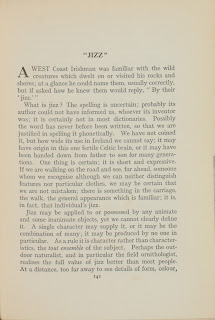

As for my interest in the term, I’m not really sure if this marks the beginning of the end, or the end of the beginning.  Perhaps I’ll just forget all about it for another twenty years or so.  Maybe if I could just find the original newspaper publication (if indeed there was one)…
And, finally, if you do have an interest in Ornithology, do please have a look at our catalogue and see what you can spot.  As well as our varied Local Studies collection of published material, we also have some fascinating Archive items that might interest.  One of my favourites is D4643/1 which is a notebook belonging to an Arthur Lewis of 28 Arkles Lane, Liverpool (literally just around the corner from Anfield, on the edge of Stanley Park).  This is a fascinating nature notebook from the first decade of the Twentieth Century in which young Arthur records his birding finds both in Liverpool and out on jaunts to the Wirral, and into both Cheshire and Wales.  This is the kind of thing he recorded:

According to a note in the front of the book, Arthur later lived (and died) in Watergate Street, Chester.